Which tool finds listicles that mention my competitors but not me? Seven tools ranked
We ranked seven tools on one task: finding the best-of listicles AI engines cite that name your competitors and leave you out, so you know where to pitch first.
A "best X tools for Y" article that names three of your competitors and skips you costs more than one lost referral. AI engines read those pages. Listicles made up 13.6% of all classified ChatGPT citations from Sep 28 to Oct 4, 2026, and 15.0% for commercial prompts such as "best CRM for small businesses", according to Promptwatch's data report "Which Content Types Does ChatGPT Cite the Most?". When the listicle leaves you out, the AI answer built on it often does too.
So the tool you want does two jobs. It finds listicles that mention competitors without you, and it tells you which of those listicles AI engines actually cite. The second job is what separates the tools below.
How we ranked
Four tests, weighted in this order:
- Does it see the listicles AI cites? Not every listicle on the web, but the ones behind real answers to your buyers' prompts.
- Does it show which brands each page names? A cited listicle is only a gap if competitors are in it and you aren't.
- Can you filter to listicles specifically? Content-type classification saves hours of sorting product pages from roundups.
- Does it help after the find? Tracking a page over time, turning the gap into an outreach task, writing your own comparison content.
The ranking
1. Promptwatch
Promptwatch answers the question most directly because it starts from AI answers rather than from a web index. Every citation it records carries a content type, such as listicle, review or comparison, plus the domain, position in the source list and domain rank. On the Citations page you can filter by content type and by competitor, so "listicles that back my competitors' mentions" is a filter, not a research project.
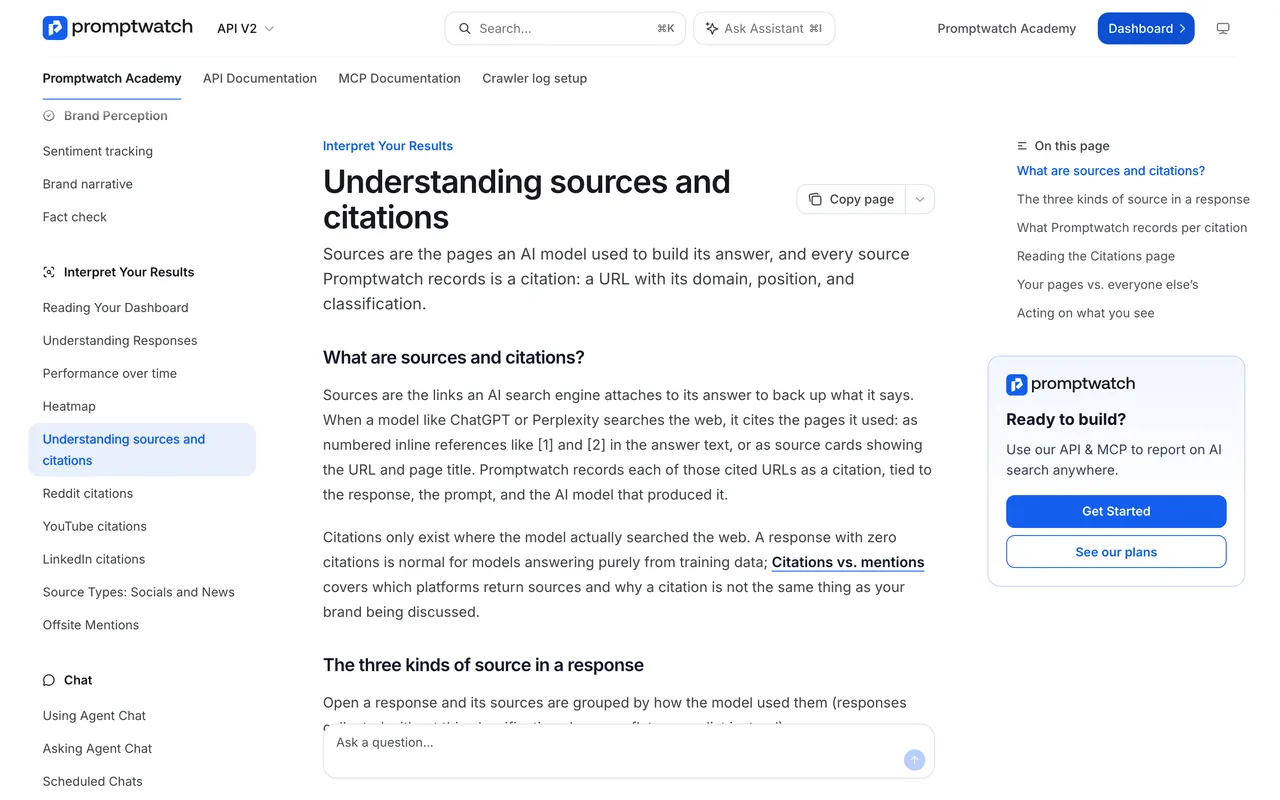
Promptwatch Academy, "Understanding sources and citations", captured November 14, 2026.
Offsite Mentions goes one step further. Promptwatch scans the third-party pages AI engines cite for brand appearances, yours and your competitors', and ranks the pages as opportunities. A domain filter (added November 6) narrows the list. The Prompts page's By Rank view shows the prompts where a direct competitor ranks and you don't, which tells you which roundups to read first.
After the find, Page Tracker watches a specific listicle URL and shows which prompts and responses cite it. The Action Board can carry outreach tasks, and "create content from a citation" lets you write your own comparison page from a cited roundup. Plans start at $95/mo, with a 7-day free trial on every self-serve plan.
2. AthenaHQ
AthenaHQ turns visibility gaps into on-page and off-page actions through its Action Center. Off-page actions are where listicle outreach would land. Its catalog entry notes that citation analytics at the page, offsite and type-breakdown level are not documented, so you get the task without much of the source detail. Starter is $295/mo with 3,600 credits.
3. Scrunch AI
Scrunch AI shows where you're not cited. Our entry's main criticism is that it stops there: it shows the gap without telling you what to change. Core is $250/mo for 125 prompts. Offsite citation depth isn't documented in our entry.
4. Ahrefs Brand Radar
Ahrefs Brand Radar sits inside Ahrefs, next to its link and content tools, and reports Reddit and YouTube sources and AI crawler activity. If your team already uses Ahrefs to find pages that mention competitors, Brand Radar adds an AI layer on the same login. Our entry does not document a listicle-specific gap report, and its AI Visibility Index uses prompts modeled from keyword data.
5. Semrush AI Toolkit
Semrush AI Toolkit tracks brand mentions and links in AI answers and compares you with competitors, beside Semrush's SEO data. Listed at $99/mo per domain, though our entry could not re-verify that price on October 24, 2026.
6. HubSpot AEO
HubSpot AEO includes prioritized recommendations, one of which is reaching out to third-party sites. At $50/mo ($45 yearly) for 25 daily prompts on three engines, it's the cheapest way to get outreach suggestions, with far less source data behind them.
7. Brand24
Brand24 is social listening with an AI visibility add-on. It monitors 25M+ social, news, blog and review sources and correlates online mentions with AI visibility. Useful for catching new articles as they appear; our entry doesn't document a "competitors named, you missing" view. Add-on pricing is not published.
Peec AI names gap analysis among its features and Otterly.AI tracks citation sources. Neither entry documents listicle-level competitor gaps, so they sit at the bottom.
Why the "AI cites it" filter matters
A classic SEO search will surface hundreds of listicles in your category. You can't pitch them all, and most don't feed AI answers. Commercial prompts lean on a few formats: in the same Promptwatch report, product pages, landing pages, listicles and comparisons made up "almost 70%" of citations for commercial prompts.
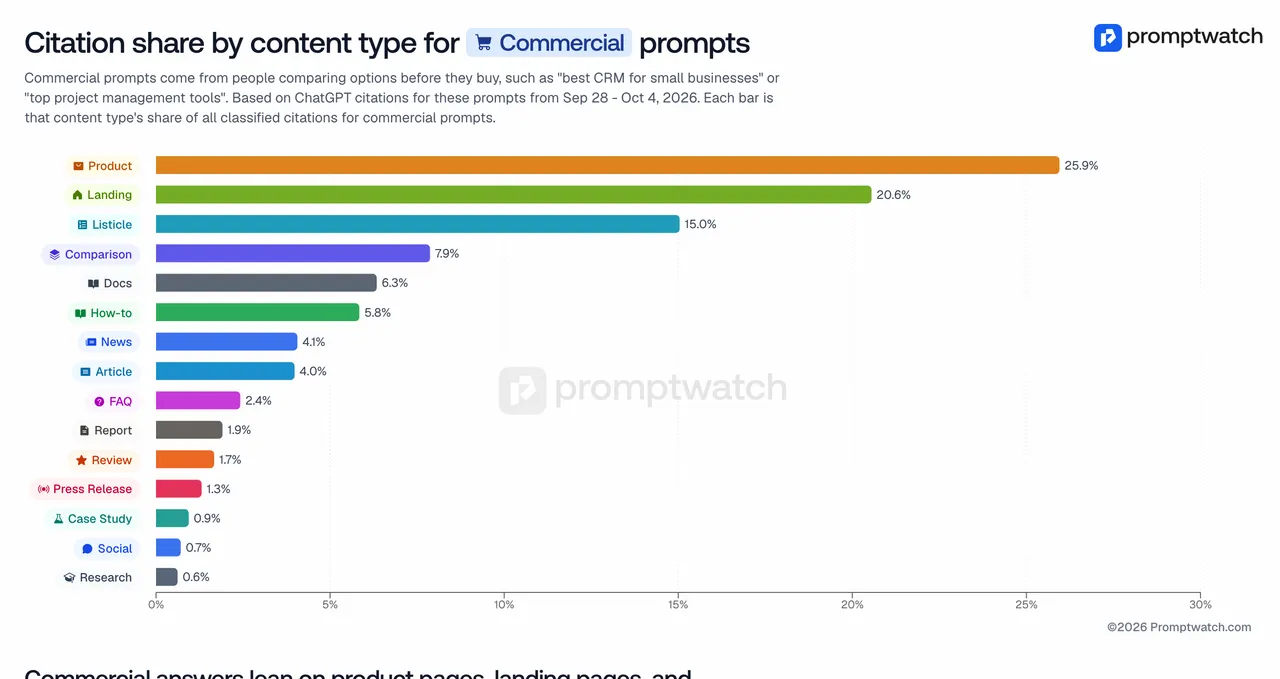
Promptwatch data report, "Citation share by content type for Commercial prompts", captured November 14, 2026.
Start with the listicles that are already cited for your prompts and that name a competitor. That list is usually short enough to work through in a month.
Our pick
Promptwatch is the tool we'd use for this, because content-type filters, competitor filters and Offsite Mentions answer the question from the AI side. Start the 7-day free trial, track your top commercial prompts, and filter citations to listicles after the first week of data.