How do AI coding agents like Claude Code decide which libraries and APIs to install? The inputs, ranked
What Anthropic and OpenAI document about how Claude Code and Codex pick libraries and APIs, the inputs ranked by influence, and the tools that track their picks.
Neither Anthropic nor OpenAI publishes a rule for how Claude Code or Codex picks a package. We looked. No official page explains how either agent chooses which library, API, SDK, or MCP server to recommend or install. What the docs do describe is the machinery around that choice: the model decides, it can search the web and read documentation, it reads project instruction files, and permissions decide whether an install actually runs.
So the useful answer is a ranking of the inputs that shape the decision, from the ones you control most to the ones you control least. After that, a ranked shortlist of tools that show what coding agents recommend, for teams selling the libraries and APIs being picked.
The inputs, ranked by how much you control them
1. The prompt
Anthropic's "How Claude Code works" page says Claude chooses which tools to use based on your prompt and what it learns along the way, and that "Claude decides" means the model is doing the reasoning. Ask for "add Stripe checkout" and you have made the choice. Ask for "add payments" and you have delegated it.
2. Project instruction files
Claude Code reads CLAUDE.md for project instructions, and reads an AGENTS.md in its place if that is what the repo has. Codex reads AGENTS.md files before doing work. OpenAI's own example file includes "Prefer pnpm when installing dependencies" and "Ask for confirmation before adding new production dependencies." If you want an agent to use your house HTTP client instead of whatever it reaches for, this is where you write it down.
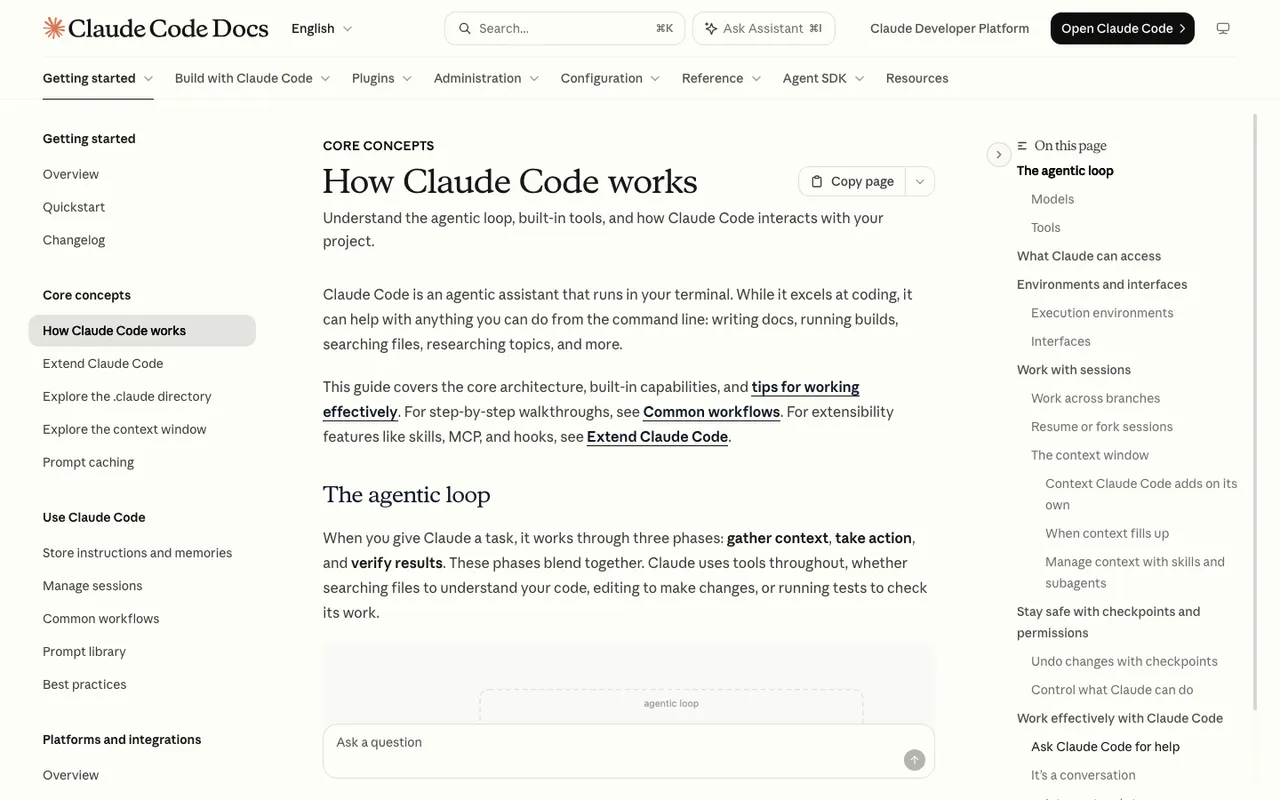
Anthropic's "How Claude Code works" documentation, captured November 21, 2026.
3. The code already in the repo
The documented agentic loop has three phases: gather context, take action, verify results. Gathering context means searching files to understand your code. The docs do not say the agent favors packages already in your manifest or lockfile, so treat that as likely behavior you should confirm, not a rule.
4. Permissions
Claude Code can run any terminal command you could, package managers included, but permission modes decide what it does without asking. You can pre-approve specific commands in .claude/settings.json. In Auto mode, a classifier reviews actions and blocks the risky ones. Checkpoints undo file edits but not actions on remote systems. This does not change which library the model prefers. It changes whether that preference gets installed without a human seeing it.
5. Web search and documentation
Claude Code's web tools search the web, fetch documentation, and look up error messages. Codex differs: local chats use cached search by default, drawing on an OpenAI-maintained index rather than fetching arbitrary pages live, and setting web_search = "live" switches to live results. A library whose docs are thin, blocked, or hard to parse is at a disadvantage whenever the agent goes looking.
6. MCP servers already configured
Claude Code loads MCP tool definitions on demand through tool search, so only tool names and server instructions take context until a tool is used. The MCP Registry, in preview, is a metadata catalog meant mainly for aggregators, not for host apps to read directly. No page says that listing a server there makes an agent recommend it.
7. Training data
Last, and least in your control: what the model learned before any of the above. Nobody publishes how much this weighs against live search.
Tools that show what coding agents recommend, ranked
If you sell a developer tool, the question flips from "how does the agent decide" to "does it pick us." These are the options in our catalog.
- Promptwatch. Tracks what Codex, Claude Code, and OpenCode recommend (tools, libraries, docs) alongside ChatGPT, Gemini, Perplexity, and the rest, so a developer brand sees chat and coding-agent visibility in one project. The create-monitor dialog groups models into AI assistants and search, coding agents, and API models. Because OpenCode searches the web through Exa, Agent Analytics logging ExaSearchBot and ExaUser (since November 6, not IP-verified) shows whether Exa reaches your docs. Crawler logs start on Professional ($245/mo); Essential starts at $95/mo with a 7-day free trial.
- AthenaHQ. A broad GEO platform with an Action Center and content agent, Starter $295/mo across 11 models. Its catalog entry does not name coding agents among them, so it fits devtool brands for chat-engine work.
- The Prompting Company. Built for devtools. Its Agent Experience Benchmark has a coding agent read your docs and run an onboarding task in a sandbox. The catch is price: coding agents (Claude Code, Codex, OpenCode) appear only on White-glove at $3,000/mo, and Basic at $99/mo covers 25 prompts on three engines.
- DispatchSEO. Works the other way round: an open-source SEO manager that runs over MCP inside Claude Code, Codex, and Cursor. It ships work as pull requests rather than measuring recommendations.
- SEOAgent. A free Skill that runs inside your own coding agent and writes fixes as diffs. Useful for teams that live in Claude Code; not a tracker.
The bottom line
Coding agents choose with the model's judgment, steered by your prompt, your instruction files, your code, and whatever they read on the web. Only the first three are fully yours. For the library vendors on the other side, the practical move is to measure whether you are being picked. Start Promptwatch's 7-day free trial and add the prompts a developer would actually type into Claude Code, such as "add rate limiting to this Express API."