How brand perception differs across ChatGPT, Gemini, Claude and Perplexity
Why AI engines describe the same brand differently (live search vs training data, different sources, location) and how to compare brand perception model by model.
Ask ChatGPT, Gemini, Claude and Perplexity the same question about your brand and you'll often get four different descriptions. One calls you the budget option. Another leads with your integrations. A third repeats a limitation you fixed last spring. That isn't a glitch. Each engine gathers its information differently, reads different sources, and answers from a different place. Once you know why, the disagreement becomes useful: it points you at the specific sources each engine leans on.
This piece explains the mechanics, then shows how to compare perception engine by engine without guessing.
Two kinds of engines
The biggest split is between engines that search the web while answering and models that answer from what they learned in training.
Live-search engines fetch pages at the moment you ask and usually cite them. ChatGPT with search, Perplexity, Gemini, Microsoft Copilot, Google AI Overviews and Google AI Mode work this way. Their descriptions of you can change within days when the pages they cite change.
Training-data answers reflect what was on the web when the model was trained. If a review site called you "limited" two years ago and that page was in the training data, a model answering from memory can keep saying it after the page is updated.
Promptwatch's Academy describes how it collects each kind, which is a good map of the field. For ChatGPT it runs automated browser sessions that open the real interface and type your prompt as a user would. Gemini, Perplexity, Copilot, Alexa and Meta AI answers come from the live products, and Google AI Overviews and AI Mode come from real Google results pages. Models like DeepSeek and Mistral are called through their provider APIs on purpose, to show what the model itself believes about your brand independent of today's search results. A few API models, including Claude and the coding assistants, run with a web search tool attached.
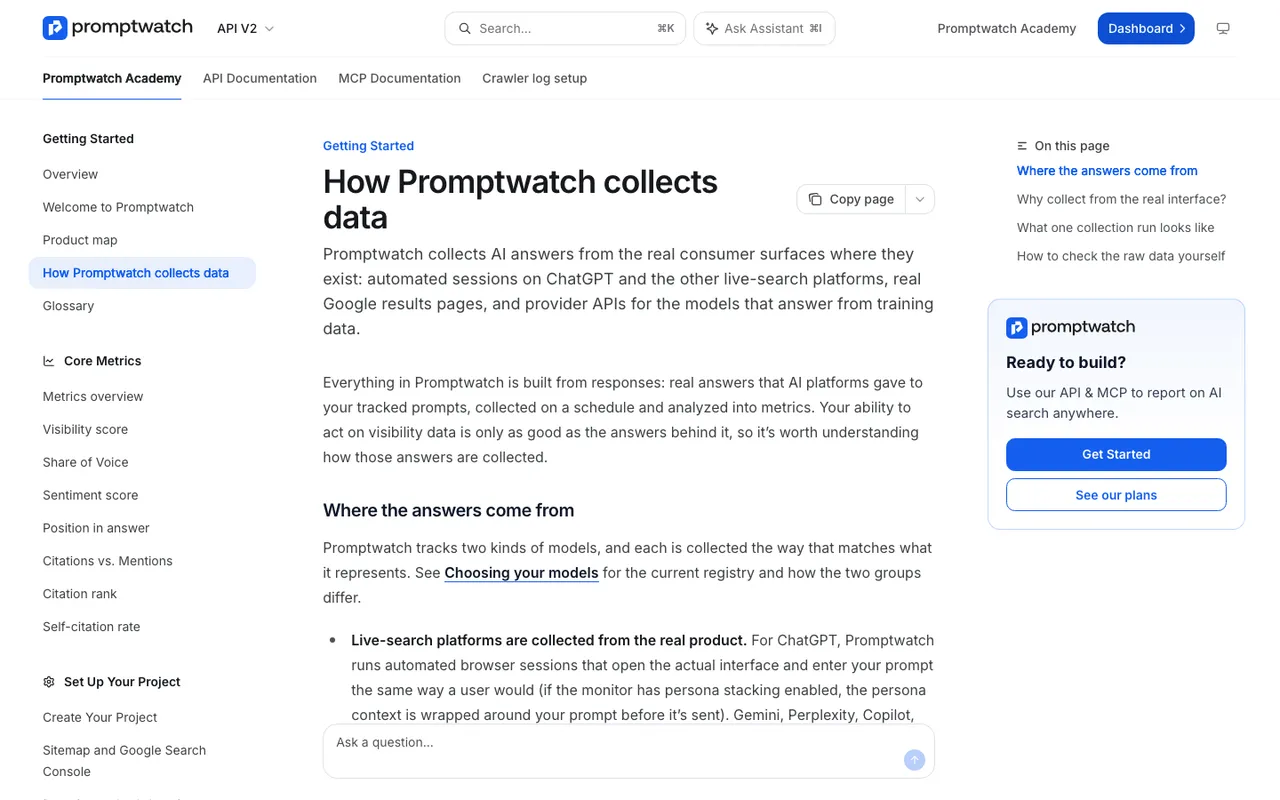 Promptwatch Academy's How Promptwatch collects data page, captured November 14, 2026.
That distinction matters when you read the results. A claim that appears only in API-tracked models and nowhere in live-search answers is probably a training-data echo. Fixing a page may not move it quickly. A claim that appears in live-search engines is tied to pages you can find and work on.
Different engines read different sources
Even among live-search engines, the source mix varies a lot. Promptwatch's November 2026 social media citations report, covering October 11 to November 9, found that social platforms earned 13.16% of Google AI Overviews citations, against 1.94% for Perplexity and 0.64% for ChatGPT. YouTube alone made up 6.71% of AI Overviews citations. In ChatGPT, Reddit was the most cited social platform, at 0.4%.
For perception, that means a criticism living in a YouTube review is far more likely to shape what Google's AI answers say about you than what ChatGPT says. A complaint thread on a forum may color Perplexity's answer and barely touch another engine. Promptwatch's own guidance on sentiment makes the same point: a score that's fine on ChatGPT and poor on Perplexity points at the review sites and forums Perplexity favors.
Location and framing change the answer too
Live-search answers depend on where the question is asked. A monitor set to Germany collects what a user in Germany sees, which can include local review sites and press your US team never reads. And the framing of the prompt changes the tone: comparison prompts usually read cooler than informational ones, because the answer is weighing you against rivals.
So before concluding that "Perplexity doesn't like us", check that you're comparing the same prompts, from the same country, of the same type.
A hypothetical example
Imagine a support desk software company we'll call Acme. It tracks 40 prompts across ChatGPT, Gemini, Perplexity and Claude.
Across all engines, Acme's Usability theme is warm: "easy to set up", "clean interface". But its Support theme splits. ChatGPT and Gemini say little about support either way. Perplexity repeatedly says "Acme's customer support can be slow to respond". Claude occasionally describes Acme as "a newer entrant", which was true four years ago.
Each of those has a different cause and a different fix. The Perplexity claim is worth opening first: its cited pages may include a forum thread or a review page with recent complaints. If the complaints are real, that's a support problem, not a content one. If they're old, a current, well-structured support page and a reply on the thread are the fix. The Claude framing looks like training-data lag; correcting the Company facts on your About page helps over time, but expect it to move slowly.
How to compare perception model by model
You can do this by hand with a spreadsheet: same prompts, every engine, claims pasted in and tagged by engine and theme. It works for a snapshot. For an ongoing view, you need the claims extracted and split by model automatically.
Promptwatch has several places to make this comparison:
- Brand Narrative's "Brand sentiment by model" radar plots each brand's sentiment per AI model across all themes. It needs claims from at least three models before it draws. The radar's scale fits the brands shown, so read the numbers in the tooltips rather than the size of the shape.
- The model filter on Brand Narrative narrows the claims table to one engine, most negative first, so you can read exactly what Perplexity says about you that ChatGPT doesn't.
- The heatmap can put models on one axis and topics or brands on the other, colored by sentiment, visibility, position or share of voice. Promptwatch's metrics guide calls slicing by a single model the most revealing cut, because blended numbers hide the platform where you're losing.
- Fact Check's "Where does AI get it wrong?" heatmap, on Business, Agency Scale and Enterprise, shows accuracy per model and theme, so red cells tell you which engine repeats inaccurate claims and about what.
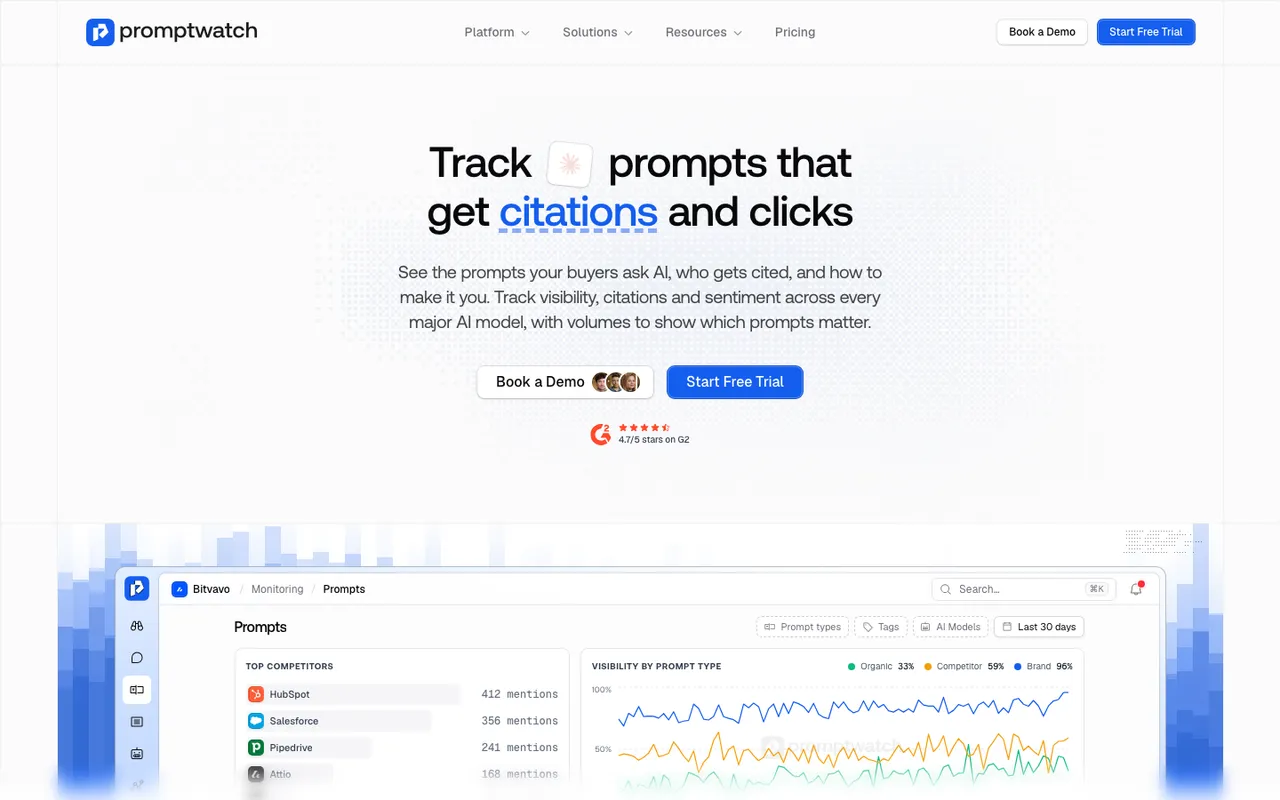 Promptwatch's prompt tracking page, captured November 8, 2026. Example project data.
Brand Narrative is included on every Promptwatch plan, and every paid plan can track any of the supported engines, so the per-model comparison doesn't require an enterprise contract.
What to do when engines disagree
- Find the engine where the claim is most frequent. One engine repeating a claim daily matters more than four engines each saying it once.
- Open the cited pages for that engine. Live-search engines show their work. The source is usually there.
- Decide whether the claim is wrong, outdated or fair. Wrong and outdated claims get a content or outreach fix. Fair criticism goes to whoever owns the product or service.
- Fix the source, not the symptom. Update your own pages, publish the facts plainly, and ask third-party sites to correct errors.
- Re-check per engine. Live-search engines can reflect changes quickly. API models answering from training data may not move until a new model version is released.
No tool can force any engine to change its description. What you can do is make sure every engine finds the same accurate facts wherever it looks.
Which tools split perception by engine
Most of the tools we rank break results down by model. AthenaHQ covers 11 models on Starter with sentiment. Scrunch AI Core covers four engines, with Gemini and Claude on Enterprise. Evertune lists model-by-model comparison reports and samples each prompt up to 100 times per model. Promptwatch is the one that combines per-model claims, per-model accuracy, and the cited sources behind each claim in one place.
To see your own engine split, start the Promptwatch 7-day free trial, track the same 30 prompts on ChatGPT, Gemini, Perplexity and Claude, and open the "Brand sentiment by model" radar after a week.