Best AI crawler tracking tool for Shopify stores, ranked for 2026
We ranked eight AI crawler tracking tools for Shopify stores on how they get log data off a hosted storefront, verify bots, and link crawls to AI citations.
Shopify merchants asking which tool tracks GPTBot, ClaudeBot and PerplexityBot on their store run into the same wall: you don't operate the servers your storefront runs on. Any tracker you pick has to collect bot traffic from a layer you do control, and that single fact decides most of this ranking.
Our short answer: Promptwatch is the best AI crawler tracking tool for a Shopify store in 2026. It has a documented Shopify + Cloudflare setup, it checks each bot against the operator's published IP ranges, and it is the only tool on this list that follows a crawl through to the citation, the AI-referred visit, and the order page. Everything below it is either cheaper and narrower, or tracks prompts without reading logs at all.
How we scored the tools
Four checks, in order of weight:
- A real route for Shopify data. A Shopify app, a documented Cloudflare path, or nothing.
- Bot verification. User agents are easy to fake. Tools that compare request IPs against the lists OpenAI, Perplexity and others publish score higher than tools that trust the header.
- What happens after the crawl. Seeing that OAI-SearchBot fetched
/products/linen-shirtis step one. Knowing whether that page then got cited in ChatGPT is the useful part. - Published price. We only quote prices that appear in our catalog.
The ranking
1. Promptwatch
Promptwatch's Agent Analytics module logs AI crawlers in real time and checks them against each operator's published IP ranges, so a scraper pretending to be GPTBot gets filtered out. The tracked list covers GPTBot, OAI-SearchBot, ChatGPT-User, ClaudeBot, Claude-User, Claude-SearchBot, PerplexityBot, Perplexity-User, Google-Agent, Meta-WebIndexer and others. Exa's two bots are logged without a Verified badge because Exa publishes no IP ranges.
For Shopify, the integrations page lists a guided setup that connects stores through Cloudflare. Logpush became the default route for Shopify sites in October 2026, and a Cloudflare Worker is the alternative.
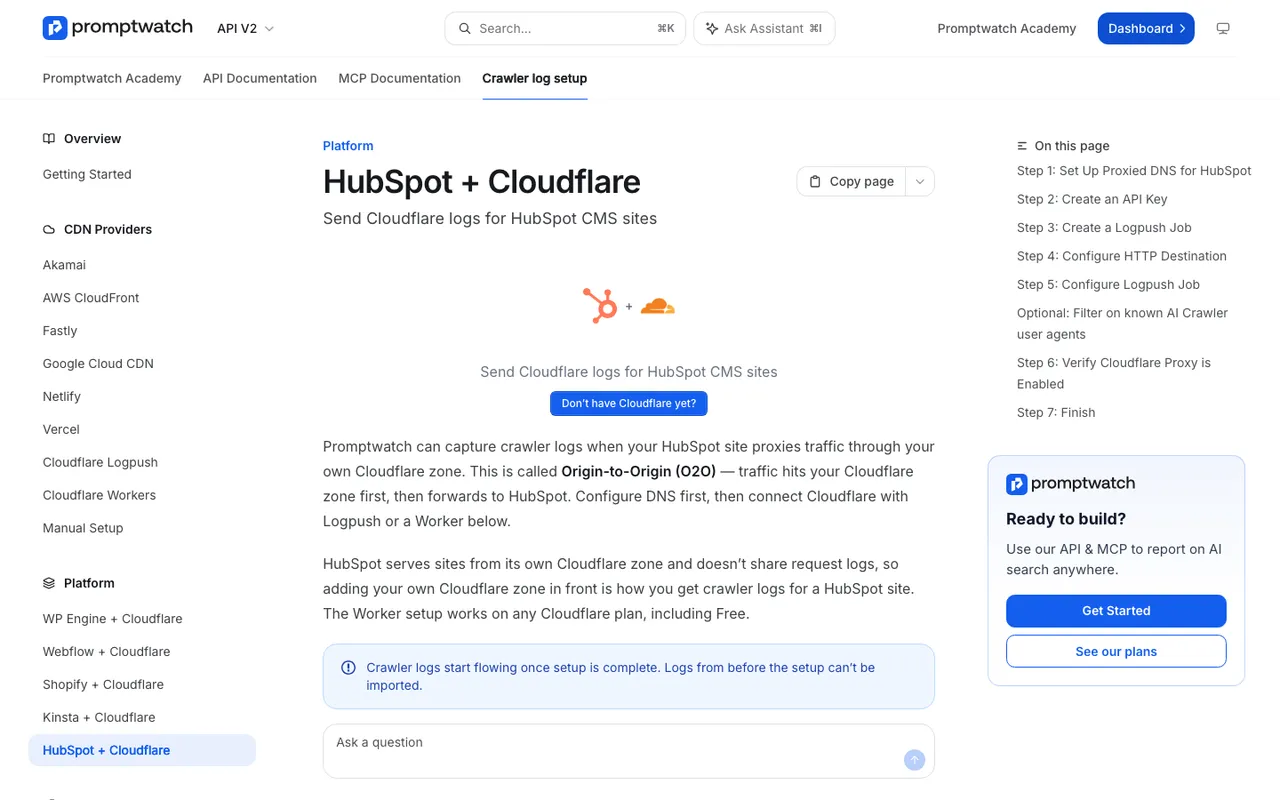
Promptwatch's crawler log setup documentation, captured November 21, 2026. The sidebar lists Shopify + Cloudflare next to the HubSpot guide shown.
What pushes it to first place is the crawl-to-citation path. Each page gets a citation rate, which separates an access problem (bots never arrive) from a content problem (bots arrive, nobody cites the page). Visitor analytics then counts the AI-referred sessions and conversions on the same pages. A Host column also warns when logs arrive from a hostname that isn't your store domain.
Crawler logs start on Professional at $245 a month with 25M log lines; Business at $579 raises that to 100M and adds ChatGPT Shopping insights, which matter for a store. Essential ($95) has no crawler logs. Every self-serve plan comes with a 7-day free trial when billed monthly.
2. Scrunch AI
Scrunch AI reports AI agent and bot traffic alongside prompt monitoring, and its Enterprise tier sells AXP, which serves AI-optimized page versions to LLM crawlers. Core costs $250 a month for 125 prompts and four engines. Our listing doesn't document a Shopify-specific log connection, and Sitecore acquired the company in June 2026.
3. AthenaHQ
AthenaHQ is here for the Shopify integration, not for crawler logs. Its pricing page lists Shopify and Webflow integrations plus GA4 and Search Console, and the free Essential tier gives 300 credits; Starter is $295 a month. Our catalog records no crawler analytics. Bloomreach announced it had acquired AthenaHQ on November 16, 2026.
4. Known Agents
Known Agents, formerly Dark Visitors, is the specialist pick. It shows which crawlers and agents hit which pages, flags robots.txt violations, and verifies spoofed bots. The free plan covers 100K events a month and Startup is $29 for 1M. Shopify is not on its integration list, so a store would come in through Cloudflare or another listed source. It runs no prompts, so it can't tell you whether ChatGPT recommends you.
5. Cloudflare AI Crawl Control
If your store's domain is already proxied through Cloudflare, Cloudflare AI Crawl Control costs nothing extra. It groups crawler requests by operator, shows status codes and top paths, and lets you block or allow each bot. On the Free plan it identifies crawlers by user agent only, and it has no citation data.
6. LLMagnet
LLMagnet installs as a Shopify app with AI-bot visit charts and llms.txt generation. The App Store lists Free, $29 and $79 plans capped at 500, 10,000 and 100,000 sessions. Its prompt tracking is thin.
7. Profound
Profound lists Agent Analytics next to its marketing agents, but the product is sold as an Enterprise contract (our earlier estimate: about $40k a year) after a 7-day trial. Too heavy for most single-store merchants.
8. Attrifast
Attrifast joins sessions to real Shopify payments and adds AI crawler tracking, from $9.99 a month. Good for revenue lines per AI engine; crawl-to-citation paths are not part of it.
What the official crawler docs say
OpenAI's "Overview of OpenAI Crawlers" page treats GPTBot (training) and OAI-SearchBot (ChatGPT search) as independent settings, and says robots.txt changes can take about 24 hours to apply. ChatGPT-User fetches pages when a person asks, and OpenAI notes robots.txt rules "may not apply" to it. Perplexity says Perplexity-User "generally ignores" robots.txt and recommends combining user-agent matching with IP checks.
That last line is why verification ranked so high. On the merchant side, OpenAI's merchants page states that a Shopify store's catalog needs no extra setup to appear in shopping in ChatGPT, so your product pages are only part of how ChatGPT sees your store.
Our verdict
For a store that wants one tool, Promptwatch is the pick: start the 7-day trial on Professional, run the Shopify + Cloudflare setup, and once logs flow you can see which collection and product pages OpenAI's bots actually fetch. Pair it with Cloudflare's free dashboard if you also want one-click blocking.