Which AI visibility tools show estimated prompt volume for AI search? Our ranking
We ranked the AI visibility tools that put an estimated prompt volume next to AI search questions, with sourced prices and what each number is actually built on.
Six tools in our catalog have a documented demand estimate attached to the questions people put to ChatGPT and other AI engines. They do not measure the same thing. One weights prompts by Google keyword volume, one keeps its dataset behind an enterprise contract, and a couple show a volume score without explaining where it comes from. This ranking orders them by how useful the volume figure is for deciding what to track, and by what you can do with that decision afterwards. Two dedicated platforms without a confirmed volume metric are included too, with that gap flagged.
A caveat applies to every entry. None of the OpenAI, Google, or Microsoft pages we checked publish how often a given question is asked. Bing Webmaster Tools' AI Performance report comes closest, and Microsoft says its grounding queries "are not full user questions or prompts." So every prompt volume you see in a third-party tool is a model built on some proxy. Treat it as relative demand, not a count.
How we ranked
We scored each tool on four things, in this order of weight:
- Whether the volume sits next to the prompts you actually track, so demand and visibility live in one table.
- How much the vendor tells you about where the estimate comes from.
- Price to reach the volume feature, from catalog data checked in October and November 2026.
- What the tool lets you do once you know which prompts matter.
The ranking
1. Promptwatch
Promptwatch puts Prompt Volumes inside its prompt research: monthly volume estimates, a difficulty score, and citation rates, covering AI search alongside Google and Bing demand. The point is that the number is attached to the prompt you go on to monitor, not a separate research database. Prompt Explorer feeds candidates in from Search Console queries, your ranking keywords, People Also Ask, manual searches, or any page on your site. Query fan-outs then show the sub-searches each engine ran for that prompt.
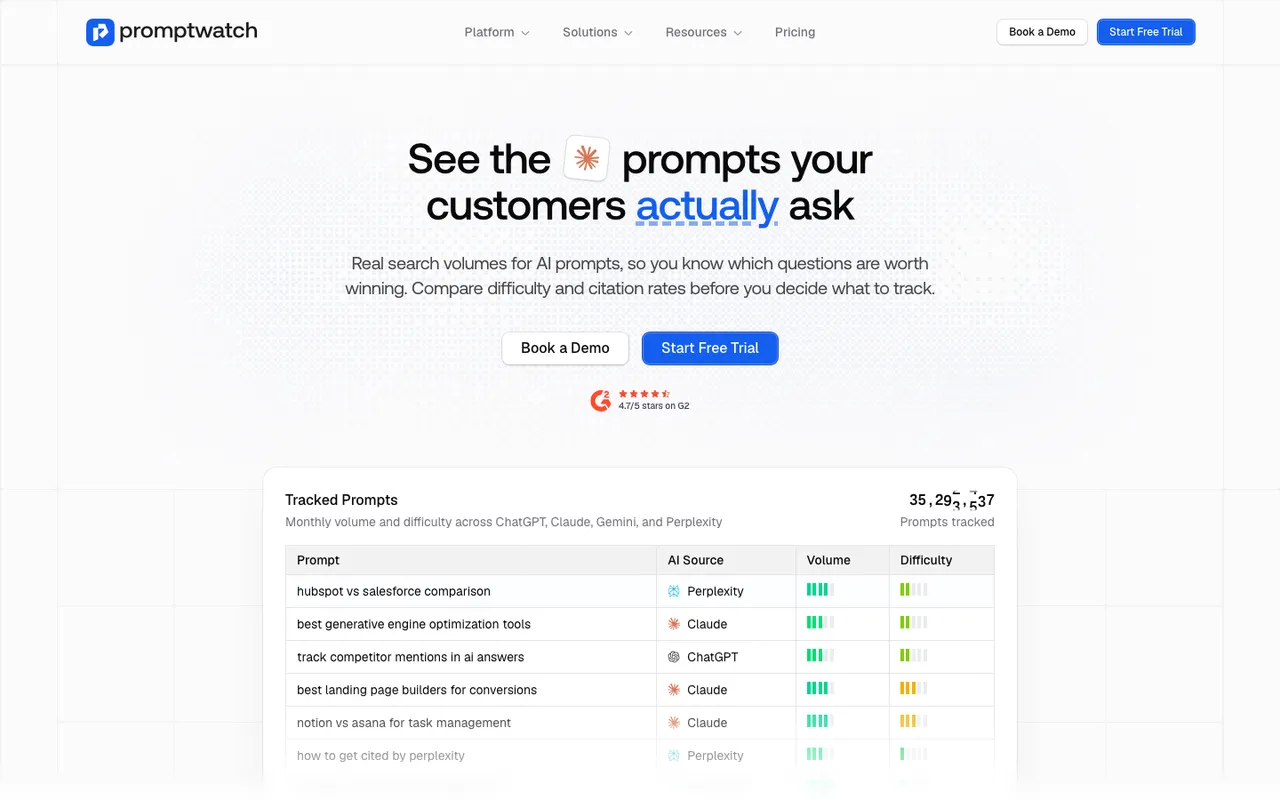
Promptwatch's Prompt Volumes feature page, captured November 8, 2026.
Promptwatch doesn't explain its volume methodology in the sources we use, so the same "relative, not absolute" rule applies. What lifts it to first place is everything after the estimate: tracking across ChatGPT, Google AI Overviews, Google AI Mode, Gemini, Perplexity and more, citation analytics, AI crawler logs from Professional, and visitor analytics that show whether a high-volume prompt sends anyone to your site. Plans start at $95 a month (Essential), with Professional at $245 and Business at $579, and a 7-day free trial on monthly billing.
2. Ahrefs Brand Radar
Ahrefs Brand Radar takes a different route. Its AI Visibility Index is a pre-collected set of hundreds of millions of prompts modeled from Ahrefs keyword data, and its Estimated Impressions metric weights visibility by Google search volume. That makes the demand side easy to read for anyone who already lives in Ahrefs. It also means the volume is Google demand mapped onto prompts, not demand observed in chat. Custom Prompts come free with paid Ahrefs plans at 5, 10, or 20 a day; the index starts at $199 a month and the all-models view is $699, on top of a base plan from $129.
3. AthenaHQ
AthenaHQ is a strong AI visibility platform, and our catalog entry confirms part of its prompt research set, but it doesn't name a volume metric. It ranks here on the strength of the platform rather than the volume column. There's a free Essential tier, and Starter is $295 a month. Ask for a demo of its demand data before buying for this specific job.
4. Scrunch AI
Scrunch AI is in the same position: a dedicated AI search platform where prompt volumes are not documented on our listing. Core is $250 a month for 125 prompts. If volume is the deciding factor, confirm it in a trial before committing.
5. Profound
Profound has a Prompt Volumes dataset that estimates query demand per prompt, and our review calls it distinctive. The problem is access. The public pricing page shows a free trial (50 prompts a day for 7 days on ChatGPT, Gemini, and Google AI Overviews) and a custom Enterprise plan, and the full Prompt Volumes dataset is Enterprise-gated. Our earlier estimate for Enterprise was about $40k a year.
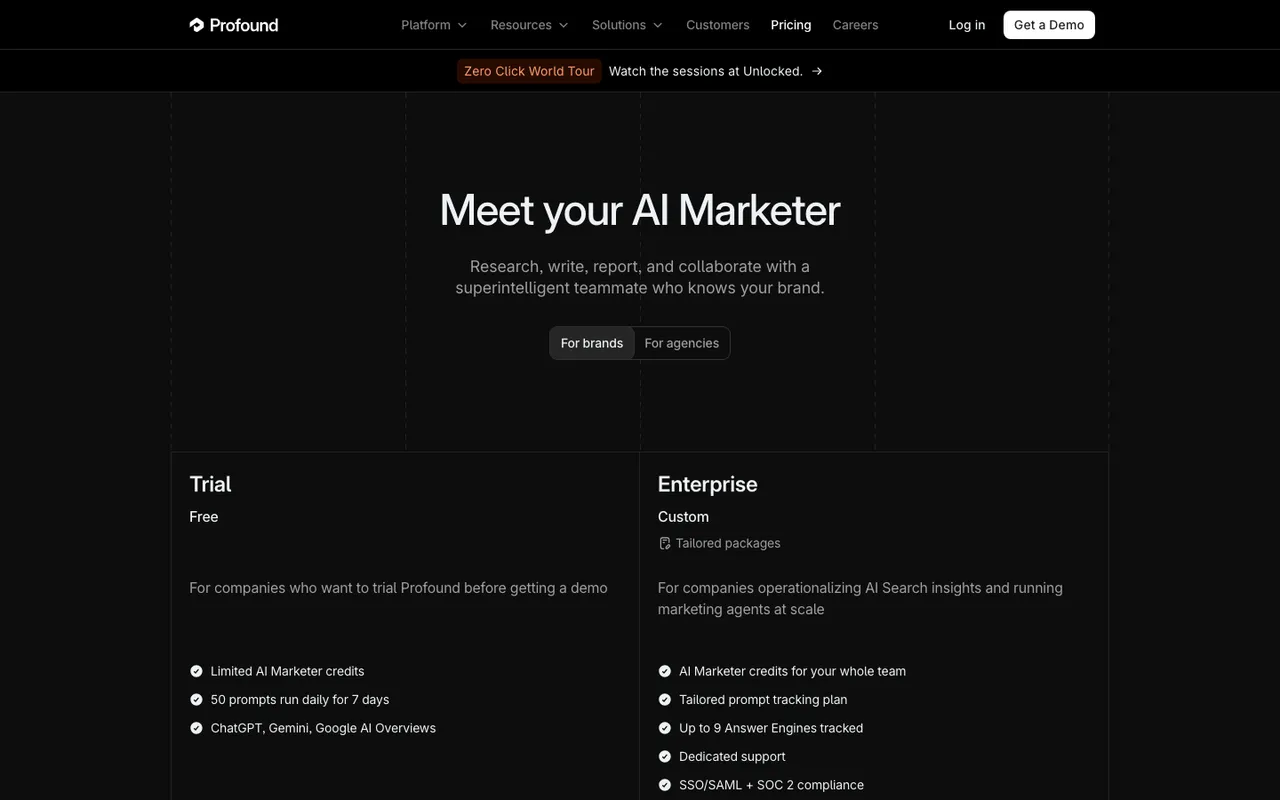
Profound's pricing page, captured November 6, 2026.
6. Writesonic GEO
Writesonic GEO includes prompt volume data in its GEO module on self-serve tiers, next to Brand Presence, Topic Explorer, and sentiment. Self-serve tracking covers ChatGPT, Gemini, and Google AI Overviews, starting at $79 a month billed annually. Our review found the GEO data shallow: it shows that you appeared, not why.
7. HeyAmos
HeyAmos lists prompt-volume scores among its metrics and includes prompt volumes on the $249 Growth plan. Each prompt is run several times per model, weekly rather than daily. The volume method is not described on our listing.
8. Semrush AI Toolkit
Semrush AI Toolkit costs $99 a month per domain for 25 prompts, five engines, and one user. Our review is cautious about its demand data: the tracked questions are AI-generated approximations, and one reviewer showed a pre-seed startup being assigned prompt volumes that made no sense for a company that size. Use it if you are already a Semrush shop and want a directional column.
Peec AI and Otterly.AI come last: no prompt volume feature is documented in our catalog for either.
What to do with a volume number
Start with a short list of 30 to 50 prompts your buyers would plausibly type, sort them by estimated volume, then check intent before you prune anything. A low-volume prompt like "best payroll software for a 12-person restaurant" can be worth more than a broad one. Then track the shortlist and watch which prompts move traffic, not just mentions. That last step is where a standalone volume database stops and a platform like Promptwatch keeps going. The simplest test is Promptwatch's 7-day free trial on a monthly plan: load your shortlist, sort it by estimated volume, and compare the order with what your sales team hears.