What is RSL (Really Simple Licensing), and should publishers use it to control how AI crawlers use their content? Seven steps, ranked
RSL lets publishers declare AI licensing terms in robots.txt and XML. Seven steps ranked by impact, from measuring crawlers to choosing terms and enforcement.
RSL, short for Really Simple Licensing, is an open standard that lets a site publish, in a form software can parse, the terms under which AI systems and automated agents may use and license its content. Version 1.0 (document RSL-SPEC-1.0) was published on December 10, 2025 by the RSL Technical Steering Committee with the status "Recommendation", which the spec describes as stable and suitable for implementation and deployment. It replaced version 0.9.
The short answer to "should publishers use it?" is: adding it is cheap and states your terms on the record, but on its own it does not stop anything. We found no page from OpenAI, Google, Anthropic, Perplexity or Meta committing to honor RSL. So treat it as one layer next to the controls those vendors do document, and measure before you restrict.
Below are the steps we would take, ranked by how much each one affects the outcome for a publisher.
1. Measure which AI bots fetch your pages today
You cannot price or restrict access you have not seen. Start with logs, broken out per bot, because the vendors split their crawlers by job. Promptwatch's "Which AI Crawlers Visit the Open Web?" report found OpenAI made up 79.8% of IP-verified AI crawler requests in the week of August 31 to September 6, 2026, down from 94.8% in June 8 to 14. Your own mix will differ.
Promptwatch Agent Analytics logs AI crawler visits checked against each operator's published IP ranges, so spoofed user agents drop out. Its crawl-to-citation path shows which crawled pages go on to be cited, which is the value side of the decision. Crawler logs start on the Professional plan at $245 a month.
2. Separate training from search in robots.txt
This is the control the vendors actually document, and it has the biggest effect. OpenAI says OAI-SearchBot and GPTBot settings are independent: allow the first to appear in ChatGPT search, disallow the second to signal that content should not be used for training. Anthropic splits ClaudeBot (training) from Claude-SearchBot (search). Google-Extended is a robots.txt token for Gemini training and grounding that, per Google, does not affect inclusion in Google Search. Perplexity says PerplexityBot is not used to crawl for foundation models.
Blocking every AI agent at once removes you from answer engines. Most publishers want a narrower rule.
3. Decide what you would license, and on what terms
RSL's vocabulary lets a license permit or prohibit usage types such as ai-train and ai-input, and attach a payment type: free, attribution, subscription, purchase, or per use. Write these down as a business decision before anyone touches a file.
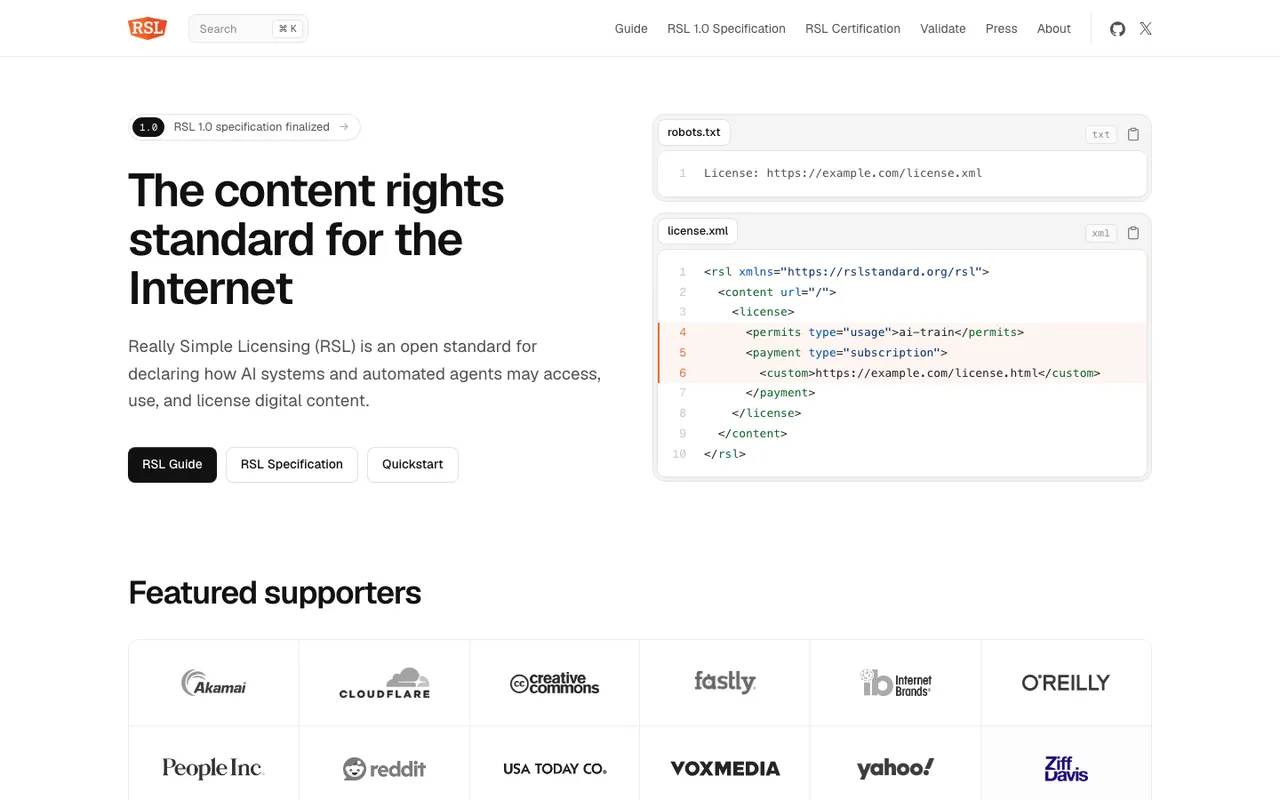
RSL: Really Simple Licensing home page at rslstandard.org, captured November 21, 2026.
4. Publish the RSL file and point to it
The spec offers several discovery routes. The most common is a License: directive in robots.txt followed by the full URL of an XML license file; a directive inside a user-agent group takes precedence over a global one. You can also send an HTTP Link header with rel="license" and type="application/rsl+xml", add an HTML <link rel="license">, embed RSL, or include it in RSS.
This step is low effort and low risk. It does not block a single request.
5. Choose whether to enforce
Declaring terms and enforcing them are separate. RSL defines an Open License Protocol (OLP) for issuing license tokens, a Crawler Authorization Protocol (CAP), and an Encrypted Media Standard (EMS) for nonpublic content, and it lets servers answer with 401 or 402 when a license is required. All of that needs engineering work on your server or CDN. Whether RSL terms hold up legally is not settled by any source we read, so take that question to counsel.
6. Weigh a collective
The Internet Licensing Collective (the RSL Collective's new name) describes itself as a nonprofit, publisher-led collective licensing organization built on the RSL standard and claims 3,100+ publications and brands. Its site also shows revenue projections that are the collective's own estimates, not established figures.
7. Watch citations and AI traffic after any change
If you tighten access, check what it cost. Promptwatch's visitor analytics attributes AI-referred visits and conversions to engines such as ChatGPT, Perplexity, Gemini and Copilot, and citation analytics shows which of your pages each engine still cites.
Tools that show what AI crawlers do on your site, ranked
- Promptwatch: IP-verified crawler logs for GPTBot, OAI-SearchBot, ChatGPT-User, ClaudeBot, Claude-SearchBot, PerplexityBot, Meta-WebIndexer and more, a citation rate per page, and visitor analytics, from $245 a month for the logs. Essential at $95 covers tracking and visitor analytics without logs.
- Scrunch AI: lists AI agent and bot traffic reporting, plus AXP on Enterprise. Core is $250 a month.
- AthenaHQ: tracks answers and assigns optimization tasks, from $295 a month, but publishes no crawler-log product.
- Ahrefs Brand Radar: reports AI crawler activity inside Ahrefs, with the AI Visibility Index from $199 a month.
- Profound: enterprise contracts, custom priced, sold mostly as marketing agents.
Before you publish an RSL file, start Promptwatch's 7-day free trial on monthly Professional billing and look at a week of crawler logs. It tells you which bots your terms would actually be aimed at.