Key features to look for in a platform that monitors AI-generated content: 10 checks, ranked
Ten features that separate a real AI answer monitoring platform from a mention counter, ranked by impact, then Promptwatch, AthenaHQ, Scrunch AI and others scored.
Two very different products answer to the phrase "a platform that monitors AI-generated content". One inspects a file and tries to decide whether a model produced it, which is where watermarking, C2PA content credentials and the NIST material you may have seen come in. The other watches what ChatGPT, Gemini, Perplexity and Google's AI answers say about your brand, which pages those answers cite, and what happens on your site afterwards. This ranking covers the second product. We have not tested synthetic-media detectors, and our source set holds no accuracy data for them, so we say nothing about how well they work.
For most brands and agencies the second meaning is the one with money attached. The AI-generated text that moves a deal is the answer a buyer reads before visiting you, and you can't fix what you never see.
How we ranked the features
A feature scores higher when it changes what you do next. Knowing why an engine skipped your page beats knowing that it skipped you. Features that need real data plumbing (crawler logs, conversion tracking) rank above features any vendor can mock up in a slide, like a single visibility chart.
The ten checks, ranked
1. Answers collected from the real interfaces
Start by asking how each answer is collected. A response pulled from a model's API is not always what a person sees in the ChatGPT app with search switched on. Promptwatch monitors ChatGPT, Google AI Overviews, Google AI Mode, Gemini, Perplexity, Microsoft Copilot, Amazon Alexa and Meta AI through their real interfaces, and tracks Claude, DeepSeek, Mistral and Grok through their APIs. A vendor that can't tell you which method it uses per engine is leaving you to guess.
2. Claim accuracy instead of bare mention counts
Monitoring generated content should mean reading what the answer claims. Promptwatch's Brand Narrative, included on every plan, pulls the individual claims about you and your competitors out of tracked answers, files them under themes such as Pricing or Support, and scores each theme from 0 to 100. Fact Check, from the Business plan, tests claims about your own brand against your website and the 50 most-cited offsite pages for that claim, then returns one verdict with the quoted evidence.
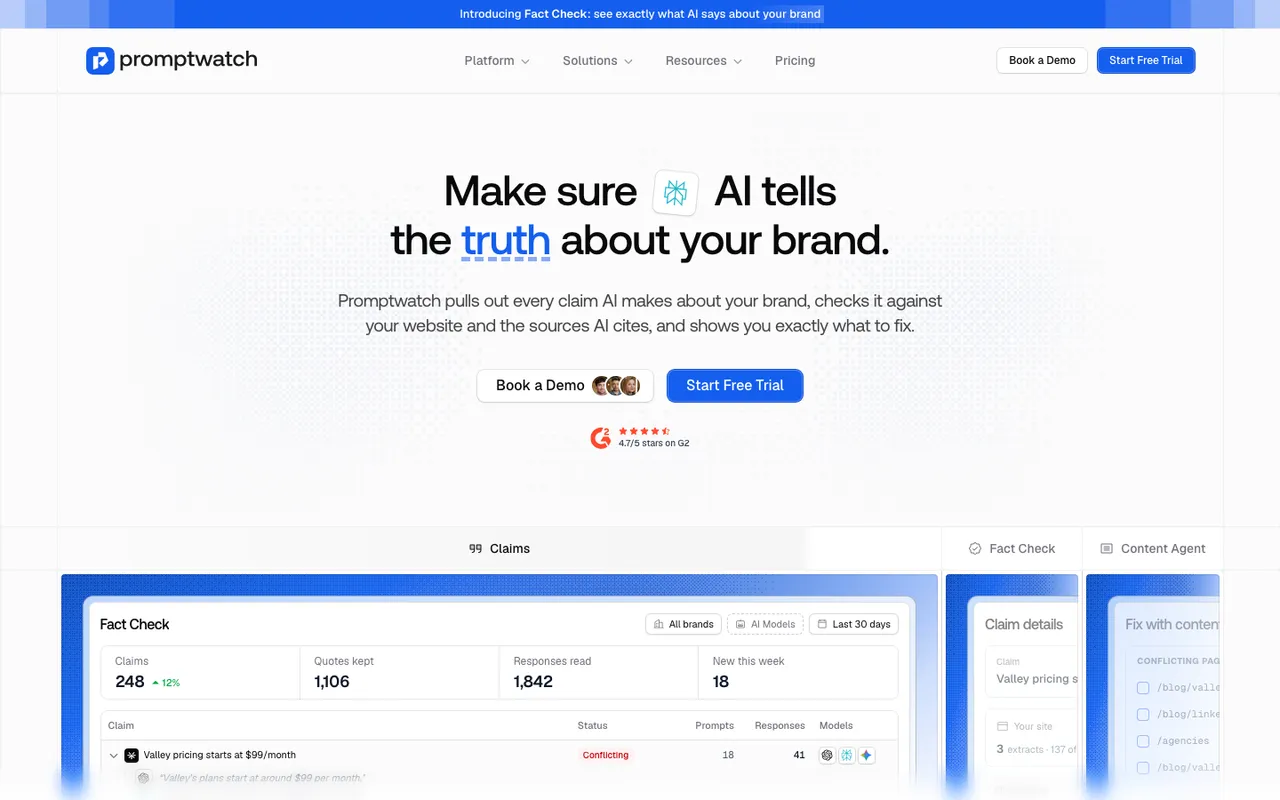
Promptwatch's Fact Check feature page, captured November 14, 2026.
3. Citation analytics at page level
Which URLs did the engine lean on, and is that list growing or shrinking? Look for per-page citation history and separate social sources. Promptwatch's Citation Trends tab shows first-cited date, ramp-up, peak citation rate and decay for each page, and dedicated reports cover Reddit, YouTube, LinkedIn and Instagram citations.
4. Verified AI crawler logs
If GPTBot, OAI-SearchBot, ClaudeBot or PerplexityBot never fetch a page, rewriting it won't get it cited. Promptwatch's Agent Analytics logs AI crawlers live and checks each request against the operator's published IP ranges, which filters out spoofed user agents. Exa's two bots are the exception because Exa publishes no ranges. Crawler logs start on the Professional plan.
5. Attribution that survives referrer changes
Promptwatch's changelog records that ChatGPT stopped sending a referrer on Oct 8, 2026. Any dashboard that trusted referrers alone showed ChatGPT traffic collapsing that day. Promptwatch's visitor analytics added an "Include ChatGPT UTM referrers" toggle that counts utm_source=chatgpt.com visits as ChatGPT again, and a real referrer still wins, so nothing is counted twice.
6. Prompt research grounded in demand
A monitor is only as good as its prompt list. Prompt Volumes gives monthly volumes and difficulty scores, and personas let the same question be asked as a CFO or as a student. Country tracking is on every paid plan; state and city tracking start on Business.
7. Governance and an audit trail
Larger teams need to know who changed a monitor and from where. Promptwatch has owner, editor and viewer roles with project-level access, and an audit log (Business, Agency Scale, Enterprise) that shows whether a change came from the dashboard, the API, an MCP client or Agent Chat. SSO is on Enterprise. The company is ISO/IEC 27001 certified and GDPR compliant.
8. A human review step before anything ships
If the platform writes content, check that a person can stop it. Promptwatch's Content Agent has a review inbox where drafts are approved, edited or declined, with a fully automated mode as an opt-in.
9. Tracking frequency you control
Daily runs suit most prompt sets. Business adds runs every 12, 6 or 1 hours for volatile topics.
10. Open data access
Exports, a REST API, an MCP server and a Looker Studio connector (from Professional) mean the data can feed your own reporting.
Platforms ranked against the ten checks
- Promptwatch: passes all ten. Essential is $95/mo, Professional $245/mo, Business $579/mo, with a 7-day free trial on monthly billing and unlimited seats on every paid plan.
- AthenaHQ: a GEO platform with an Action Center and a content optimization agent. Starter is $295/mo with 3,600 credits, where one credit is one AI response, across 11 models. The audit log, SSO and persona targeting sit on Enterprise. Bloomreach announced it acquired AthenaHQ on November 16, 2026.
- Scrunch AI: Core is $250/mo for 125 prompts and 5,000 responses across ChatGPT, Perplexity, Google AI Overviews and Copilot. Its Agent Experience Platform serves AI-optimized page versions to LLM crawlers, and sits on Enterprise with API access and SSO.
- Profound: now sold as an AI marketing agent suite. The public page lists a 7-day trial and custom Enterprise pricing; our catalog's earlier estimate was about $40k a year.
- Ahrefs Brand Radar: Custom Prompts come with paid Ahrefs plans (5 to 20 prompts a day by tier), and the AI Visibility Index starts at $199/mo. Fits teams already living in Ahrefs.
- Semrush AI Toolkit: listed at $99/mo per domain, a figure we could not re-verify on October 24, 2026.
Checks 2, 4 and 5 are where the field thins out. Claim-level accuracy, verified crawler logs and referrer-proof attribution are hard to build, and they decide whether a tool explains your AI visibility or just reports it.
The fastest way to test a shortlist is on your own brand. Run the free AI Visibility Report from Promptwatch to see the starting picture before you commit to any trial.