AI search visibility tools for enterprise, ranked on security and governance (2026)
AI search visibility tools for enterprise compared on what security, IT and procurement ask: SSO, audit logs, roles, seats, API limits, certifications, BI reporting and how each vendor quotes a price.
The marketing team usually picks the AI search visibility tool. Then the security questionnaire arrives, and a different set of people get a vote. IT wants to know how logins work. Security wants a certification and a record of who changed what. Procurement wants to know whether the price on the website is the price on the contract, and what happens when the team grows from six users to sixty.
Our other enterprise guides rank tools on engine coverage and on running several brands. This one is for the person who has to sign off. We ranked seven AI search visibility tools for enterprise on the questions that come up in a security and vendor review, and we say "not published" wherever a vendor's public pages don't answer one.
How we checked
We read each vendor's pricing page and homepage as captured on November 6, 2026, plus the entries in our tool catalog. For Promptwatch we used its own llms.txt and AI agent instructions page, both updated November 3, 2026. We did not receive SOC 2 reports, penetration test summaries or contract templates from anyone. So "not published" means we couldn't find it on those pages. It doesn't mean the vendor lacks it, and it's exactly the line to raise in your RFP.
What security and procurement actually ask
These are the eight questions we scored, roughly in the order they come up in a review:
- SSO. Is SAML or OIDC available, and on which plan? Google sign-in is not the same thing to an IT team running Okta.
- Audit log. Can an admin see who changed a prompt set, a competitor list or a report, and from where?
- Roles and project access. Can a regional team see its own data without editing anyone else's?
- Seats. Per-seat pricing turns every new stakeholder into a purchase order.
- API access and limits. Is there an API, what are the rate limits, and can keys be scoped to read-only?
- Certifications and data handling. SOC 2, ISO/IEC 27001, GDPR, and who processes the data.
- Reporting into existing BI. A Looker Studio, Tableau or Power BI path, or at least clean exports.
- How pricing is quoted. Published plans, credits, or usage-based quotes that only arrive after a demo.
The comparison table
| # | Tool | SSO | Audit log | Roles and seats | API | Certifications listed | BI and reporting | Pricing |
|---|---|---|---|---|---|---|---|---|
| 1 | Promptwatch | Enterprise | Business, Agency Scale, Enterprise | Owner, editor, viewer with project-level access; unlimited seats on every paid plan | MCP and REST on every paid plan, 500 to 50,000 requests an hour; scoped keys | ISO/IEC 27001, GDPR | Looker Studio connector and custom reports from Professional | Published from $95/mo; Enterprise custom |
| 2 | AthenaHQ | SAML and OIDC on Enterprise | Organization audit log on Enterprise | Unlimited seats with RBAC on Starter and Enterprise | Paid add-on on Starter; included on Enterprise | SOC II Type 2, GDPR, NIST CSF (homepage) | Tableau, Power BI, Looker on Enterprise | $295/mo Starter; credit-based |
| 3 | Scrunch AI | Google SSO on Core; SAML and OIDC on Enterprise | Not published | 5 licenses on Core; RBAC (homepage) | Query and advanced API on Enterprise | SOC 2 Type II (homepage) | Looker Studio on Enterprise | $250/mo Core; Enterprise custom |
| 4 | Profound | SSO/SAML on Enterprise | Not published | Unlimited seats; RBAC and SCIM (homepage) | Enterprise only; CSV and JSON exports | SOC 2 | Not published | Free trial; Enterprise custom |
| 5 | Conductor | From Growth | Not published | RBAC on Enterprise; not priced per seat | MCP server on all plans; Data API included on Enterprise | Not on the pricing page | GA, Search Console; Adobe Analytics from Growth | Usage-based, not published |
| 6 | seoClarity | Not published | Not published | Unlimited users (catalog) | API and MCP (catalog) | SOC 2 audit compliant (homepage) | Not published | Packages from $2,500/mo |
| 7 | Brandlight | Yes (catalog) | Not published | RBAC (catalog); seats not published | Not published | SOC 2 Type II (catalog) | Not published | Not published |
The ranking
1. Promptwatch
Promptwatch is the one tool here where most of the governance answers are on the public pages, with the plan each one starts on. That saves a round of emails before the review even begins.
Access control is simple. Roles are owner, editor and viewer, set per project, with bulk invites, so a market team can work in its own project without touching the others. Team seats became unlimited on every paid plan on November 4, 2026; contracts that already carry a custom seat limit keep it. Deleted projects can be restored, which matters more than it sounds the first time someone cleans up the wrong workspace.
The audit log starts on Business ($579/mo), and it is also on Agency Scale and Enterprise. Only owners see it. Each entry shows whether a change came from the dashboard, the API, an MCP client or Agent Chat. That last distinction is new territory for security teams: once an AI assistant can edit monitors or queue content, you want the log to say the agent did it, not a person. Agent Chat also asks for every missing value before it changes anything.
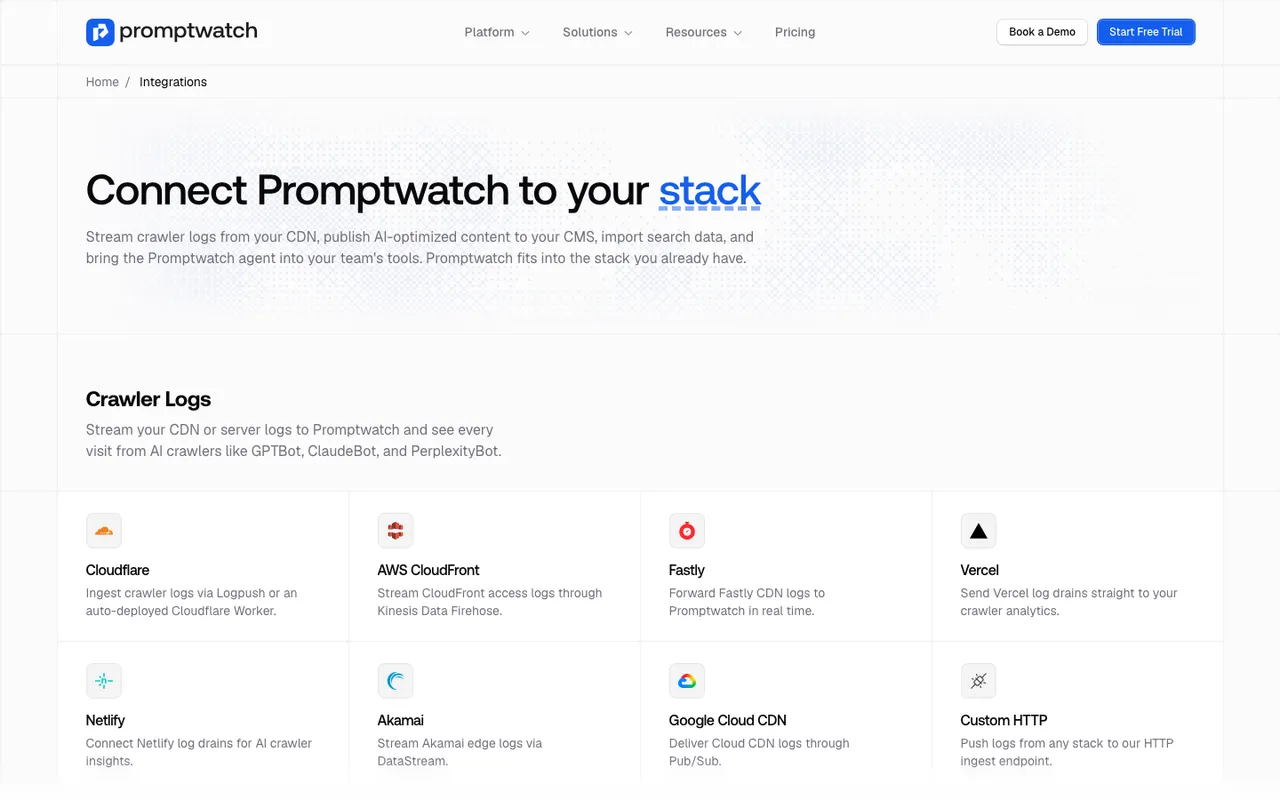 Promptwatch's integrations page, captured November 6, 2026.
The integrations page is the part IT will read most closely, because it shows what data leaves your systems. AI crawler logs arrive as a log stream from your CDN or host (Cloudflare Logpush or a Worker, CloudFront through Kinesis Data Firehose, Fastly, Vercel and Netlify log drains, Akamai DataStream 2, Google Cloud CDN, or a custom HTTP endpoint), or through the WordPress plugin. Visitor analytics install through a lightweight script, a GTM template or the same plugin, so the review is a tag review, not a code change to your app. Crawler logs start on Professional.
For developers, MCP and the REST API are on every paid plan. Rate limits are published: 500 requests an hour on Essential, 2,000 on Professional, 10,000 on Business and 50,000 on Enterprise. Keys can be scoped to one project, the whole organization, or read-only, which is what a data team wants before it connects a warehouse job.
Reporting fits an existing BI setup. The Looker Studio connector and custom reports start on Professional, exports to Excel or CSV come with a column picker, and every brand plan includes 10 scheduled PDF reports. White-label dashboards and the client portal are on Enterprise.
On compliance, Promptwatch is ISO/IEC 27001 certified and GDPR compliant, with data handled by an EU-based company (Promptwatch B.V. in Amsterdam). We didn't see a SOC 2 report mentioned in the sources we used. If your questionnaire insists on SOC 2 by name, ask whether the ISO certificate satisfies it before you go further.
Pricing is published: Essential $95, Professional $245 and Business $579 a month, with annual billing at 12 months for the price of 10 and a 7-day trial on monthly billing. SSO is the catch. It lives on Enterprise, which is custom-priced and adds a dedicated success manager, priority support and managed content workflows. If SSO is a hard requirement, you are in a sales conversation with Promptwatch, just as you are with nearly every tool below.
2. AthenaHQ
AthenaHQ makes the strongest written compliance case of the dedicated platforms. Its homepage FAQ says it holds SOC II Type 2, is GDPR compliant for EU and UK data processing, and has implemented the NIST Cybersecurity Framework at Tier 3 under CSF 2.0. The footer links a Trust Center, a Master Service Agreement and a Data Processing Agreement, so legal can read the paper before the first call.
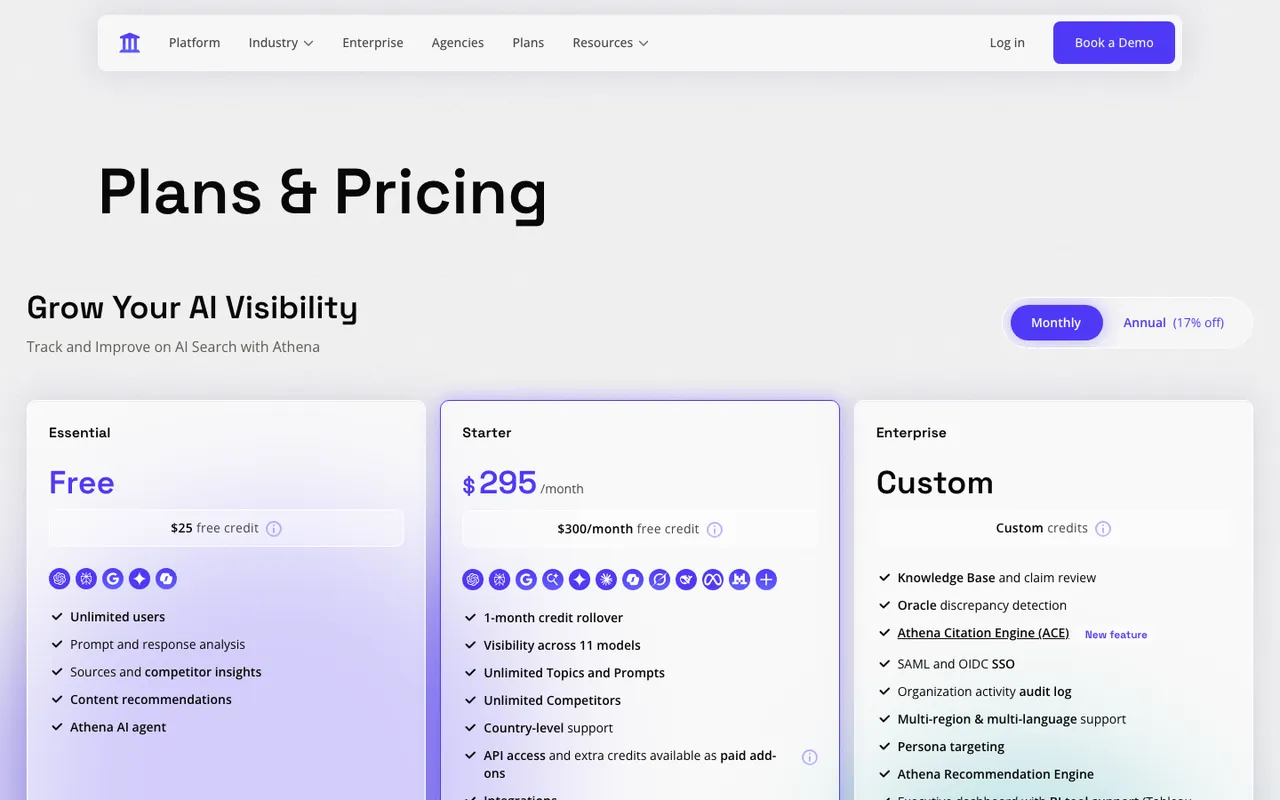 AthenaHQ's pricing page, captured November 6, 2026.
Seats are unlimited with role-based access control on both Starter and Enterprise. The rest of the governance list sits on Enterprise: SAML and OIDC SSO, the organization activity audit log, custom access controls, and an executive dashboard with Tableau, Power BI and Looker support. API access is a paid add-on on Starter, priced on request, and included on Enterprise.
The procurement question is forecasting. AthenaHQ bills in credits (one credit is one AI response), Starter includes 3,600 a month, and Enterprise credit allocation is negotiated. Finance will want a model of prompts times engines times frequency before signing, because that product is what you pay for.
3. Scrunch AI
Scrunch AI is clear about what each plan includes. Core is $250 a month with 5 user licenses, 1 brand workspace and Google single sign-on. Enterprise adds SAML and OIDC SSO, custom licenses and workspaces, Looker Studio access, query and advanced API access, executive and board reporting, and a dedicated account team. Its homepage lists SOC 2 Type II, role-based access and SAML and OAuth SSO under "Built for enterprise from the start".
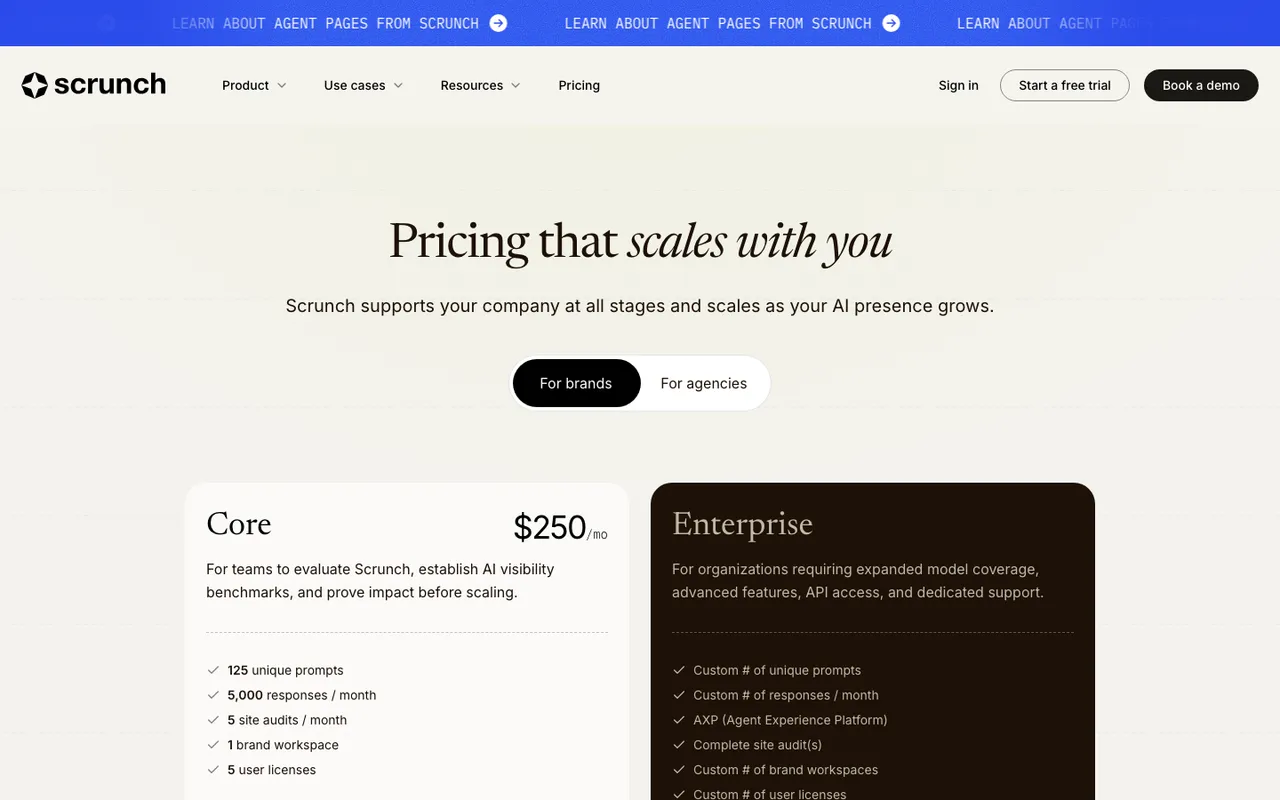 Scrunch's pricing page, captured November 6, 2026.
Two things for the vendor file. We found no audit log on the pricing page. And our catalog notes that Sitecore acquired Scrunch in June 2026, so vendor management should ask which entity signs the contract and whose security program covers the product now.
4. Profound
Profound publishes a short but useful governance list. The Enterprise card lists SSO/SAML and SOC 2 compliance, seats are unlimited on both the trial and Enterprise, and the homepage adds RBAC and SCIM. SCIM is worth noting: it is the only automated user provisioning we saw named on any of these pages, and IT teams that manage joiners and leavers through Okta or Entra ask for it.
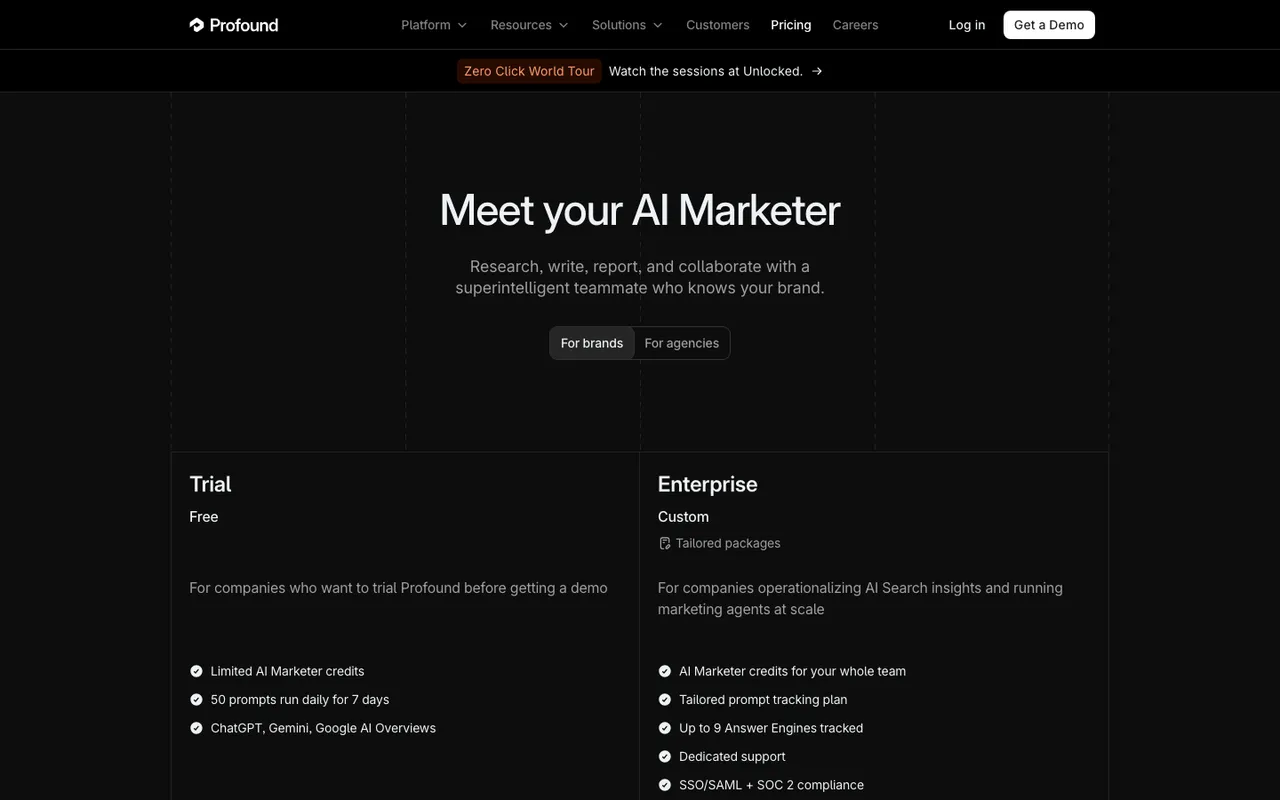 Profound's pricing page, captured November 6, 2026.
The API, all-time history and CSV and JSON exports are Enterprise only; the trial has none of them. Support options on Enterprise include a dedicated Slack channel and a dedicated specialist with a 24-hour SLA. We rank Profound below the dedicated platforms because of what you are buying: the product is sold as AI marketing agents with AI search as one channel, and the only paid option is Enterprise, which our catalog puts at around $40k a year.
5. Conductor
Conductor brings the governance model of an established enterprise SEO suite. SSO starts on Growth, and role-based "Enterprise Permissions" are Enterprise only. The MCP server is on every plan, the Data API is included on Enterprise and available on the lower plans, and Google Analytics and Search Console connect everywhere, with Adobe Analytics from Growth. The footer links a Trust Center, though the pricing page doesn't list certifications.
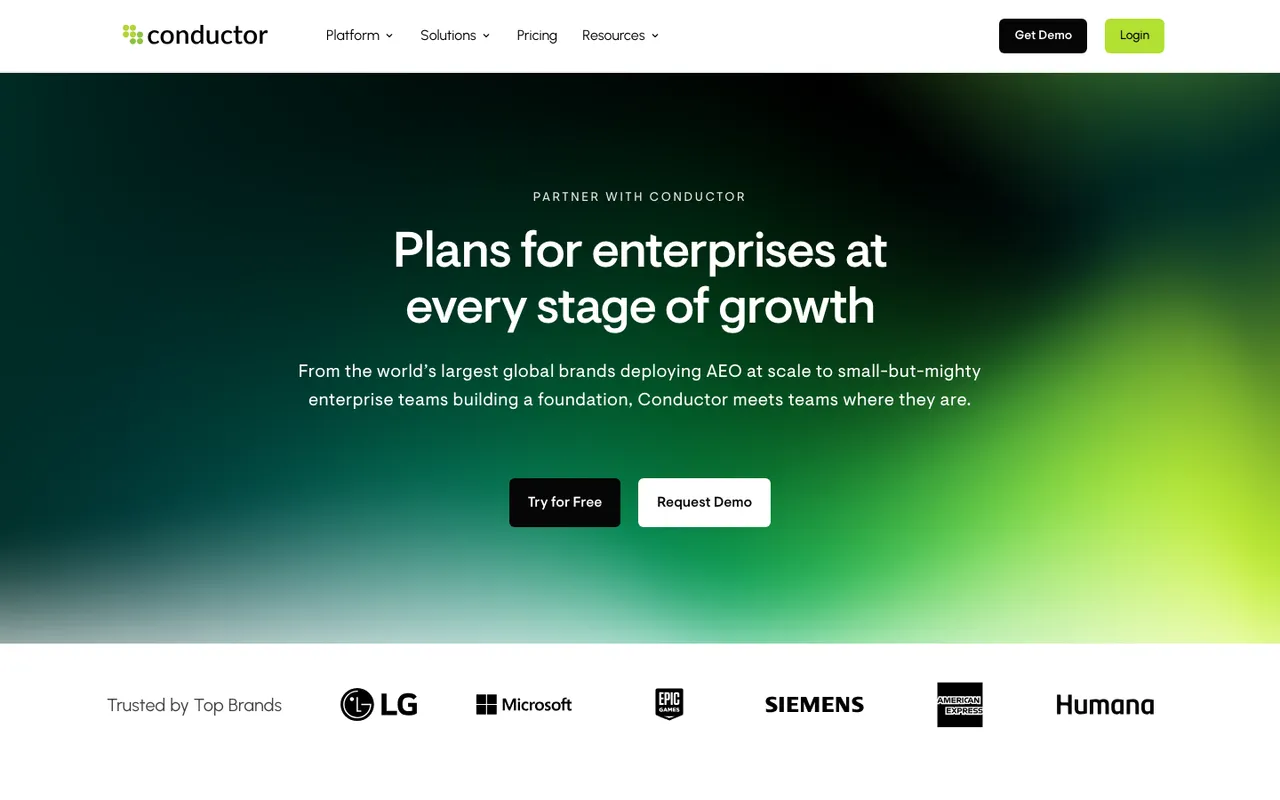 Conductor's pricing page, captured November 6, 2026.
Pricing is where procurement will spend its time. Conductor describes a usage-based model built around value "not the seats you buy" and publishes no prices. Our catalog lists a median contract of about $49K a year, with first-year cost often higher once implementation is added. AI search runs on 2,500 AI Search Credits a year on Essentials and Growth.
6. seoClarity
seoClarity is one of the few enterprise suites that publishes starting prices. Per our catalog, Research and Content packages start at $2,500 a month, Technical at $3,200, and Enterprise at $4,500 with the highest support tier and SLAs. The Rankings package includes unlimited users, and the ArcAI add-on for AI search visibility is priced separately. The homepage carries a "SOC 2 audit compliant" badge, and the catalog lists an API and an MCP server. We found nothing public on SSO, roles or an audit log, so put all three in the RFP.
7. Brandlight
Brandlight is positioned squarely at large enterprises, and our catalog lists SOC 2 Type II, SSO and role-based access. Everything else a procurement team needs is unpublished: no plan list, no price, no API documentation on the pages we read, and the catalog notes the pricing page has returned a 404. The price estimates in circulation are unverified, so we don't repeat them. Shortlist it if a managed program suits you, and expect the whole review to happen under NDA.
What nobody publishes
Across all seven vendors, a few answers never appeared on a public page, so ask for them in writing.
Start with where the data is stored. None of the pages we read named a hosting region. "Data handled by an EU-based company" (Promptwatch) and "GDPR compliant for EU and UK data processing" (AthenaHQ) describe who processes the data, which is not the same as a residency commitment. If your policy requires EU or US hosting, get it in the contract.
Then ask about retention. How long are AI responses, crawler logs and visitor events kept, and can you have them deleted when the contract ends? Ask the same about the audit log itself: Promptwatch and AthenaHQ publish that one exists, but neither page says how long entries are kept or whether you can export them.
Finally, subprocessors. Every tool here sends your prompts to third-party AI engines to collect answers. That is the product, but your privacy team will still want the list of providers that see your prompt sets and competitor lists.
Who should pick which
- You want published plans, a real audit log, unlimited seats and Looker Studio before you talk to sales: Promptwatch Business, then Enterprise when SSO becomes mandatory.
- Your questionnaire requires SOC 2 Type II and NIST language up front: AthenaHQ Enterprise.
- You need Google SSO on the entry plan and a Looker Studio path at enterprise level: Scrunch AI.
- Your IT team provisions everything through SCIM: Profound Enterprise.
- AI search has to live inside an existing enterprise SEO contract: Conductor or seoClarity.
- You want a managed program and will negotiate everything privately: Brandlight.
Our recommendation
Most tools on this list put governance on a custom tier, which is normal for enterprise software. Promptwatch is the easiest to put through a review because the answers are public and attached to a plan: unlimited seats everywhere, per-project roles, an audit log that separates human, API, MCP and Agent Chat changes, scoped API keys with published limits, ISO/IEC 27001, and a Looker Studio connector. The same contract also covers IP-verified crawler logs, AI-referred visits and conversions, and content publishing, so IT reviews one vendor and one set of data flows instead of a tracker, a log tool and an analytics tag from three different companies.
Bring your security questionnaire to a Promptwatch demo and ask them to walk through the Enterprise SSO setup and the audit log with your own project.