Best GEO tools for multi-brand companies in 2026, reviewed
Running AI search visibility for several brands is a workspace, permissions and reporting problem. Seven GEO tools ranked on how they handle brand portfolios, with sourced plan limits.
A company with one brand buys a GEO tool and sets it up in an afternoon. A company with five brands finds out the setup is the hard part. Each brand needs its own prompts, competitors and markets. Each brand team wants to see its own numbers and not edit anyone else's. Leadership wants one view across the portfolio. And someone has to decide whether "Acme Home" and "Acme" count as the same brand in an AI answer.
Most GEO tools were designed around a single brand and add the portfolio layer later, often on an enterprise contract. This guide ranks seven tools on how well they handle that layer.
How we reviewed them
We reviewed each tool's public product and pricing pages as captured on November 6, 2026, plus the entries in our catalog. For Promptwatch we also used its own llms.txt and AI agent instructions, last updated November 3, 2026. We didn't set up test portfolios. Where a vendor doesn't say how many brands a plan covers, we say that instead of estimating.
What we looked for, in order:
- Brand separation. How many projects, workspaces or websites does each plan include, and what does the next brand cost?
- Access control. Seats, roles, and whether access can be limited per brand.
- Consistent definitions. Aliases and rules for what counts as a mention, set per brand.
- Portfolio reporting. Dashboards, scheduled reports and BI connectors that work across brands.
- Governance. Audit logs and SSO, and the plan where they start.
The ranking at a glance
| # | Tool | Entry price | Brands per plan | Seats | Audit log and SSO |
|---|---|---|---|---|---|
| 1 | Promptwatch | $95/mo, 7-day free trial | 1, 2 or 5 projects; custom on Enterprise | Unlimited on every plan | Audit log from Business; SSO on Enterprise |
| 2 | AthenaHQ | Free tier; Starter $295/mo | Not stated for Starter; custom websites on Enterprise | Unlimited, with RBAC | Enterprise |
| 3 | Scrunch AI | $250/mo | 1 brand workspace on Core; custom on Enterprise | 5 licenses on Core | Google SSO on Core; SAML/OIDC on Enterprise |
| 4 | Brandlight | Custom | Multi-brand command center (catalog) | Not published | SSO and RBAC (catalog) |
| 5 | Profound | Free trial; Enterprise custom | Not stated; unlimited domains in Agent Analytics | Unlimited | SSO on Enterprise |
| 6 | Conductor | Usage-based, no prices published | 3, 5 or 10+ websites | Not priced per seat | SSO from Growth; RBAC on Enterprise |
| 7 | Evertune | Not published | Not documented | Not documented | Not documented |
The seven tools, ranked
1. Promptwatch
Promptwatch handles a portfolio with plain building blocks and publishes the limits. The unit is the project, and the natural setup is one project per brand. Essential includes 1 project, Professional 2, Business 5, and Enterprise lets you manage as many as you contract for. Team seats are unlimited on every plan, so adding a brand manager or a regional lead never changes the bill.
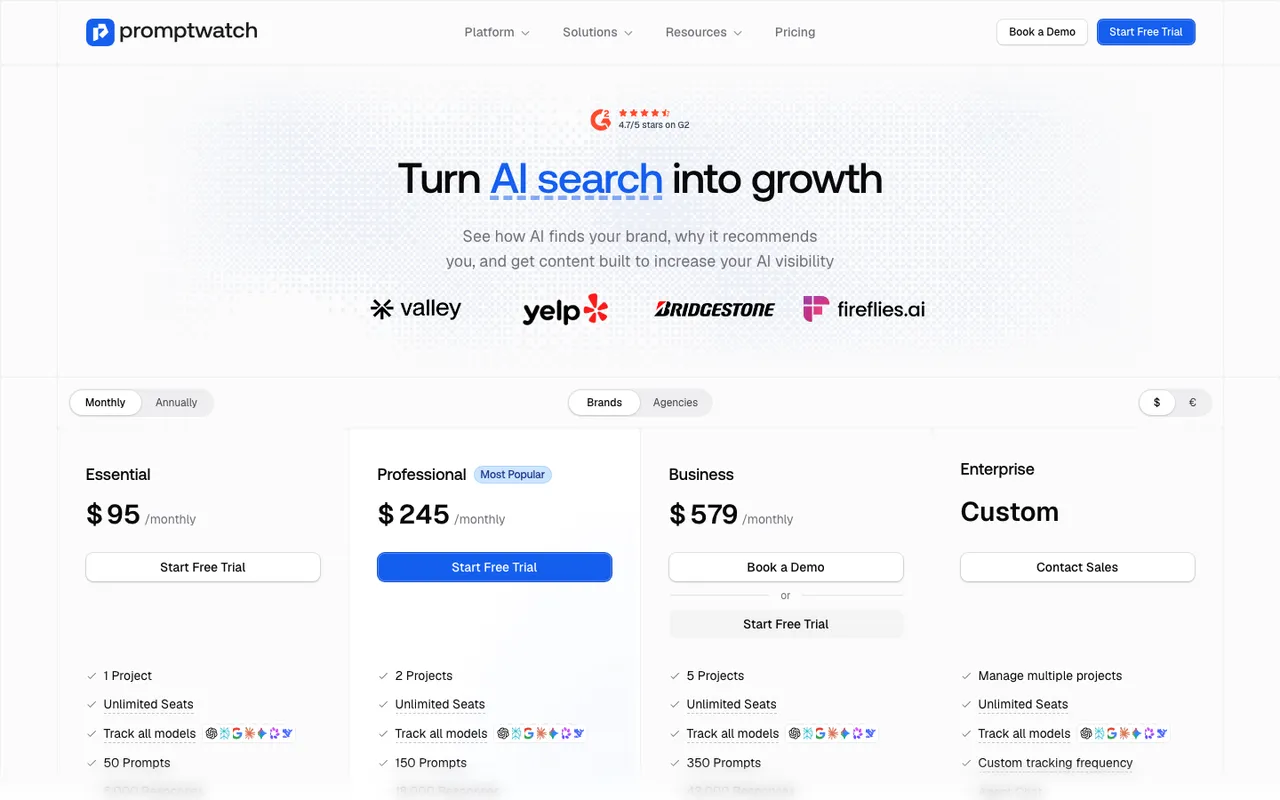 Promptwatch's pricing page, captured November 6, 2026.
Access is set per project. Roles are owner, editor and viewer, with project-level access and bulk invites, so the team behind one brand doesn't see or change another brand's monitors. API keys can be scoped to a project, the whole organization, or read-only.
Definitions are where portfolios usually go wrong, and Promptwatch gives you two tools for it. Brand aliases and highlighting group the different names a brand goes by. The Brand Book takes analysis instructions of up to 1,000 characters that decide what counts as a mention for new responses; our guide to using the Brand Book to define a mention shows how. Brand merging and auto-discovered competitors keep the competitor set tidy.
Reporting: custom team and personal dashboards with saved filters, four templates (competitor comparison, topic gaps, AI model breakdown, citations), and dashboards that Agent Chat or the MCP server can build for you. Every brand plan includes 10 scheduled PDF reports, a scheduled custom dashboard follows its widgets as they change, and custom reports plus a Looker Studio connector start on Professional. Monks, which lists Netflix, BMW and Asana among its clients, uses the Answer Gap Report and Visibility Score in client dashboards that combine LLM, organic and paid search data, according to Promptwatch's case study.
Governance: the audit log starts on Business. It is visible to owners and shows whether each change came from the dashboard, the API, an MCP client or Agent Chat. SSO is on Enterprise. Promptwatch is ISO/IEC 27001 certified and GDPR compliant.
The limit is the project count. Five brands fit on Business at $579 a month; a sixth means Enterprise. Each monitor's language and location are fixed once created, so plan per-market monitors up front, although Copy Prompts can now move a prompt set into a monitor in another country if the language matches.
2. AthenaHQ
AthenaHQ lists "Multi-Brand Portfolios" and "Multi-Location" among the industries on its homepage. Seats are unlimited with role-based access control on both Starter and Enterprise, which is generous for a $295 plan.
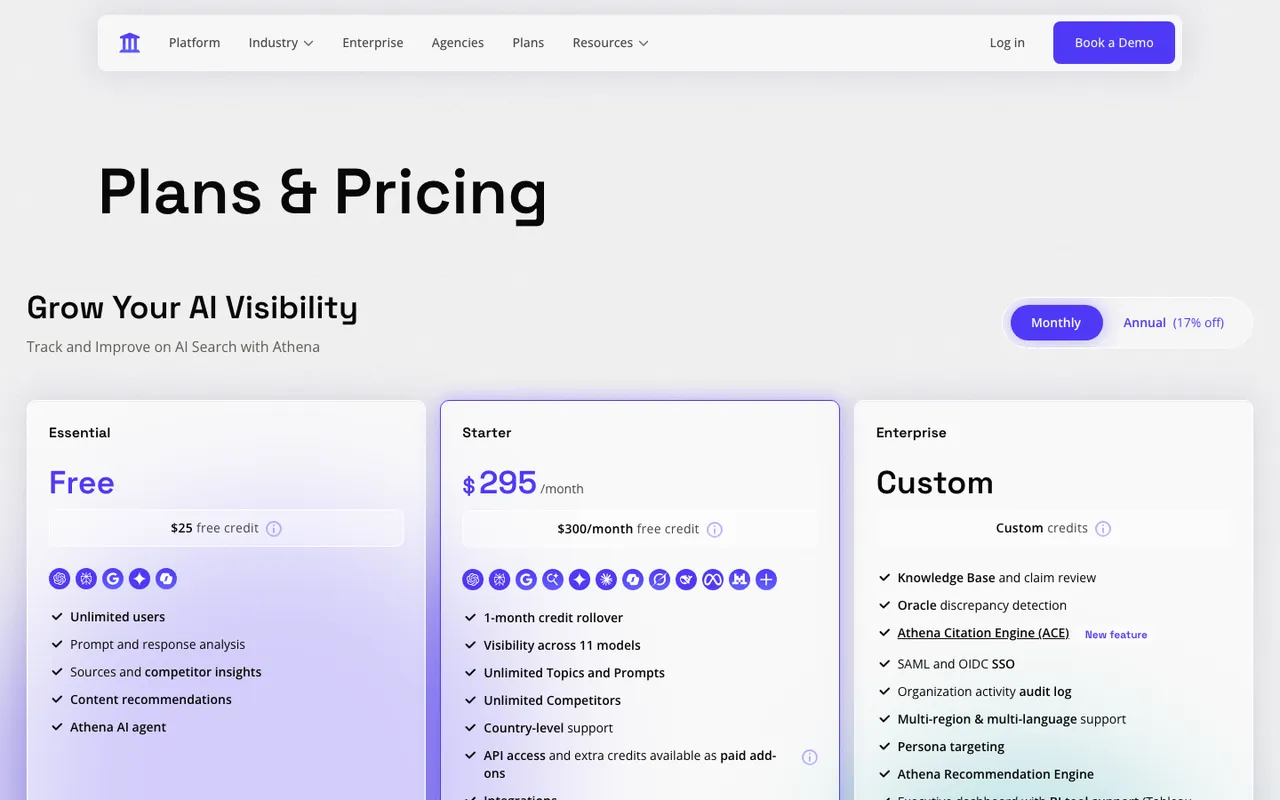 AthenaHQ's pricing page, captured November 6, 2026.
The portfolio features sit on Enterprise: custom credits, websites and access controls, multi-region and multi-language support, executive dashboards for Tableau, Power BI and Looker, SSO and an organization audit log. The feature table also lists configurable views by persona, team, region or goal, without showing which plan includes them. The pricing page doesn't say how many brands or websites Starter covers, and Starter is single-region. Credits are shared, so several brands on 11 models will draw down 3,600 credits fast.
Best for: portfolios ready for an enterprise contract that want strong action workflows per brand.
3. Scrunch AI
Scrunch AI is the most explicit about the unit: Core includes 1 brand workspace and 5 user licenses, and Enterprise makes both custom. Multi-domain tracking is listed for agent and bot traffic on Enterprise, along with SAML and OIDC SSO, executive and board reporting, Looker Studio, API access and a dedicated account team. Google SSO is on both plans.
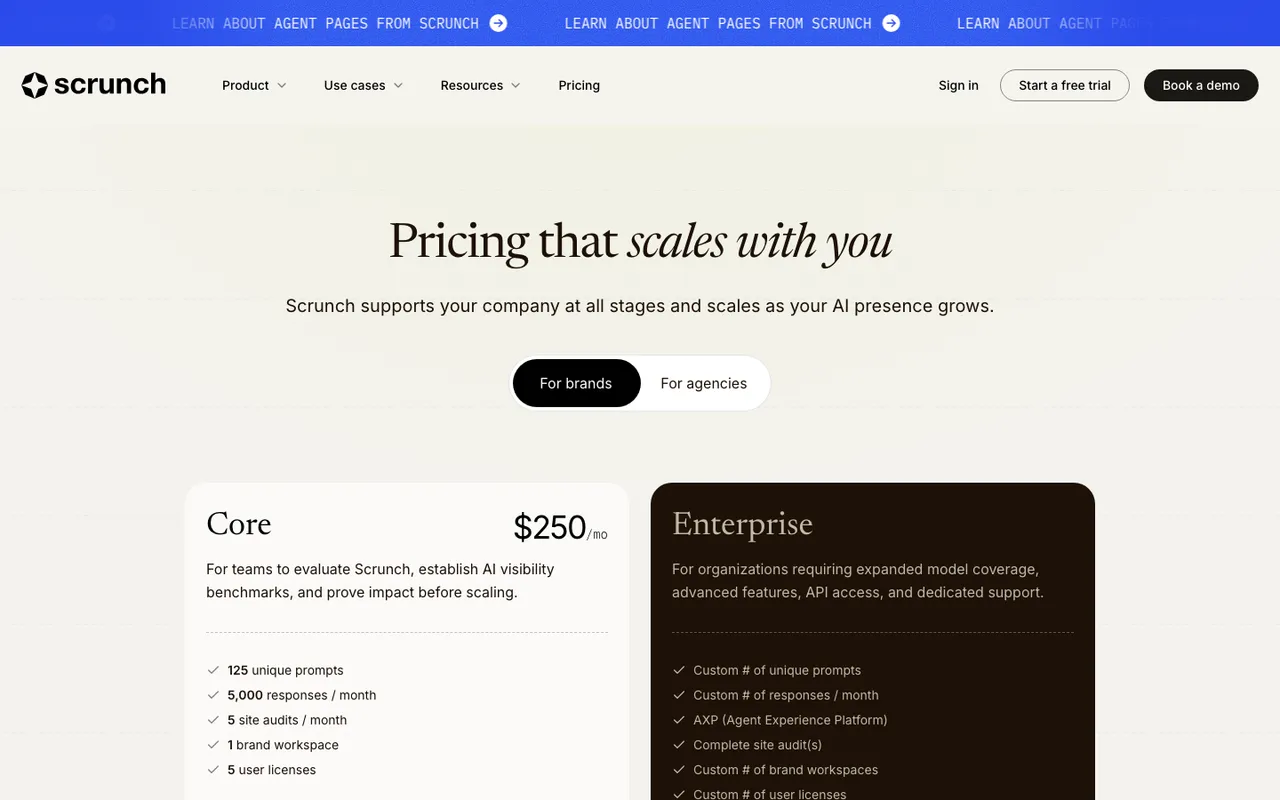 Scrunch's pricing page, captured November 6, 2026.
Its pricing FAQ asks "Can I track multiple brands on one plan?" but the answer wasn't in the captured text, so ask sales. Best for: portfolios moving straight to Enterprise that also want AXP.
4. Brandlight
Brandlight is built for large enterprises and sells the portfolio view directly. Our catalog describes a multi-brand, multi-region command center with SOC 2 Type II, SSO and role-based access. The homepage pitches one platform for the whole organization, with priorities split by team (AEO, web, content, e-commerce, PR, paid, social and leadership) and a dedicated strategist.
 Brandlight's homepage, captured November 6, 2026.
There is no public pricing or plan list, so we can't say what a portfolio costs. Best for: Fortune 500 groups that want a managed program across brands.
5. Profound
Profound offers unlimited seats on both its trial and Enterprise, "Projects" as shared spaces for teams, unlimited domains in Agent Analytics, and custom languages and regions on Enterprise. The homepage lists RBAC, SCIM and SOC 2, and a Command Center that shows how agents are used across the marketing team.
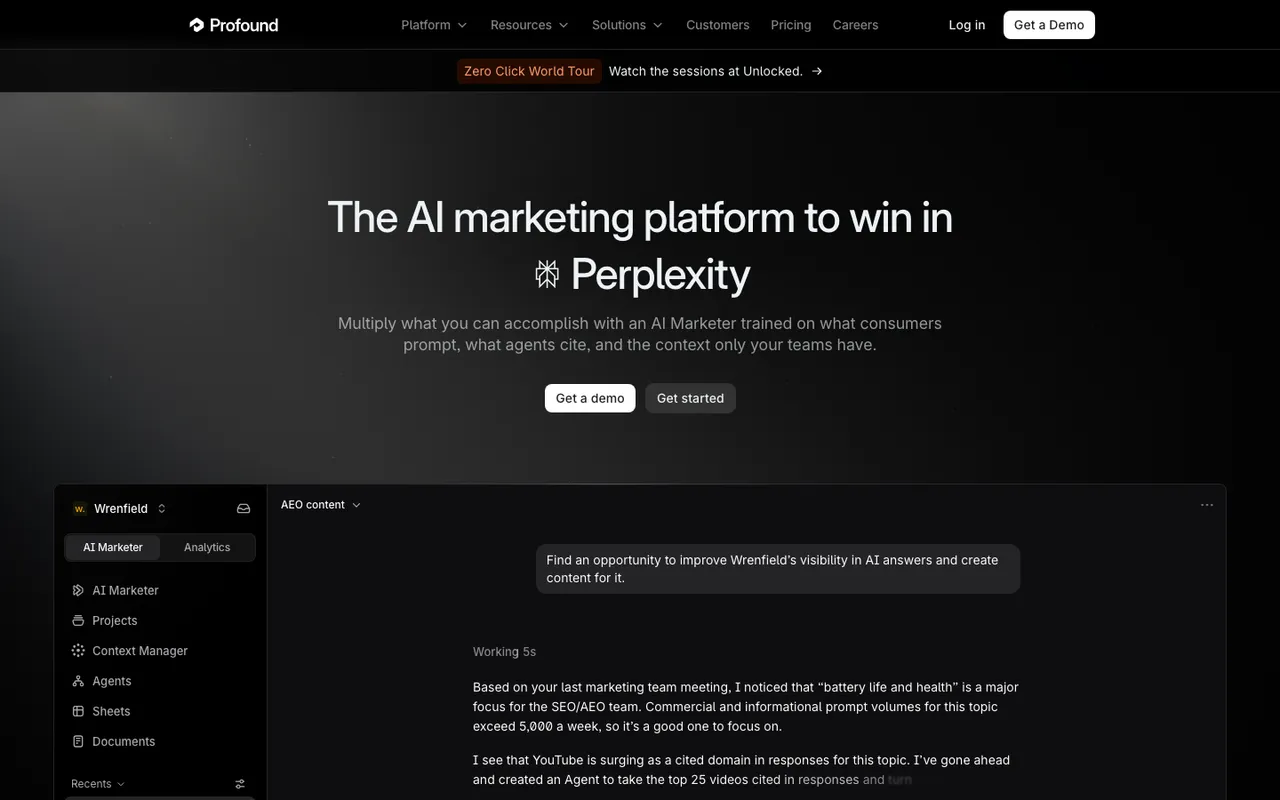 Profound's homepage, captured November 6, 2026.
The pages don't say how brands map to projects or plans, and Enterprise is the only paid option; our catalog puts it around $40k a year. Best for: enterprise marketing orgs buying agents for many teams.
6. Conductor
Conductor counts websites: 3 on Essentials, 5 on Growth, 10 or more on Enterprise. SSO starts on Growth, and role-based "Enterprise Permissions" are Enterprise only. The pricing page says pricing is built around value "not the seats you buy", and Growth adds Adobe Analytics.
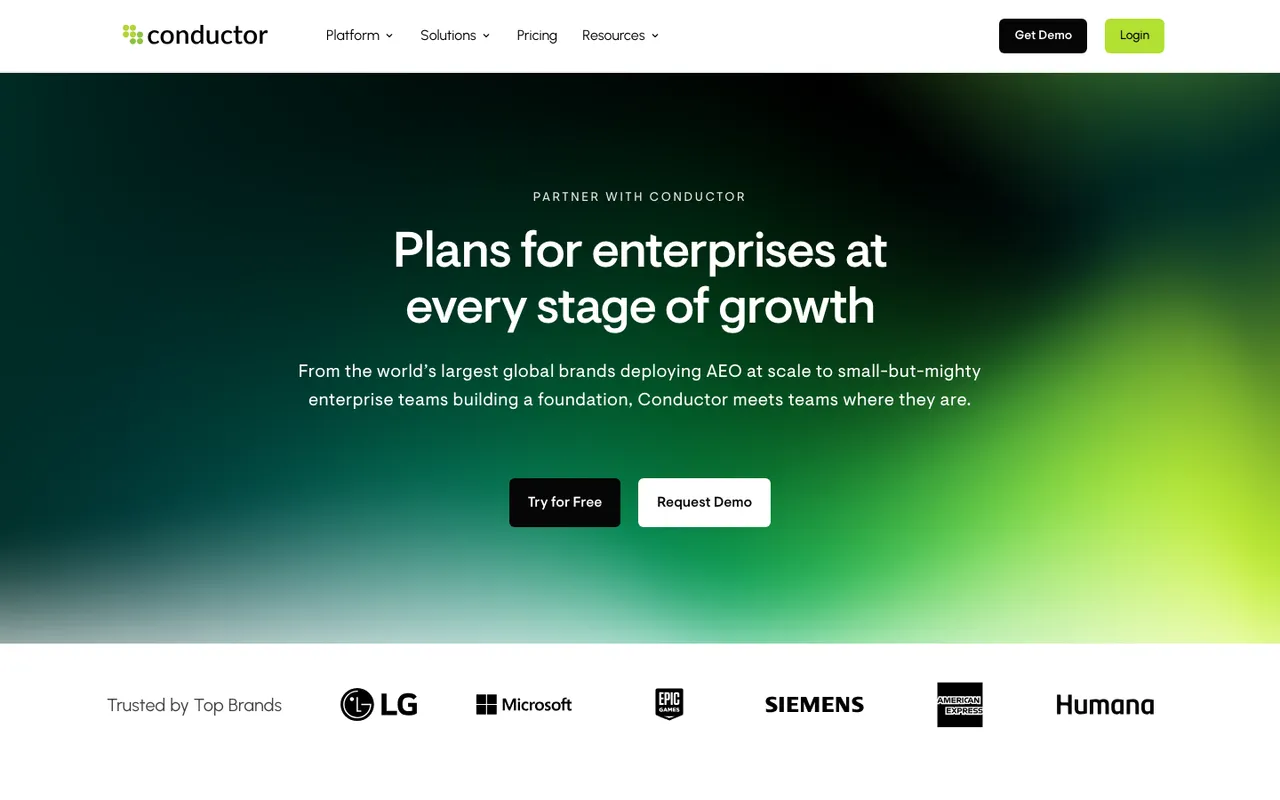 Conductor's pricing page, captured November 6, 2026.
The AI search layer runs on 2,500 AI Search Credits a year on Essentials and Growth, and prices aren't published. Best for: groups that already run enterprise SEO in Conductor and want AI data in the same governance model.
7. Evertune
Evertune measures AI brand perception like market research: it samples each prompt up to 100 times per model across 11 models and builds prompt sets from a panel of more than 150 million user prompts. The homepage says it is trusted by more than 700 advertisers and agencies, and it now extends into ChatGPT ads.
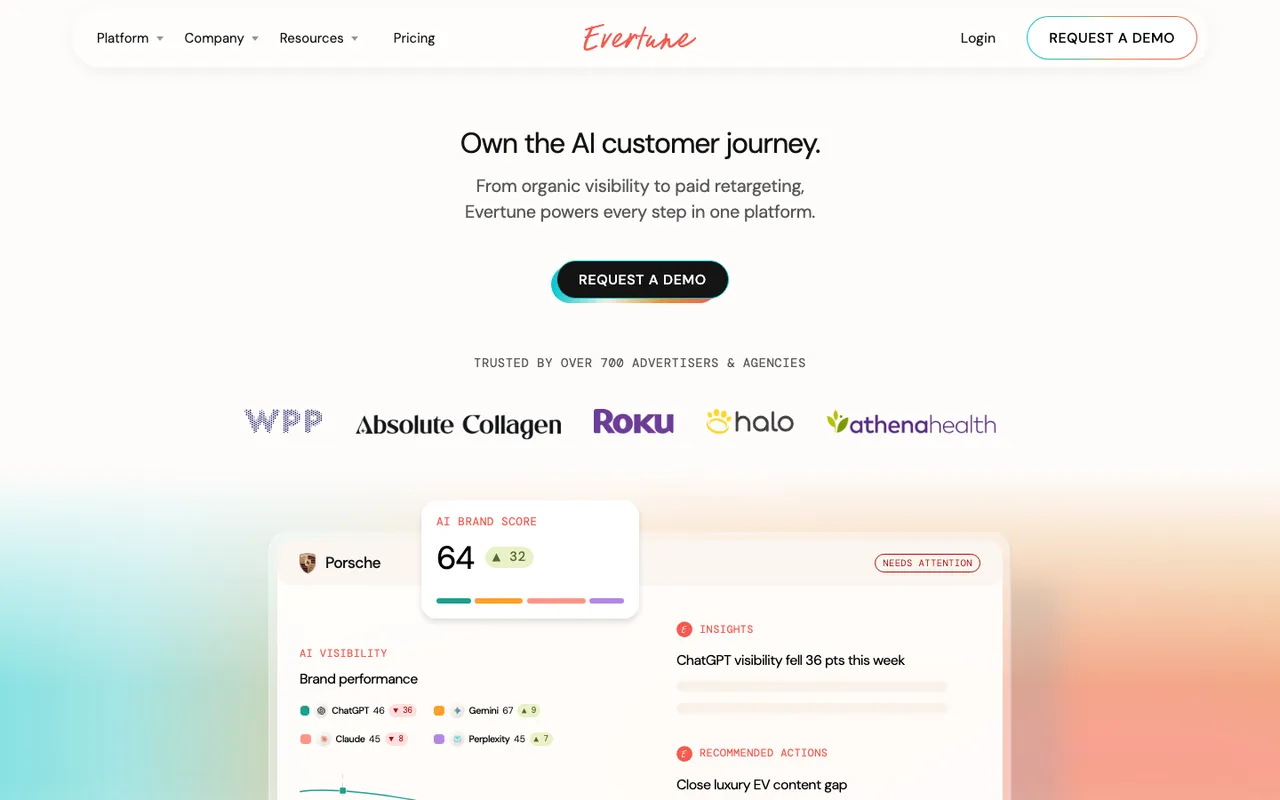 Evertune's homepage, captured November 6, 2026.
We found nothing in the reviewed pages about workspaces, seats or permissions across brands, and pricing isn't published. Best for: insights teams that need statistically sampled perception data per brand and will scope the portfolio setup with sales.
Who should pick which
- Up to five brands, published pricing, unlimited seats: Promptwatch Business; more brands on Enterprise.
- Enterprise portfolio with action workflows per brand: AthenaHQ Enterprise.
- Enterprise portfolio that also wants agent-side page delivery: Scrunch AI Enterprise.
- A managed program across a Fortune 500 house of brands: Brandlight.
- Agents for many marketing teams at once: Profound.
- AI data inside an existing enterprise SEO setup: Conductor.
- Perception research per brand: Evertune.
If your portfolio is really a client list, our guide to the best tool to track AI visibility for multiple clients covers agency plans.
Our pick for multi-brand companies
The cost of a multi-brand setup is rarely the tracking itself. It is seats, permissions and the arguments about whose numbers are right. Tools that price per seat or keep roles and audit logs on a sales-only tier make every new brand a procurement event.
Promptwatch avoids most of that. Seats are unlimited on every plan, roles are set per project, each brand can carry its own aliases and Brand Book rules, custom dashboards roll the portfolio up, and the Business plan adds an audit log that shows who changed what and from where. If you run more than five brands or need SSO, that's an Enterprise conversation: book a Promptwatch demo and bring your brand list.
FAQ
How should I structure several brands in a GEO tool?
Give each brand its own project or workspace, with its own prompts, competitors and markets. Use a shared dashboard for the portfolio view rather than mixing brands in one project, so mentions and share of voice stay clean.
Do seats matter for multi-brand companies?
Yes, more than for single brands. Every brand adds managers, agencies and regional leads. Promptwatch, AthenaHQ and Profound list unlimited seats; Scrunch Core includes 5 licenses.
Which tools include an audit log?
Promptwatch from Business, AthenaHQ on Enterprise. Conductor lists RBAC on Enterprise; the others we reviewed don't document an audit log on their plan pages.
What does a sixth brand cost on Promptwatch?
Business covers five projects. Beyond that, Promptwatch Enterprise is custom-priced.