Which sites ChatGPT cites for healthcare prompts, and the tools that track it
NIH, the FDA and the NHS lead ChatGPT's healthcare citations in Promptwatch's October 2026 report. What that means for health brands, and which tools show your own sources.
When ChatGPT answers a health question with web search on, it reaches for the National Institutes of Health first. In Promptwatch's healthcare citation report, which covers organic ChatGPT prompts from September 9 to October 8, 2026, NIH earned 5.46% of all healthcare citations across six nih.gov subdomains. The FDA came second at 1.76% and the NHS third at 1.1%. The page adds that NIH alone earns more than the FDA, the NHS, CMS, and SAMHSA combined.
That is a 30-day window, longer than the 7-day windows Promptwatch used for its software and travel reports in the same month, and it only counts organic prompts: questions people ask without naming a brand. This post is about where those citations go, what that tells a health brand, and which tools can show you the same picture for your own prompts. It is not medical advice, and nothing here says what any health content should claim.
The ranking, from research databases down
Most of NIH's share comes from two research databases. In the September 9 to October 8, 2026 window of the healthcare report, PubMed Central had 2.38% and PubMed 2.33%. In plain terms, when ChatGPT backs up a health answer it often points to the paper rather than to a write-up of the paper.
Below the government sources, the report names the American Society of Plastic Surgeons as the top non-government site at 0.64%, with the American Academy of Dermatology at 0.54%. Together those two specialty associations hold 1.18%, which the page notes is more than Mayo Clinic (0.49%) and Cleveland Clinic (0.4%) combined. Those two are the only hospitals in the chart. All 20 charted domains together account for 15.54% of healthcare citations, so even in a category this concentrated, most citations go to pages outside the top 20. Those figures are all from the same October report and the same September 9 to October 8 window.
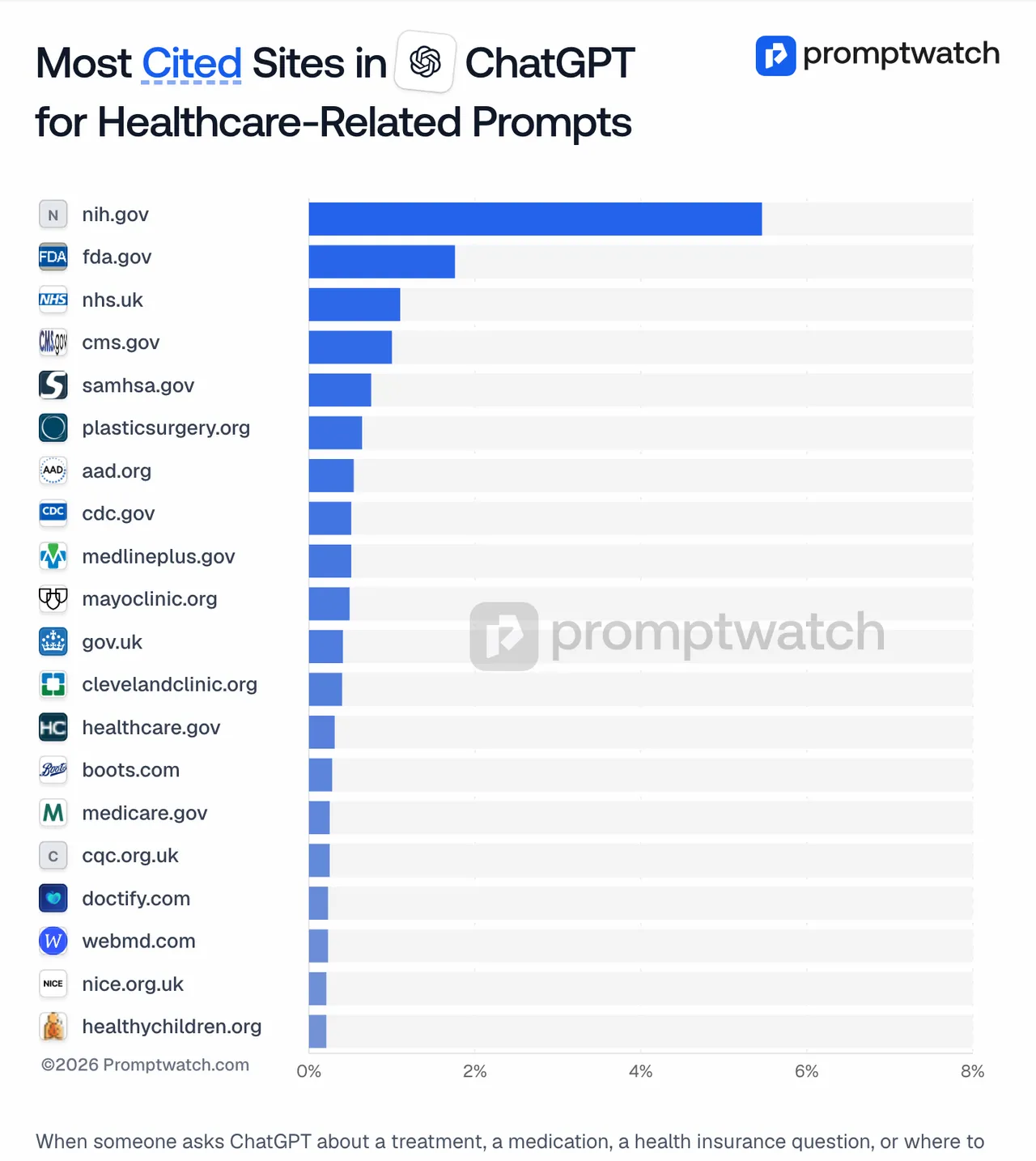 Promptwatch's "Most Cited Sites in ChatGPT for Healthcare-Related Prompts" chart (September 9 to October 8, 2026), captured November 14, 2026.
The source-type split
The second chart in the report groups citations by kind of source, still as a share of all healthcare citations, not just the top 20. In the September 9 to October 8, 2026 window of the healthcare report, government and public health sites (the page names FDA, CDC, NHS, and NICE) earned 7.06%. NIH and its research databases added 5.46%. Medical associations had 1.39%, hospitals and clinics 0.89%, and reviews and directories 0.46%. Doctify and WebMD, at 0.23% each, are the only review and directory sites in the chart. Boots, the only pharmacy, had 0.28%.
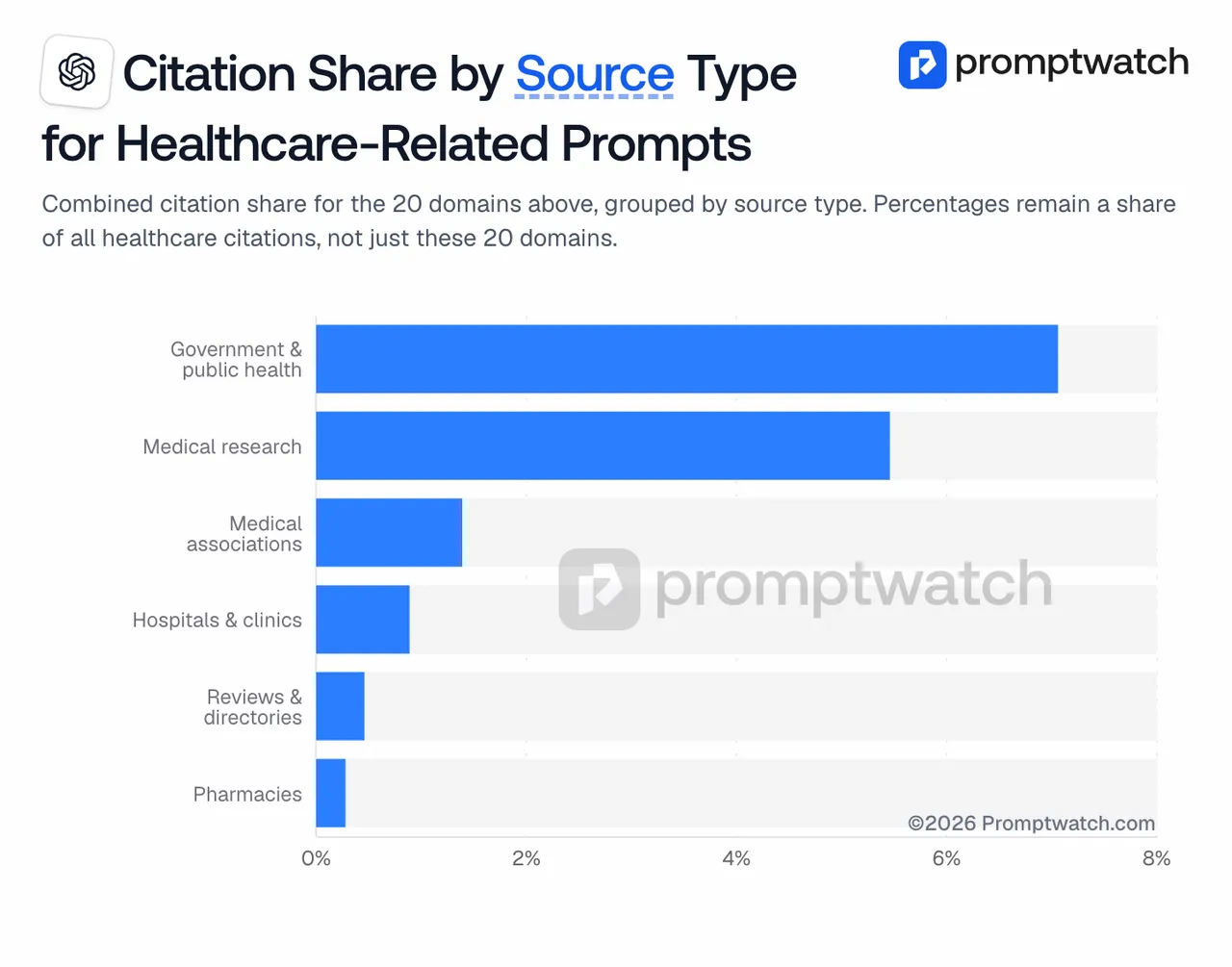 Promptwatch's "Citation Share by Source Type" chart from the October 2026 healthcare report, captured November 14, 2026.
The page's own heading sums it up: government and public health sites earn almost half of the citations shown. Add NIH and the research databases, and public bodies account for most of the charted share.
Why government and research sources win
The report doesn't say why ChatGPT picks these sources, so what follows is our read, not a finding.
The simplest explanation is that health questions are where an answer engine has the most to lose from a wrong source. A regulator's page or a peer-reviewed paper is easy to defend. A brand's product page about its own supplement is not. Government and research pages also tend to be plain, stable, and densely factual, which makes them easy to quote in a sentence or two.
A second likely factor is coverage. NIH databases index an enormous number of studies, so for almost any condition or treatment there is a PubMed page that matches the question. Few commercial sites have that breadth.
Whatever the cause, the practical effect is the same. On organic health prompts, a health brand's own site is competing for a small slice of citations that government, research, and specialty associations don't already hold.
What this means for health brands
None of this means a health brand can't be cited. It means the route usually runs through the sources ChatGPT already trusts, and through pages on your own site that agree with them. Here is what we'd take from the data, phrased as positioning, not medical guidance.
Agree with the authorities, and say so. If your content on a condition contradicts FDA, CDC, NHS, or NICE guidance, it competes with sources holding 7.06% of citations in this report. Pages that reference that guidance and link to it at least sit in the same conversation.
Reference the research directly. PubMed and PubMed Central carry most of NIH's 5.46%. Where your content summarizes a study, link the study. It helps readers check you, and it puts your page next to the source ChatGPT already uses.
Work with your specialty association. The two associations in the chart, plastic surgery and dermatology, out-cite the two hospitals combined. If your category has an association that publishes patient information, being listed, quoted, or referenced there is likely worth more than another blog post.
Keep directory profiles accurate. Doctify and WebMD appear at 0.23% each. Small, but they are the only review sites that show up at all, and an outdated profile is a cheap thing to fix.
Those percentages all come from Promptwatch's healthcare report for September 9 to October 8, 2026, and they describe aggregate behavior across many healthcare prompts. Your sub-category may look different: a telehealth service, a cosmetic clinic, and a medical device maker will each see their own mix.
How to see which pages ChatGPT cites for your health prompts
The useful version of this report is the one built from your prompts. The workflow is short.
Write the questions your patients or customers actually ask, without naming your brand, and track them as a monitor. Promptwatch runs monitors daily across the engines you choose, including ChatGPT through its real interface. Prompt Volumes adds monthly volumes and difficulty scores, which helps you decide which questions deserve a place in the set.
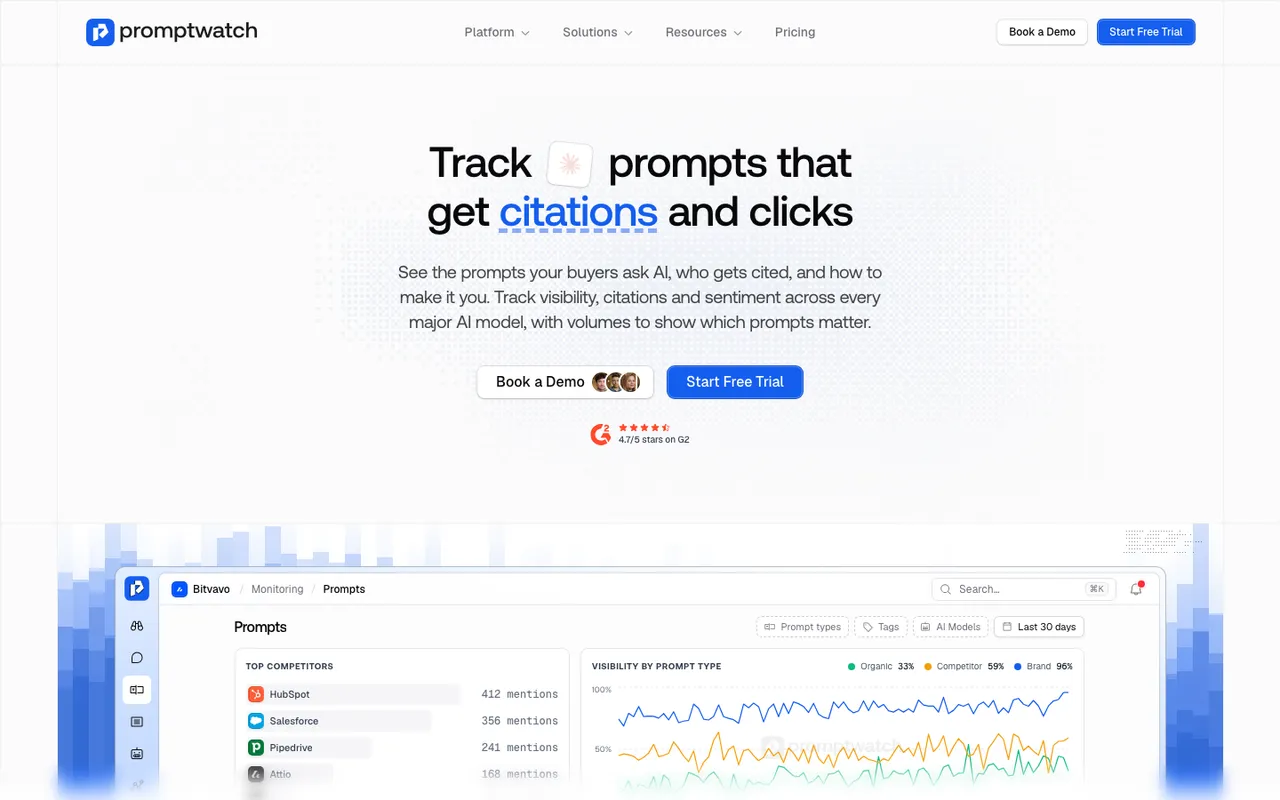 Promptwatch's prompt tracking page, captured November 8, 2026. Example figures on the page are illustrations.
Then look at the sources. Citation analytics list every URL an answer cited, with competitor domains highlighted. Citation Trends classifies each citation into 22 content types and 20 source types, including a Directory type for listing and review sites, so you can check whether your prompts look like the report (government and research first) or not. Self-citation rate tells you how often answers cite your own domain rather than third-party pages.
Health brands have one more reason to look closely: accuracy. Brand Narrative, on every brand plan, pulls the individual claims AI makes about you out of tracked responses and groups them by theme. Fact Check, on Business ($579 a month), Agency Scale, and Enterprise, checks those claims against your own site and the 50 most-cited offsite pages for each claim, and returns one verdict. For a health brand, a wrong claim in an AI answer is a reputation problem worth catching early.
Our AI visibility tools for healthcare brands post covers compliance questions and a broader shortlist. On compliance, Promptwatch states ISO/IEC 27001 certification and GDPR compliance; check anything beyond that with the vendor.
Tools that show which pages AI cites for health prompts, ranked
We ranked on one question first: can the tool show which URLs and source types an engine cited for a prompt, not just whether your brand was named?
- Promptwatch. URL-level citation analytics, Citation Trends by content and source type, Page Tracker for specific pages (useful for tracking a PubMed article or an association page that cites you), Brand Narrative on every plan, and Fact Check from Business. Essential starts at $95 a month.
- AthenaHQ. Tracks brand appearance across many models and turns gaps into tasks in an Action Center. Starter is $295 a month for 3,600 credits. Our entry does not document citation analytics at URL or source-type depth.
- Scrunch AI. Core is $250 a month for four LLMs, including ChatGPT, with site audits and sentiment. Citation breakdowns at Promptwatch's depth are not documented in our entry.
- Profound. Enterprise-priced (custom; an earlier estimate put it near $40k a year) and sold as marketing agents more than as a dedicated AI-search tracker. Citation share and answer-level analytics are listed.
- Ahrefs Brand Radar. Good for a first look if you already pay for Ahrefs, since Custom Prompts come with paid plans. Prompts in its index are modeled from keyword data rather than real patient questions.
If you want a quick baseline before committing, start with Promptwatch's free AI Visibility Report, which scans ChatGPT, Gemini, and Perplexity for your site without a login. When you're ready to track your own health prompts and their sources daily, that's the job for a monitor.