Best AI blog writer for getting cited in ChatGPT and AI Overviews: the 2026 ranking
We ranked nine AI blog writers on one test: does the tool know which prompts you lose, publish against them, and show whether ChatGPT or AI Overviews cite the result?
Most AI writers can produce a clean 1,500-word article in a minute. That part is solved. What separates them for AI search is everything around the draft: where the topic came from, whether the page actually goes live, and whether anyone checks if ChatGPT or Google AI Overviews started citing it.
So this ranking does not score prose quality. It weighs three questions, heaviest first:
- Does the writer start from AI search data (prompts you lose, pages engines cite, gaps against competitors), or from a keyword you typed?
- Can it publish to your CMS on a schedule, with a review step?
- After publishing, can the same tool show crawls, citations, and AI-referred visits for that page?
A writer that passes the first two and fails the third leaves you guessing. Several popular tools land exactly there.
What nobody can sell you
Google's Search Central page "AI features and your website" says there are no extra requirements and no special optimizations needed to appear in AI Overviews or AI Mode. A page has to be indexed and eligible to show in Search with a snippet. Google also says you don't need new machine-readable files or special schema.org markup. OpenAI's help article "Searching the web with ChatGPT" says ChatGPT ranks results using multiple factors and that placement is not guaranteed; the eligibility step it names is letting OAI-SearchBot crawl your site.
No writer on this list can change those rules. The useful ones aim your content at the right prompts and then measure what happened.
The ranking
1. Promptwatch
Promptwatch is the only tool here where the writer sits inside a full AI visibility platform. Its Content Agent plans, writes, and publishes against visibility gaps on a schedule, with a publishing calendar, a monthly budget, and either a review inbox or fully automated mode. On-demand Content Creation can write about any tracked prompt, a query fanout, or a page that engines already cite. The brief pulls in your branding, Google results, news, internal links, YouTube transcripts, live page screenshots, and up to five competitor URLs.
Publishing goes to WordPress, Webflow, or Framer, and publish status tracking follows each piece from draft to live URL, then through AI crawls, citations, and AI traffic. That third test, proof, is where it pulls clear of everyone else.
Pricing: Essential is $95/mo but has no AEO articles. Professional ($245/mo) includes 5 AEO articles and the Knowledge Base. The automated Content Agent starts on Business ($579/mo). There's a 7-day free trial on monthly billing.
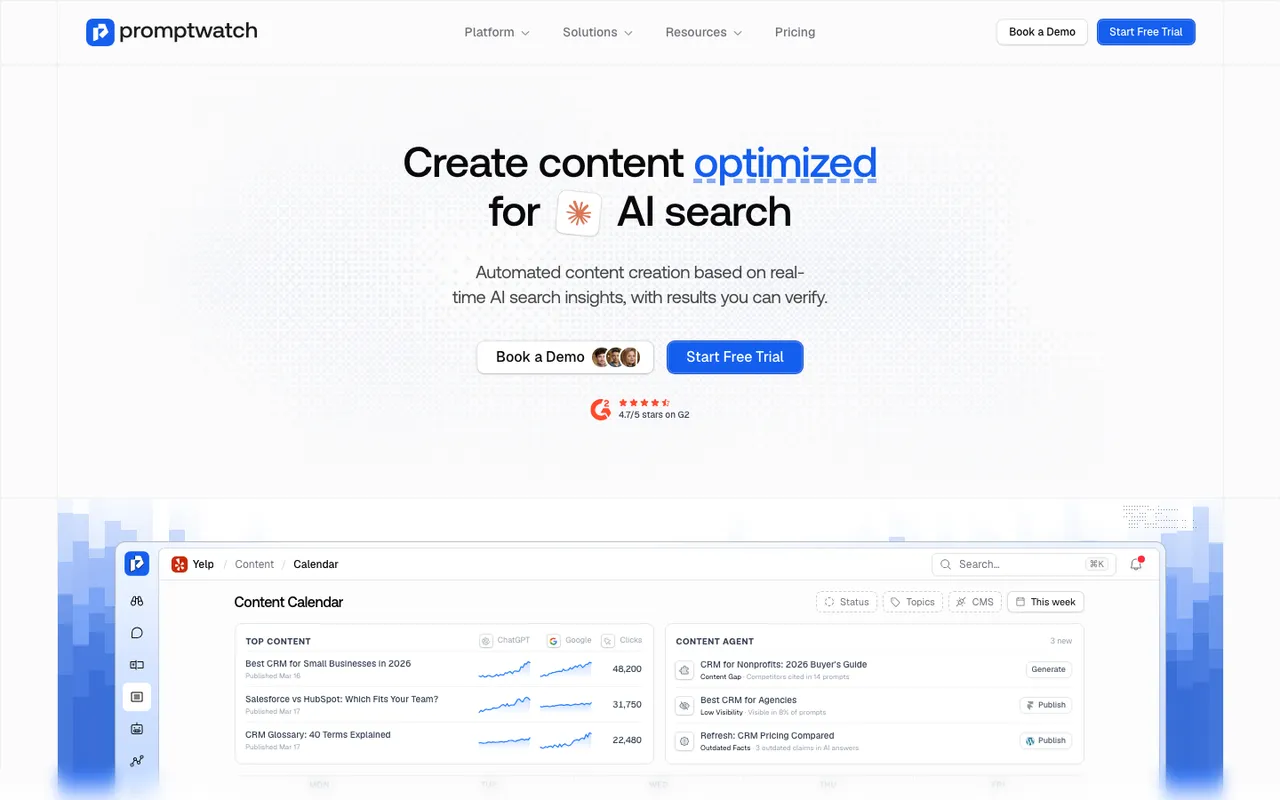
Promptwatch's Content Agents feature page, captured November 8, 2026.
2. AthenaHQ
AthenaHQ tracks brand appearances in AI answers, rolls them into a GEO score, and turns gaps into actions through its Action Center and a content optimization agent. Starter is $295/mo with 3,600 credits; a free Essential tier comes with 300 credits. On November 16, 2026 Bloomreach announced it had acquired AthenaHQ, and standalone pricing after the early 2027 joint launches has not been stated. Our catalog lists no crawler-log product for it, so proof stops at the answer level.
3. Frase
Frase now calls itself a content operating system for AI search: it researches, drafts, scores, audits, and publishes to WordPress, Webflow, Sanity, or Wix, with AI Visibility tracking built in. Starter is $39/mo billed yearly ($49 monthly) with 10 articles and 20 AI Visibility prompts. Good input and output for the price. Proof is limited to its prompt tracking.
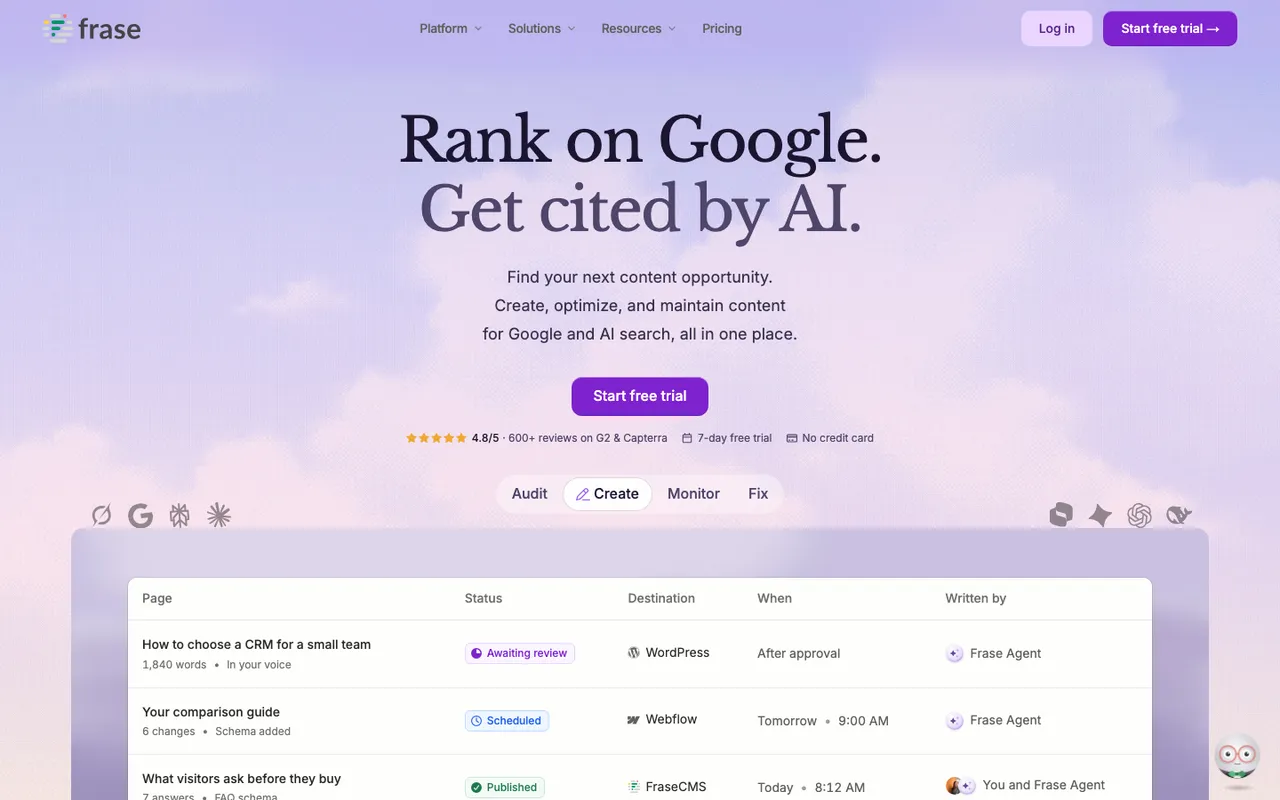
Frase homepage, captured November 6, 2026.
4. Writesonic GEO
Writesonic GEO pairs an AI article writer with tracking across ChatGPT, Gemini, and Google AI Overviews on self-serve plans. Starter is $79/mo billed annually for 50 prompts and 15 articles. Its Action Center, the part that turns tracking into tasks, is listed as Enterprise only.
5. Surfer
Surfer built its name on on-page optimization scores and has added an AI Tracker, a topical map, and a content audit. Discovery is $49/mo; Standard is $99/mo billed yearly with 25 AI prompts refreshed weekly. A separate AI Search Analytics plan tracks 50 prompts daily for $82/mo billed yearly. Strong editor, thin proof.
6. Clearscope
Clearscope grades drafts against search intent and recommends terms and questions. It also tracks queries on ChatGPT and Gemini and shows the web searches AI platforms trigger. Essentials is $129/mo. It's an editor-first tool: helpful while drafting, but it doesn't publish or report AI traffic.
7. Jasper
Jasper is strongest on Brand Voice and on keeping a team on tone. Pro is $69 per seat monthly or $59 on yearly billing. Its GEO layer lives on the custom-priced Business plan, so the self-serve seat is a drafting tool, not a citation tool.
8. AirOps
AirOps is a workflow builder for content operations, with brand kits, knowledge bases, and CMS integrations. Its pricing page shows Solo, Pro, and Enterprise without dollar figures. It suits teams that want to design their own pipelines and have the people to maintain them.
9. Profound
Profound now sells itself as an AI Marketer with agents for research, content, and reporting. The public plan is a custom Enterprise contract (an earlier estimate put it around $40k a year). Too expensive to buy as a blog writer alone.
How to read this list
If you already own a tracker and only need drafts, Frase or Surfer at the low end will do. If you want one tool that picks the topic, writes, publishes, and then shows whether ChatGPT cited the page, the field narrows to Promptwatch. Start the 7-day free trial on Professional or Business and point the writer at three prompts you currently lose. Then watch the publish status move from draft to crawled to cited.