Best tool to track AI visibility by topic cluster: seven trackers ranked
We ranked seven AI visibility trackers on one job: grouping prompts into topic clusters and showing share of voice, citations and position for each cluster.
A blended visibility number is the least useful figure an AI tracker can show you. If ChatGPT names your brand for every pricing question and never for integration questions, the average hides both facts. Tracking by topic cluster fixes that: you group prompts by theme, then read share of voice, citations and position per group.
Most trackers on our list can store prompts. Far fewer can group them, score each group on its own, and put competitors in the same view. That is what this ranking measures.
How we ranked them
We scored each tool on five things, in this order of weight:
- Topic grouping as a first-class object. Can you create a cluster, assign prompts to it, and filter every chart by it?
- Per-topic metrics. Visibility, share of voice, position and, ideally, a citation figure for each cluster.
- Competitor comparison inside a topic. Who beats you on "onboarding" questions is a different answer from who beats you overall.
- Prompt headroom for the price. Clusters need several prompts each to mean anything, so the prompt allowance matters more here than in a single-list setup.
- What happens after the number. Citations, crawler data and content tools that let you fix a weak cluster.
Pricing below comes from our catalog entries and vendor pages. Where our entry flags a figure as unconfirmed, we say so.
The ranking
1. Promptwatch
Promptwatch treats topics as a reporting unit, not a tag you export and pivot later. Since October 26, 2026, Topics has its own page under Trends. Each topic and each prompt inside it shows Visibility, Citation Share, Avg. Position, Share of Voice and Sentiment for whatever date range you pick. Citation Share is the most telling of the five for this job: your own sites' citations divided by every citation in that topic's answers. A low figure tells you the engines answer questions in that cluster from somebody else's pages.
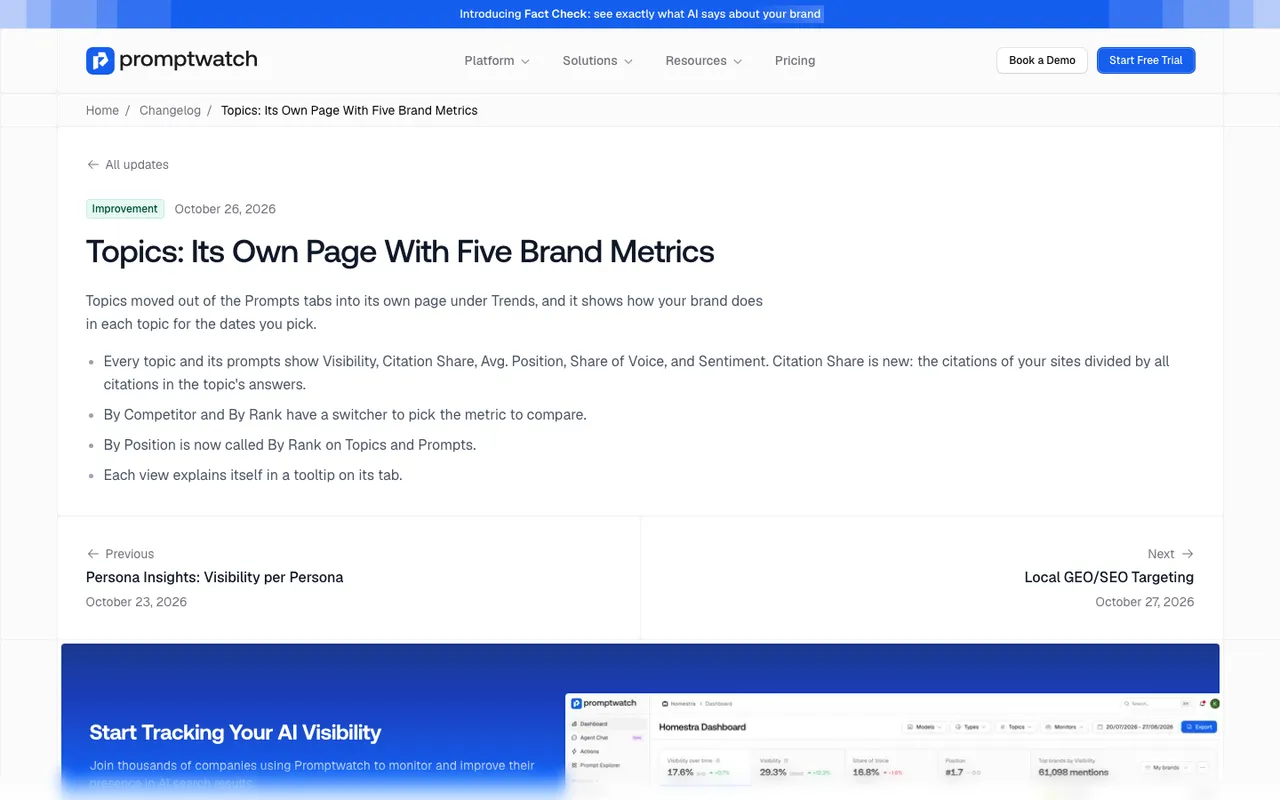
Promptwatch changelog, "Topics: Its Own Page With Five Brand Metrics", captured November 14, 2026.
Two views do the competitor work. By Competitor lays topics against brands, and By Rank ranks brands per topic, each with a switcher for the metric. A Manage tab added on November 13 lets you build a cluster in one screen: name it, give it a color, tick its prompts, filter by monitor. A Suggested tab proposes prompts that share words with the topic and shows which words matched. The heatmap can also put topics on one axis against models, countries or personas.
The reason it ranks first is the rest of the loop. Citation analytics, crawler logs (from Professional), visitor analytics and Topic Insights, which flags where your pages underdeliver for their topic, all sit in the same workspace. Plans start at $95/mo for Essential with 50 prompts. Professional is $245 with 150 prompts and Business is $579 with 350. Agency plans from $199/mo include unlimited prompts.
2. AthenaHQ
AthenaHQ lists "Unlimited Topics and Prompts" on its $295/mo Starter plan, alongside 11 models and unlimited competitors. The catch is the meter: Starter includes 3,600 credits, and one credit equals one AI response, so a large cluster set burns credits quickly. Our catalog entry also notes Starter is country-level only, with persona targeting and multi-region support on Enterprise.
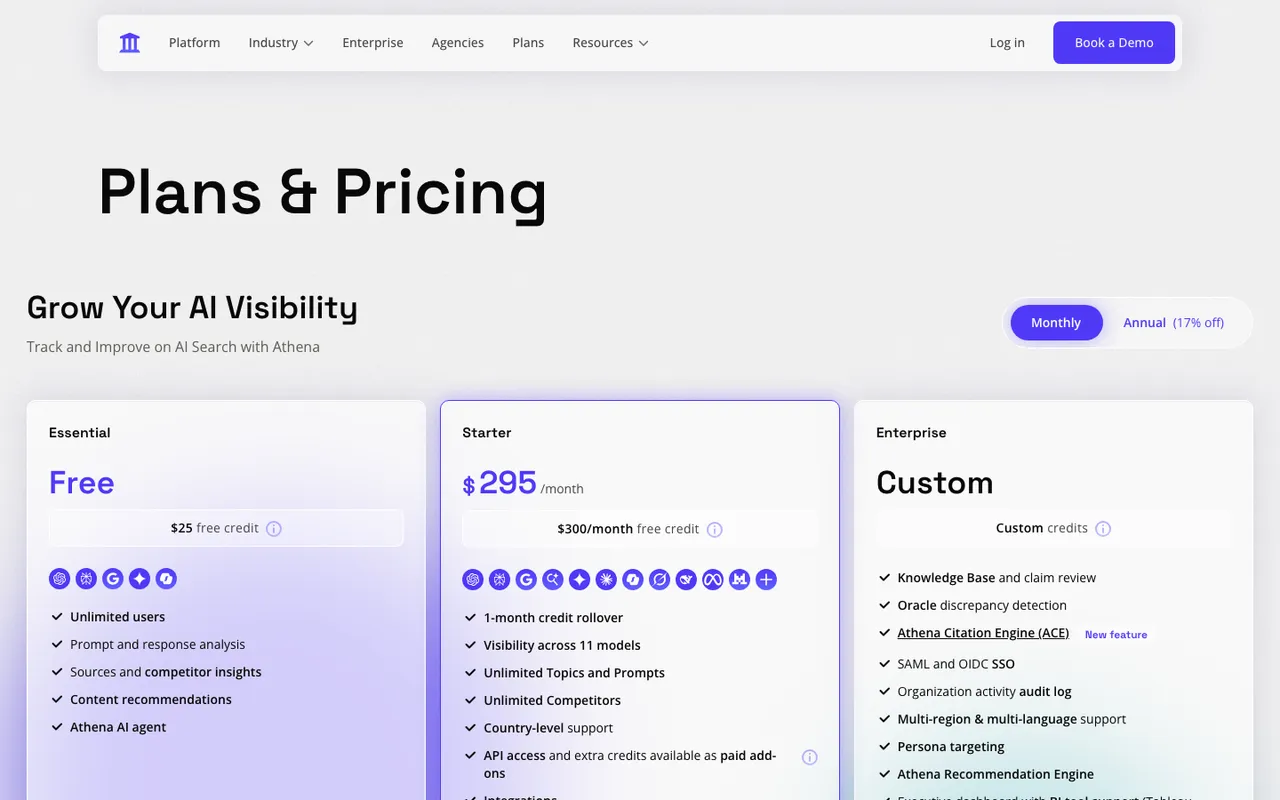
AthenaHQ "Plans & Pricing" page, captured November 6, 2026.
Bloomreach announced it acquired AthenaHQ on November 16, 2026. Standalone pricing after the joint launches planned for early 2027 is not stated. AthenaHQ has no published crawler-log product.
3. Scrunch AI
Scrunch AI Core costs $250/mo for 125 unique prompts, 5,000 responses and four LLMs. Our entry does not document topic grouping as a reporting layer, and it records weekly data refreshes as a common complaint. Its Agent Experience Platform, which serves AI-optimized pages to crawlers, is Enterprise-only.
4. Profound
Profound sells enterprise marketing agents with citation share and answer-level analytics alongside. The public page lists a 7-day trial (50 prompts daily, three engines) and a custom Enterprise plan; our entry carries an earlier estimate of about $40k a year. Strong data, but you are buying a broader agent program to get topic-level reporting.
5. Ahrefs Brand Radar
Ahrefs Brand Radar approaches clusters from the category side. Its AI Visibility Index, from $199/mo, is a pre-collected set of 496M+ prompts modeled from Ahrefs keyword data. That is useful for sizing a topic. For tracking your own cluster prompts, Custom Prompts comes with paid Ahrefs plans at a daily quota of 5, 10 or 20 prompts depending on tier, which is thin for several clusters.
6. Semrush AI Toolkit
Semrush AI Toolkit offers competitor share comparisons and keyword-to-prompt mapping next to Semrush's SEO data. Our entry lists $99/mo per domain with 25 prompts, but flags that pricing as unconfirmed against the vendor on October 24, 2026. Twenty-five prompts covers one or two small clusters at most.
7. Writesonic GEO
Writesonic GEO has a Topic Explorer in its GEO module. Self-serve plans track three engines (ChatGPT, Gemini, Google AI Overviews) and start at $79/mo billed annually for 50 prompts. It is a content tool first, so treat the tracking as a signal next to the writer.
Also considered
Otterly.AI (from $29/mo for 15 prompts) and Peec AI both track prompts with share of voice, but neither of our entries documents topic-level reporting. They sit at the bottom for this job.
One free signal worth adding
Bing Webmaster Tools' AI Performance report added Topics and Citation Share in a June 16, 2026 preview, and a Topics Portfolio beta followed on October 13. It covers Microsoft Copilot and Bing's AI summaries only, and Microsoft says its Citation Share does not expose competitor domains. Good as a cross-check, not as your tracker.
Our pick
For topic-cluster tracking with competitors in the frame, Promptwatch is the tool to trial first. Set up three or four clusters on the 7-day free trial and check whether the Topics page agrees with what your team already suspects about where you're weak.