Best AEO tools for SaaS companies (2026)
AEO tools ranked for SaaS: tracking comparison and alternatives prompts, review-site and docs citations, coding agent visibility, and trial signups from AI traffic.
Software buyers use AI assistants the way they used to use review sites: they ask for a shortlist, then ask for a comparison. "Best help desk software for a 20-person team." "Intercom vs Zendesk." "Alternatives to Jira for agencies." Each answer names a short list of products and cites a few pages. If yours isn't one of them, you're not on the shortlist.
SaaS AEO therefore has a narrower job than general brand monitoring. You need to know which comparison prompts you lose and which review profiles, docs pages and vendor pages the engines cite instead. Whether the AI traffic you do get turns into trials and demos matters most of all. This ranking scores tools on those jobs.
What ChatGPT cites for software questions
Promptwatch's software citation report looked at organic software prompts in ChatGPT from September 28 to October 4, 2026. GitHub was the most cited domain at 1.2% of all software citations. learn.microsoft.com came next at 0.98%, and G2, the most cited review site, had 0.73%. Capterra had 0.32%.
The source-type split is more useful for planning. Documentation and help centers earned 2.64% of software citations, vendor sites 2.01%, and review sites and analysts together 1.57%. Your own docs and product pages, in other words, are the largest single lever, and review profiles still count.
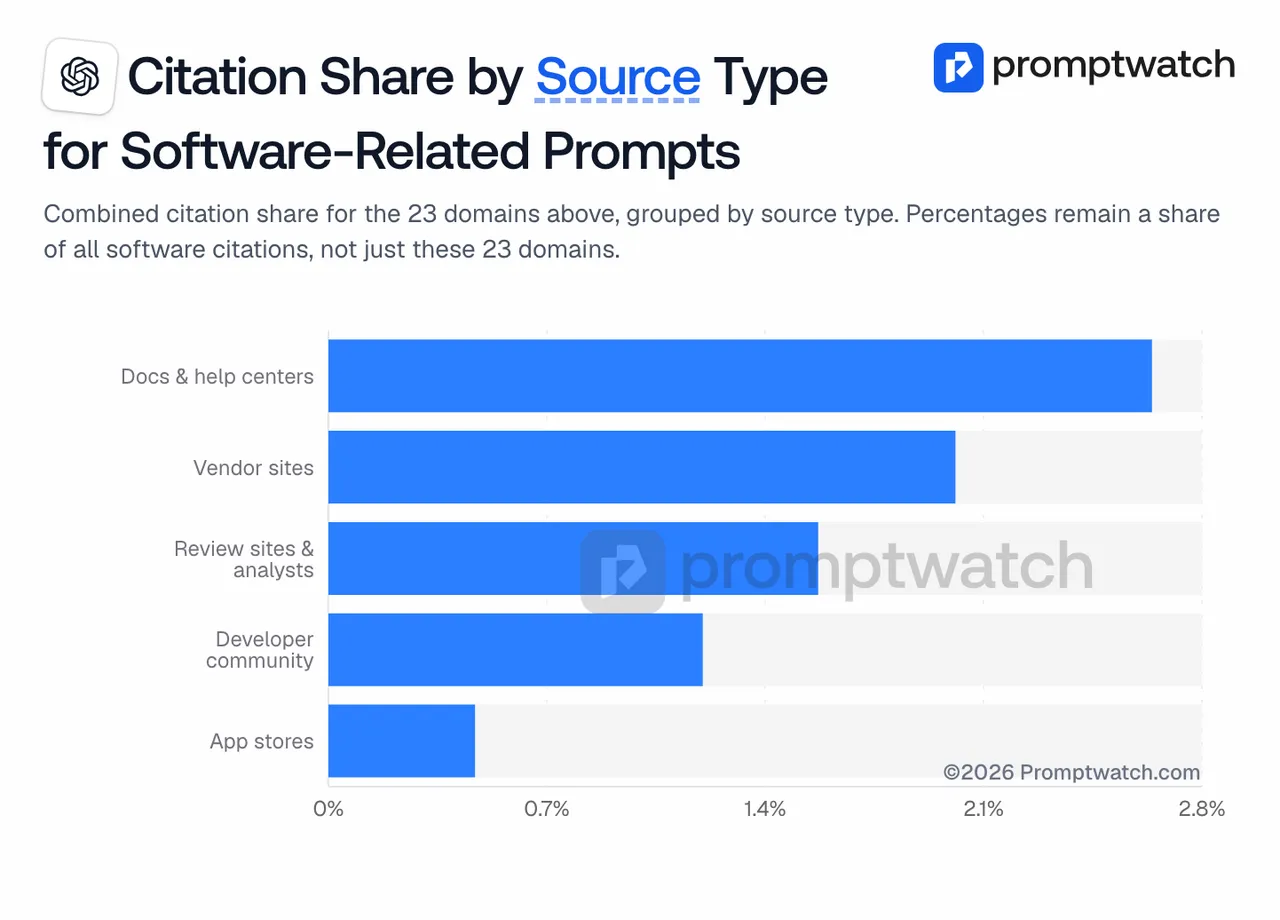 Promptwatch's "Citation Share by Source Type" chart from the October 2026 software report (September 28 to October 4, 2026), captured November 14, 2026.
The shares look small because each domain's slice is measured against every software citation in the window. A 0.73% share for one review site is a lot of answers.
What a SaaS AEO tool has to do
Separate prompt types. Category prompts ("best X for Y"), comparison prompts ("X vs Y") and branded prompts behave differently. You want them tagged and reported apart, or a strong branded score will hide a weak comparison score.
Show which review and directory pages get cited. If G2 or Capterra pages are cited for your category and your profile is thin, that's a fix you can make this week.
Track the docs. Help centers are where AI goes for "does X integrate with Y" and "how do I do Z in X". You need page-level citation data for your docs subdomain.
Cover coding agents, if developers buy you. Codex and Claude Code recommend libraries, APIs and tools to developers inside their terminal. For an API or developer-tool company, that recommendation is a new top of funnel.
Attribute signups. A SaaS team will be asked whether AI traffic converts. You need AI-referred visits joined to trial starts or demo requests.
The ranking
1. Promptwatch
Verdict: the only tool here that covers all five SaaS jobs, coding agents included.
Promptwatch tags every prompt by type (Organic, Brand Specific, Competitor Comparison) and by intent, so comparison losses show up as their own line. Prompt Explorer suggests new prompts from your Search Console data, your ranking keywords, People Also Ask, or any page on your site. Personas cover the rest: with persona stacking on, a buyer profile such as a startup founder or an IT lead is wrapped around the prompt before it's sent.
For citations, Citation Trends classifies every source into 22 content types and 20 source types. One of those types, Directory, covers G2, Capterra and Trustpilot-style listing and review sites, so you can see directly how much of your category's answer set rests on review profiles. Page Tracker follows individual docs or comparison pages over time.
Coding agent visibility is the part most SaaS teams haven't seen elsewhere. Promptwatch tracks what Codex, Claude Code and OpenCode recommend, which matters for developer-tool and API brands.
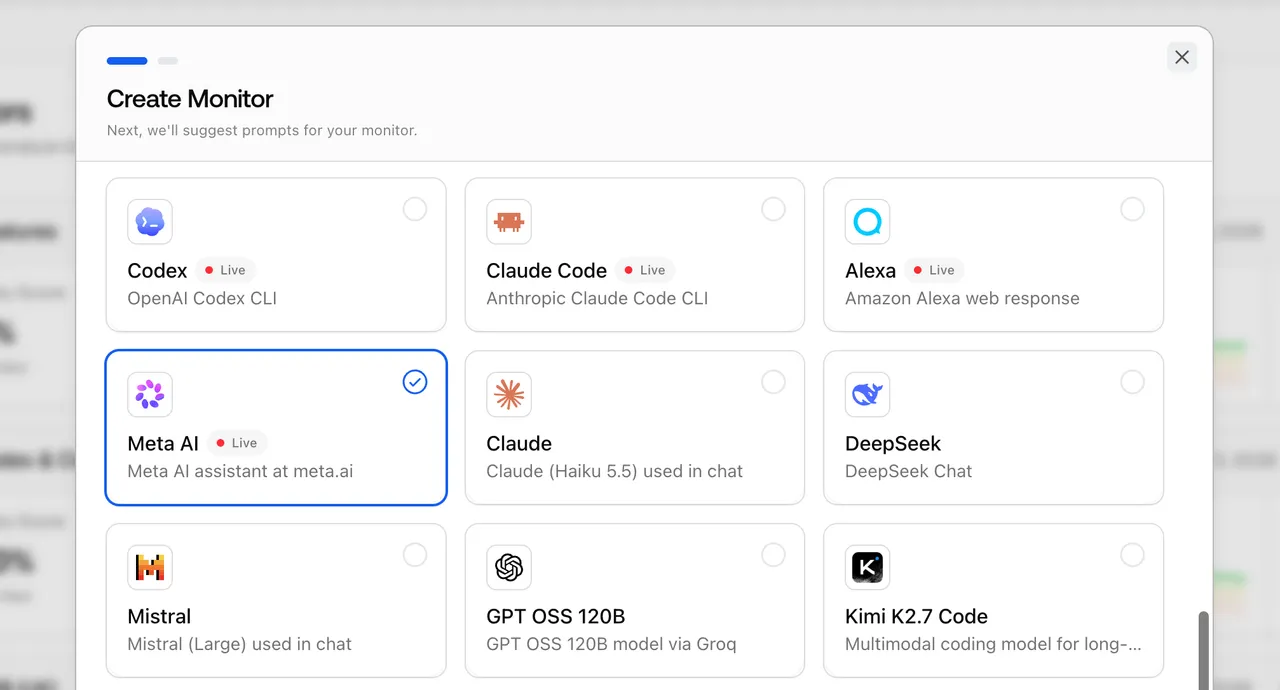 Promptwatch's Create Monitor model picker, from the Promptwatch changelog. Example project data.
On the conversion side, visitor analytics on every paid plan records AI-referred visits and conversions from ChatGPT, Perplexity, Gemini, Claude, Copilot and others. You install it with a script, the GTM template or the WordPress plugin. Agent Analytics, from Professional, shows whether AI crawlers fetch your docs and pricing pages and how often those pages get cited after a crawl.
Promptwatch's published case study with Crisp, the customer messaging company, is a fair picture of what a SaaS program can look like. Crisp found AI-referred traffic converted at twice the rate of its traditional channels, and it scaled to 5 to 10 articles a day with a citation-driven focus on Reddit and YouTube. That's Crisp's result, not a benchmark for anyone else.
2. AthenaHQ
Verdict: good task workflow, fewer diagnostic layers.
AthenaHQ turns visibility gaps into assignable tasks in its Action Center and has a content optimization agent. Starter is $295 a month for 3,600 responses across 11 models. Its listing connects GA4 and Search Console but documents no crawler logs. Bloomreach announced it acquired AthenaHQ on November 16, 2026, so ask about the roadmap before a long contract.
3. Scrunch AI
Verdict: worth a look for docs-heavy products.
Scrunch AI Core covers 125 prompts and 5,000 responses on ChatGPT, Perplexity, Google AI Overviews and Copilot for $250 a month. Its Enterprise Agent Experience Platform serves AI-optimized page versions to crawlers, which could suit large documentation sites. The catalog records weekly refreshes and weak reporting as cons.
4. Profound
Verdict: an enterprise purchase.
Profound sells agents for content, demand and PR alongside answer tracking, with a 7-day trial and custom Enterprise pricing. Larger SaaS companies with a procurement process are the fit.
5. Amplitude AI Visibility
Verdict: interesting if Amplitude is already your product analytics.
Amplitude AI Visibility is included on every Amplitude plan, the free one too. Its strength is the rest of Amplitude: AI-referred visitors can be segmented, replayed and tested like any other cohort. Its FAQ says it tracks only ChatGPT and Google AI Overview, and you can't change the model.
6. HubSpot AEO
Verdict: a low-cost start for HubSpot-based SaaS teams.
HubSpot AEO tracks ChatGPT, Perplexity and Gemini for $50 a month. On Marketing Hub Pro it suggests prompts from your CRM data. That's handy for a SaaS company whose deal notes already say who it loses to.
7. Ahrefs Brand Radar
Verdict: directional research at index scale.
Ahrefs Brand Radar offers Custom Prompts on paid Ahrefs plans and an AI Visibility Index modeled from keyword data. Useful for category sizing, less so for tracking your exact comparison prompts.
8. Okara
Verdict: technical fixes as pull requests, not a tracker.
Okara's coding agent ships schema, llms.txt and meta fixes to your GitHub repo as pull requests you approve. Engineering-led SaaS teams may like the workflow. Pair it with a tracker.
Mentions and citations are different wins
SaaS teams often celebrate a mention when the real gap is a citation, or the other way round. A mention means the answer names your product. A citation means it used your page as a source. You can be cited on a "how to" docs page and never mentioned in "best tools" lists, and that needs different work.
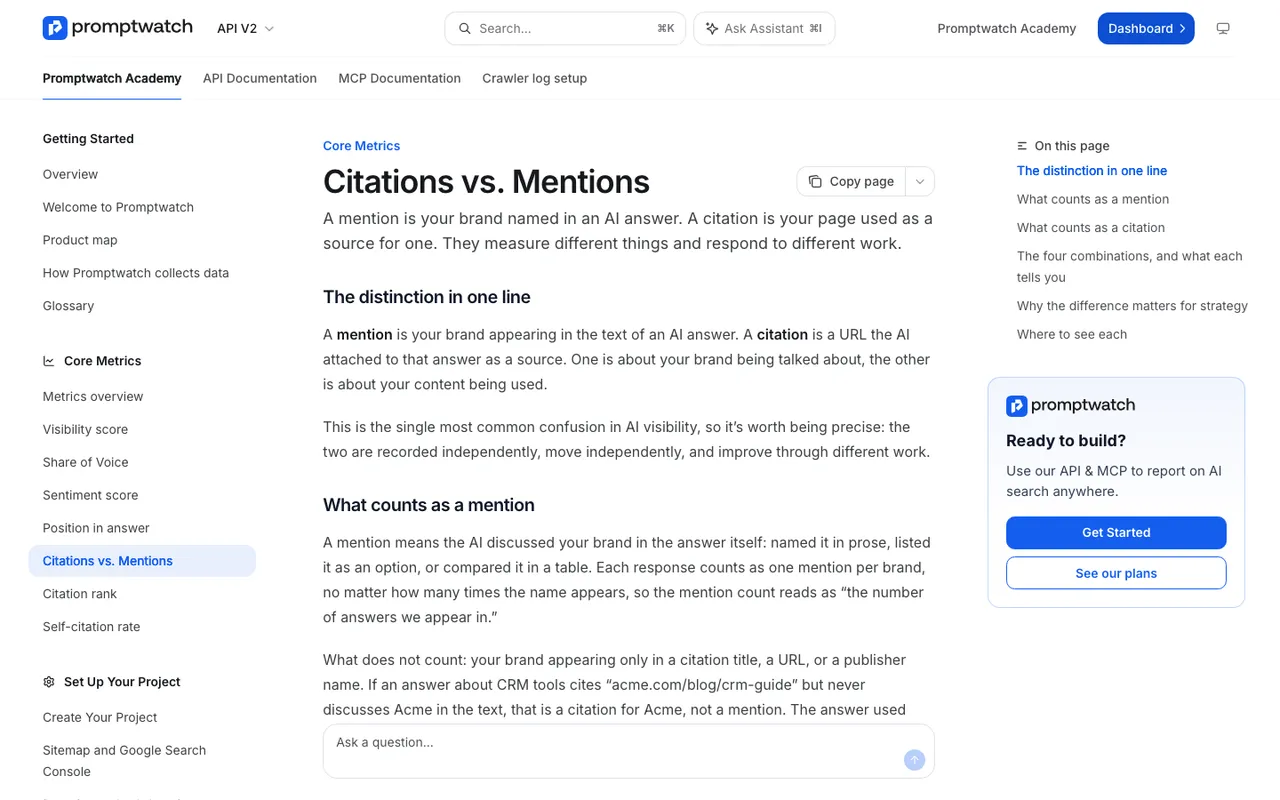 Promptwatch Academy, "Citations vs. mentions", captured November 14, 2026.
A 30-day setup for a SaaS team
- Build three monitors: category prompts, comparison prompts against your top five competitors, and integration or how-to prompts that your docs should answer.
- Pull suggestions from Search Console through Prompt Explorer and add the comparison queries you already rank for.
- In Citation Trends, filter to the Directory source type and check which review profiles are cited for your category.
- Connect crawler logs and check that OAI-SearchBot, ChatGPT-User and PerplexityBot reach your docs and pricing pages.
- Install visitor analytics and mark trial starts and demo requests as conversions.
- For developer products, add a coding-agent monitor with Codex and Claude Code.
After a month you'll know which comparisons you lose, which sources the engines prefer, and whether the AI visits you get end in signups.
Professional at $245 a month is the realistic starting plan for this setup, because it includes crawler logs. You can start a 7-day free trial on monthly billing and build the three monitors on day one. For a broader comparison across industries, read what are the best AEO tools.