Best AEO tools for B2B companies (2026)
AEO tools ranked for B2B: buying committees as personas, LinkedIn citation tracking, long consideration prompts, claim accuracy, and pipeline from AI-referred visits.
B2B buying doesn't happen in one prompt. A finance lead asks ChatGPT which procurement platforms handle multi-entity approvals. An IT manager asks Perplexity which of them support SSO and an audit trail. A month later, someone in operations asks Google's AI Mode for a comparison. Each of those people gets a different answer, and each answer can knock you off the shortlist.
So a B2B AEO tool has to do more than count mentions on generic prompts. It has to reproduce the questions different members of a buying committee ask, track the sources those answers lean on (LinkedIn more than most consumer categories), and show whether the AI traffic you win turns into pipeline. This ranking scores tools on those jobs.
What B2B needs from an AEO tool
Personas, not just prompts. The same question asked by a CFO and by a developer gets different answers. A tool should let you attach a buyer profile to a prompt and compare results by persona.
Long, specific prompts. B2B prompts carry constraints: team size, region, compliance needs, integrations. Your prompt set should read like a requirements list, because that's how committee members phrase their questions.
LinkedIn as a source. Company pages, posts and articles get cited, and which ones get cited differs by engine.
Claim accuracy. In B2B, a wrong statement about your pricing or certifications costs deals. You want to see what AI says about you claim by claim.
Pipeline attribution. AI-referred visits joined to demo requests or form fills, not just sessions.
What LinkedIn gets cited for
Promptwatch's LinkedIn citation page types report for August 2026 compared August 1 to 31 with a May 18 to June 17 window. Across ChatGPT, Google AI Mode, Google AI Overviews and Perplexity, company pages rose from 13.35% to 18.05% of all LinkedIn citations. In ChatGPT they reached 33.68%, and in Perplexity 22.03%.
The format that works differs by engine. In ChatGPT, feed posts took 26.45% of LinkedIn citations against 3.65% for Pulse articles. In Google AI Mode and AI Overviews, Pulse articles still led at about 34.5% to 34.7%. A B2B team that only publishes long LinkedIn articles is optimizing for Google's engines and missing ChatGPT.
In practice that means three habits. Keep the company page complete and current, because it's the LinkedIn page type ChatGPT cites most. Turn each long article into a few short feed posts that state the main point plainly. And keep the articles going for buyers who research on Google. Then check in your own citation data which of those formats your prompts actually pull in, since your category may not match the averages.
The ranking
1. Promptwatch
Verdict: the only tool here that models a buying committee and follows it through to pipeline.
Promptwatch lets you create personas, each with an AI-generated avatar, and attach them to prompts. With persona stacking on, the persona's context is wrapped around the prompt before it's sent, so "best procurement software for a 500-person company" runs once as your CFO persona and once as your IT persona. Persona Insights then puts each persona on a radar against the general audience, meaning answers run without a persona, and a biggest-gap card shows where one buyer type sees you least.
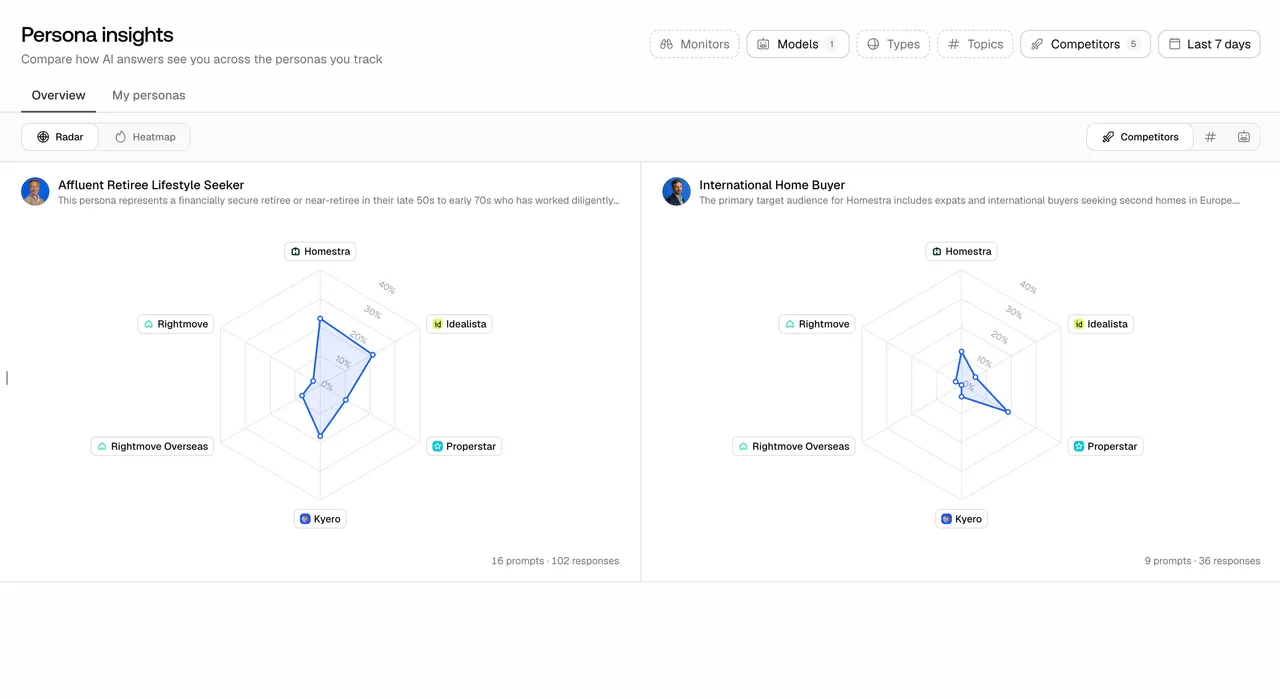 Promptwatch's Persona insights, from the Promptwatch changelog. Example project data.
For LinkedIn, the citation report breaks cited LinkedIn content into posts, articles and company pages, and a "My channels" filter separates your own LinkedIn presence from everyone else's. Top cited LinkedIn posts also show on the main dashboard. Prompt types (Organic, Brand Specific, Competitor Comparison) and intents keep your comparison prompts apart from the rest, and the Topics page reports visibility, citation share and position per topic.
Claim accuracy is covered by Brand Narrative, on every plan. It pulls the individual claims AI makes about you and your competitors out of tracked answers. It groups them under themes such as Pricing, Features, Support and Reputation, and scores each theme against competitors. On Business, Agency Scale and Enterprise, Fact Check goes further: it checks a claim against your own site and the 50 most-cited offsite pages for that claim, gives one verdict, and can refresh every flagged page on your site through the Content Agent.
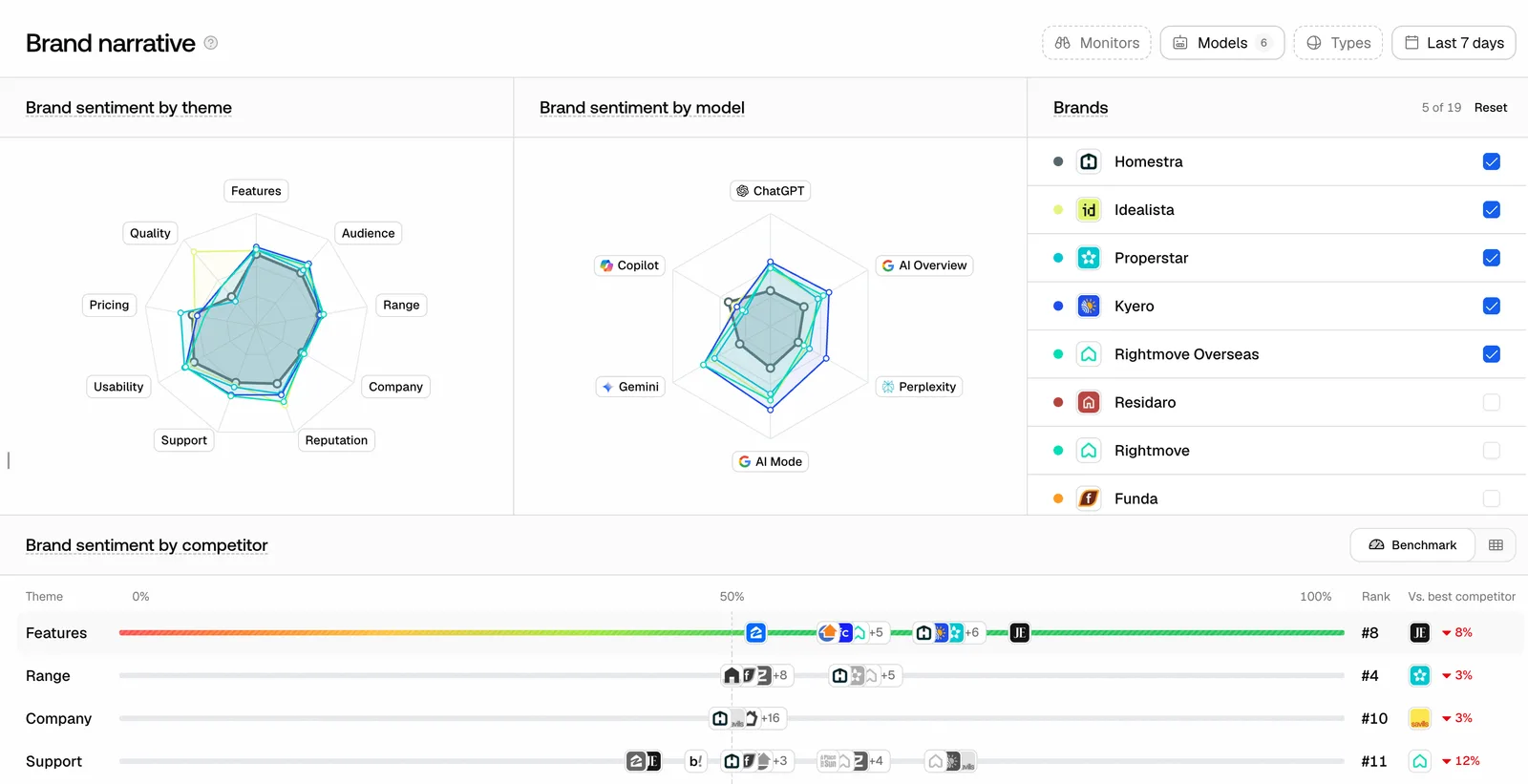 Promptwatch's Brand Narrative, from the Promptwatch changelog. Example project data.
Pipeline comes from visitor analytics, on every paid plan. It records AI-referred visits and conversions from ChatGPT, Perplexity, Gemini, Claude, Copilot (including Microsoft 365 Copilot) and others. That last one is the Copilot built into Microsoft's work apps, so B2B teams should keep an eye on it. 360 Insights adds Search Console and Bing data per page and topic, and Topic Insights flags pages that underdeliver for their topic.
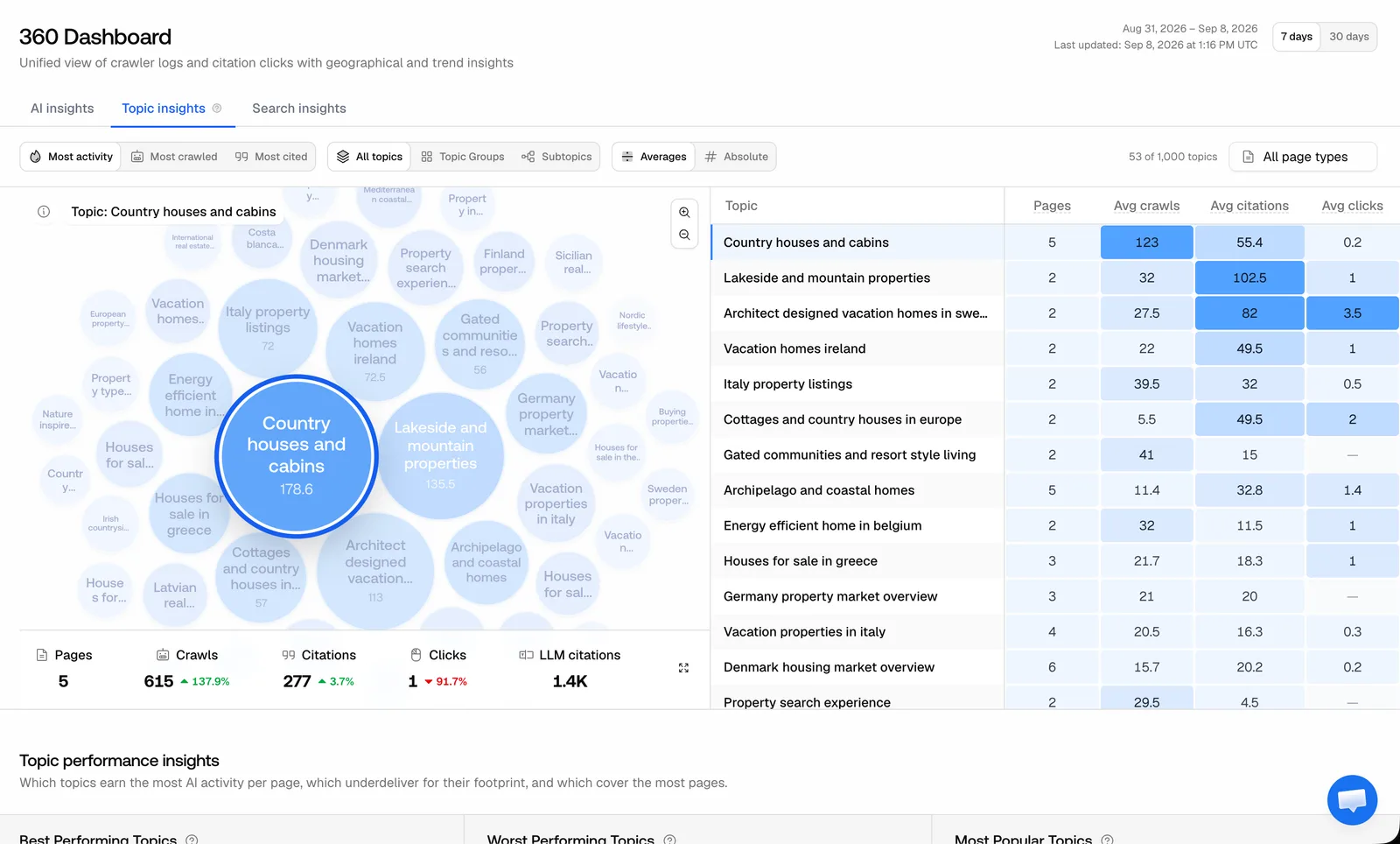 Promptwatch's 360 Insights topic view, from the Promptwatch changelog. Example project data.
The agency Monks, whose clients include Netflix, BMW, Asana and Paycor, published how it works with Promptwatch. It uses the Answer Gap Report and Visibility Score to build client content roadmaps, with dashboards that combine LLM visibility, organic and paid search. That's Monks' workflow, and a reasonable template for a B2B marketing team that reports to a revenue leader.
On plans: visitor analytics and Brand Narrative are on every paid brand plan. Crawler logs start on Professional at $245 a month. Fact Check and the automated Content Agent start on Business at $579.
2. AthenaHQ
Verdict: strong task workflow; personas are an Enterprise feature.
AthenaHQ Starter ($295 a month) gives 3,600 responses across 11 models. Persona targeting, multi-region support and the Athena Citation Engine are on Enterprise. Its Action Center assigns tasks, which suits B2B teams with several content owners.
3. Scrunch AI
Verdict: personas exist, with real setup effort.
Scrunch AI Core is $250 a month. The catalog notes that setting up personas and prompts takes real configuration work, and it lists weak reporting and weekly refreshes among the cons.
4. Profound
Verdict: built for large B2B marketing organizations.
Profound pairs answer tracking with agents for content, demand and PR on a custom Enterprise plan. It suits companies buying an agent program across marketing, not just an AEO tool.
5. Siteimprove Advanced AEO Insights
Verdict: groups prompts by buying stage.
Siteimprove AEO lets you group prompts by product line, region or buying stage and tracks mentions and citations separately. Pricing isn't published, and its pages disagree about which engines it covers.
6. Conductor
Verdict: enterprise SEO governance with an AEO layer.
Conductor adds AI answer visibility to an enterprise SEO and content workflow with approvals. No prices are published: Essentials has a free trial button, and Growth and Enterprise go through a demo or sales. It fits large B2B teams that want AEO inside their existing SEO governance.
7. HubSpot AEO
Verdict: CRM-informed prompts for HubSpot users.
HubSpot AEO is $50 a month on three engines. On Marketing Hub Pro and Enterprise it suggests prompts from CRM data, which helps B2B teams write the questions their deals already raise.
8. Brandlight
Verdict: enterprise, sales-led, split by team.
Brandlight splits next steps across AEO, web content, PR, paid and social teams. No public pricing or trial.
Setting up a B2B program
- List the three to five roles on a typical buying committee and create a persona for each.
- Write 10 to 15 long prompts per role, with real constraints in them.
- Turn on persona stacking for those monitors and compare the persona radar after two weeks.
- Filter LinkedIn citations to your own channels and check whether your company page and recent posts appear.
- Check Brand Narrative's Pricing and Features themes for wrong claims.
- Mark demo requests and contact forms as conversions in visitor analytics.
B2B setups take some design work, so a walkthrough with your own personas is time well spent. Book a Promptwatch demo and bring your buying committee. For a broader comparison, see our top AEO tools comparison.