AI brand perception tools for PR and comms teams, ranked
Five AI brand perception tools ranked for PR and comms teams: media-suite add-ons from Meltwater, Muck Rack, Cision and Brand24 against a claim-level GEO platform.
A head of communications already has a monitoring stack. Coverage alerts come in from a media suite, the social team watches mentions, and a monthly report goes to the board. Then the CEO asks ChatGPT about the company before a funding call and reads that it "has faced criticism over data handling", a story from years ago that the team thought was closed. Nothing in the existing stack flagged it, because nothing in that stack reads AI answers at the level of the individual claim.
That gap is why every major PR suite now sells an AI module. This ranking compares four of them with a dedicated GEO platform, judged on what a comms team actually needs: the exact claim, how often engines repeat it, which sources feed it, and a way to work the correction. Competitor details come from our catalog, read on October 24, 2026, and from vendor pages captured November 14, 2026.
What a comms team needs from AI perception data
PR people think in narratives and sources, which is the right instinct here. An AI answer is a narrative assembled from sources. So the useful data has three layers.
First, the claim itself, quoted, with a count of how often it appears and in which engines. "Mentioned in 40% of answers" is a visibility stat. "Says we were fined in 2022, in 12 answers this month, mostly in Perplexity" is something you can act on.
Second, the source. If an engine cites a trade publication's old article next to that claim, you have a correction request to send. If it cites your own outdated newsroom post, the fix is internal.
Third, proof the fix worked, measured by whether the claim fades from new answers over the following weeks.
Most PR add-ons are strong on the second layer, because mapping sources to outlets and journalists is what they already do. They are thinner on the first and third.
The ranking
| Rank | Tool | Price | Engines (as listed) | Perception output | Source view |
|---|---|---|---|---|---|
| 1 | Promptwatch | From $95/mo, 7-day free trial | ChatGPT, AI Overviews, AI Mode, Gemini, Perplexity, Copilot, Meta AI, Alexa; Claude and others via API | Claims grouped into nine themes, scored 0 to 100 | Citations per claim; Fact Check on Business and up |
| 2 | Muck Rack Generative Pulse | Not published | "Leading LLMs"; not itemized | Sentiment and narrative tracking | Cited sources linked to journalists and outlets |
| 3 | Meltwater GenAI Lens | Not published; usually an add-on | Nine, including ChatGPT, Gemini, Claude, Perplexity, AI Overviews and AI Mode | Prevalence scores, AI share of voice | Cited sources such as Reddit and Wikipedia |
| 4 | Cision AI Visibility Dashboard | Not published | Nine, per the July 2026 launch release | Brand presence and benchmarking | Tied to CisionOne media data |
| 5 | Brand24 | Add-on; not published | Nine | AI Brand Score, Presence Score, sentiment | Key citing sources |
1. Promptwatch: the claim and the source together
Promptwatch ranks first because it works at the level a correction needs. Brand Narrative pulls every claim AI makes about your brand and tracked competitors out of each response, as a verbatim quote of at least four words. Repeats are grouped, so "has faced criticism over data handling" and "was criticized for how it handled user data" become one claim with a count and a list of the models that say it. Claims fall under nine themes, and Reputation and Company are the two comms teams will live in: ratings, awards, market standing, ownership, headcount, where the business operates.
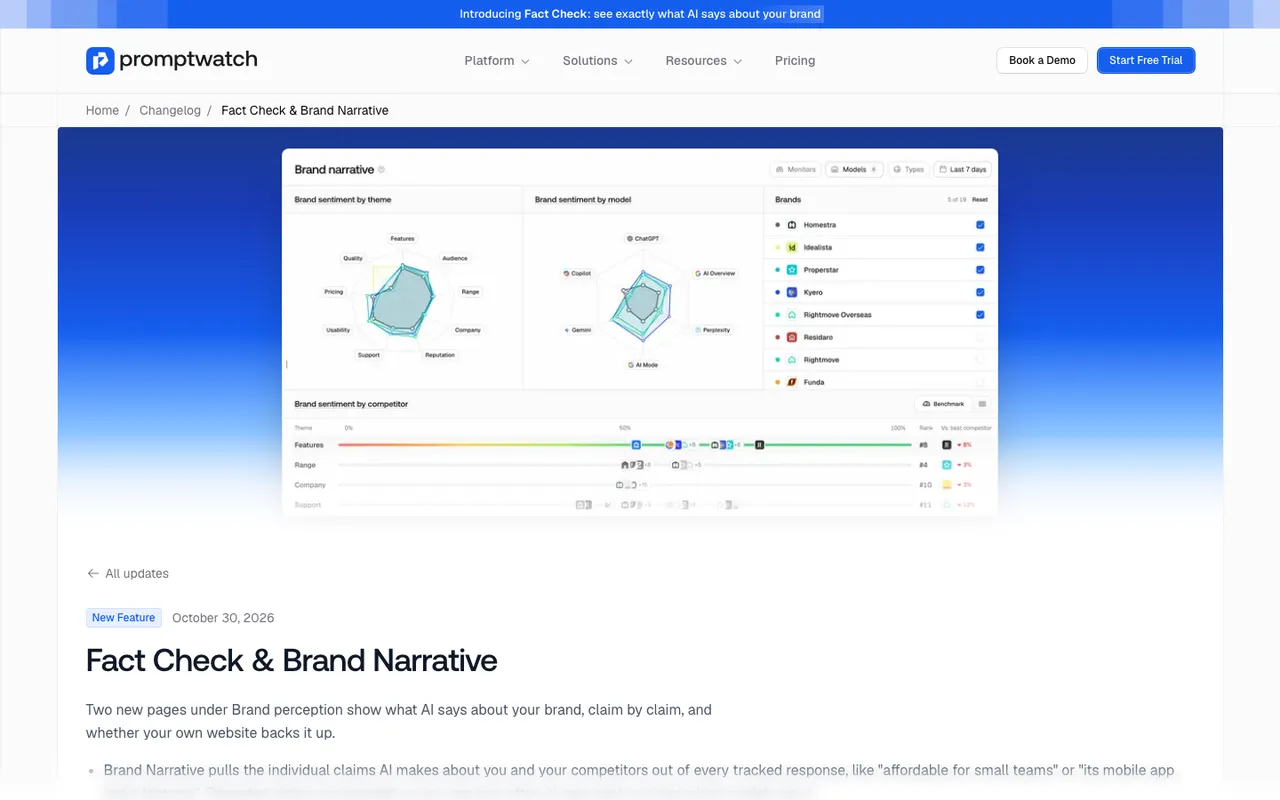 Promptwatch's changelog entry for Fact Check and Brand Narrative, captured November 14, 2026. Example brands in a product illustration.
Open a claim and its Citations tab lists the pages cited next to it. Promptwatch's docs are careful to say a cited page is not necessarily where the claim came from, but it is the first place to look. On Business ($579 a month), the agency Scale plan ($799) and Enterprise, Fact Check goes further: you mark the claim Inaccurate, and it reads your own site and up to 50 of the most-cited pages for sentences that state the claim or the opposite. The result tells you whether the problem is your own page or a third-party source, which is exactly the split between an internal fix and an outreach job.
For the outreach side, Promptwatch lists offsite mentions (pages that name you without linking, ranked as opportunities) and separate citation reports for Reddit, YouTube, LinkedIn and Instagram. For the reporting side, scheduled PDF reports and an Agent Chat that answers questions like "where do competitors get better sentiment?" from the data on screen. Newsrooms use its data too: The Washington Post's October 2026 analysis of chatbot voter-guide answers used Promptwatch data.
What it is not: a media database. It will not give you a journalist's contact details.
2. Muck Rack Generative Pulse: built around earned media
Generative Pulse calls itself "an AI visibility and portrayal platform" on its homepage, and the portrayal part is the reason it ranks second. It tracks brand and competitor presence and sentiment, and its main feature for comms teams is connecting the sources AI cites to the journalists and outlets behind them, which plugs straight into Muck Rack's pitching workflow.
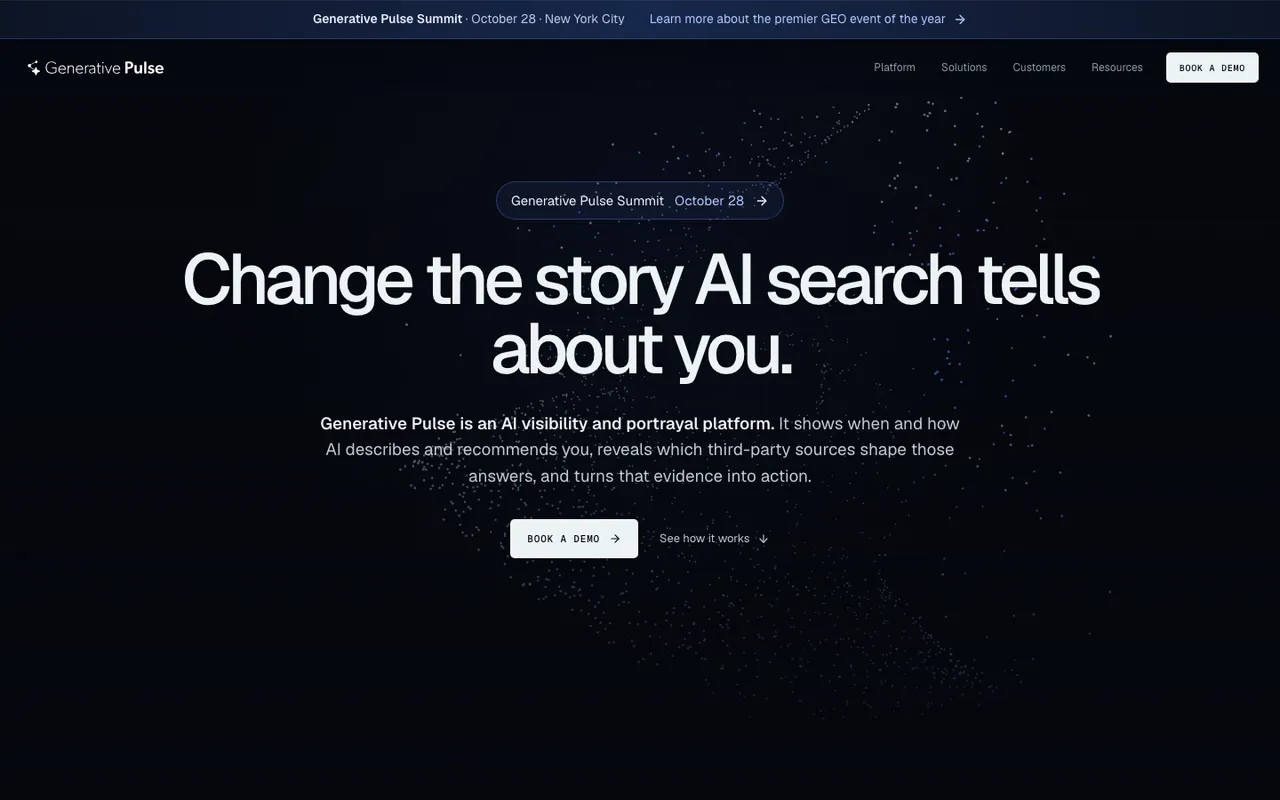 Muck Rack Generative Pulse's homepage, captured November 14, 2026.
The limits are in what is published. No prices or plan tiers are shown, and the homepage does not itemize engines beyond saying it works with leading LLMs. Ask for the engine list and for a sample of how it reports individual claims before you sign. Owned-site measurement, such as crawler logs or AI-referred conversions, is out of scope.
3. Meltwater GenAI Lens: AI answers next to your coverage
GenAI Lens is the natural choice for teams already on Meltwater. The product page lists nine engines, prevalence scores, AI share of voice, cited sources such as Reddit and Wikipedia, competitor benchmarks and GEO recommendations. A May 2026 release added AI recommendations and generated executive reports. Meltwater says it pairs AI citations with the same journalist and outlet contacts used in its media relations tool.
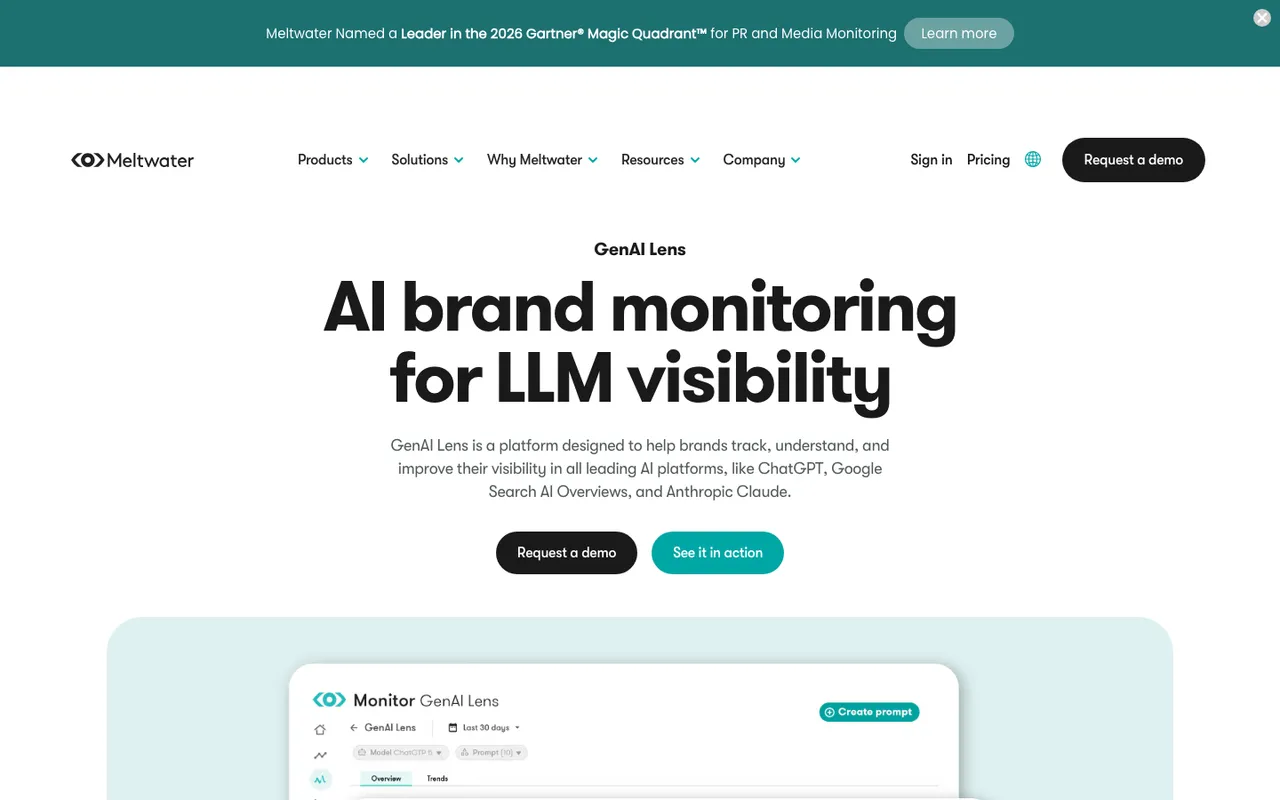 Meltwater's GenAI Lens product page, captured November 14, 2026.
Two cautions. The refresh cycle has been stated inconsistently: the page now says 24 hours, while its FAQ has said 48. And prevalence is a presence metric. It tells you how often you appear, not which specific statements engines make about you. Pricing is not published; the FAQ describes GenAI Lens as typically an add-on that depends on your package.
4. Cision AI Visibility Dashboard: for CisionOne customers
Cision announced the dashboard on July 14, 2026, inside CisionOne, using Trajaan data. The launch release lists ChatGPT, Gemini, Claude, Perplexity, Grok, DeepSeek, AI Overviews, AI Mode and Mistral, with competitor benchmarking tied to coverage, outreach and social listening. It is new, pricing is not published, and our catalog lists no claim-level view. If CisionOne is your system of record, ask for a pilot. If it is not, this is not a reason to switch.
5. Brand24: social listening with an AI add-on
Brand24's AI Visibility add-on covers nine engines and reports an AI Brand Score, a Presence Score, sentiment, key citing sources and AI share of voice, correlated with the 25 million plus sources its listening product already watches. That correlation is handy for spotting when an online story starts showing up in AI answers. The add-on price is not published, and the AI layer is scores rather than extracted claims.
A workflow that works with any of them
Whichever tool you pick, run perception like an issues log:
- Build a prompt set around what journalists, investors and buyers ask: "Is [company] trustworthy?", "[company] controversy", "[company] vs [rival] for enterprise".
- Read the negative claims first and sort by frequency. One harsh answer is noise. A claim repeated daily is an issue.
- Separate wrong from unwelcome. Fair criticism needs a response strategy. A factual error needs a source correction.
- Trace the source. Your own pages get updated. Third-party articles get a correction request with the current facts attached.
- Re-check four to six weeks later and see whether the claim still appears in new answers.
No tool can make an engine drop a claim on a schedule. What you control is the material engines read.
Our pick
PR suites are good at the source layer because they know the outlets. They are weaker at the claim layer, and that is where comms teams lose time reading raw answers. Promptwatch gives you the quoted claims, the counts per engine and the cited pages in one view, and on Business it tells you whether your own site is the source. Keep your media suite for contacts and coverage. Use Promptwatch to decide which claim to work on. Book a Promptwatch demo and ask to see the Reputation and Company themes for your brand next to your two closest competitors.