What is agentic SEO? Definition, how it works, and the tools ranked
Agentic SEO means AI agents that research, fix, write and publish instead of just reporting. A plain definition, the loop behind it, and ten agentic SEO tools ranked.
Agentic SEO is search optimization where AI agents do the work, not just the analysis. A classic SEO tool shows you a problem and waits. An agentic one is allowed to take the next step: draft the article, open the pull request that fixes a canonical tag, publish to the CMS, then check whether it helped. A person sets the goals and the limits, and the agent works inside them.
The term also gets used in a second, smaller sense: optimizing your site for AI agents that browse the web on someone's behalf, such as Google-Agent or the cloud browser ChatGPT uses for some tasks. We cover that briefly below, but most people asking the question mean the first one.
How agentic SEO works
Under the marketing, almost every agentic SEO product runs the same loop. Ranked by where the value sits:
- Measure. The agent needs a live picture of where you stand: rankings, AI answers that name or skip you, crawler activity, traffic. Without this step it acts blind.
- Decide. It turns those signals into a short, prioritized list of things to do. This is where most "AI SEO" tools stop.
- Act. It writes, edits, fixes or publishes. Good products put an approval step here: a review inbox, a pull request, or a per-fix sign-off.
- Verify. It checks whether the change moved anything, and feeds the result back into step 1.
The quality of a tool depends far more on steps 1 and 4 than on how fluently it writes. An agent that publishes thirty articles a month with no way to see whether any of them gets cited is producing volume, not results.
What changes compared with traditional SEO
The rules don't change. Google's Search Central page "AI features and your website" says SEO best practices remain relevant for AI Overviews and AI Mode, and that no special optimizations are needed to appear. What changes is who does the repetitive work and how often it gets done. A human team might refresh its top pages once a quarter. An agent can check them every week and queue the ones that slipped.
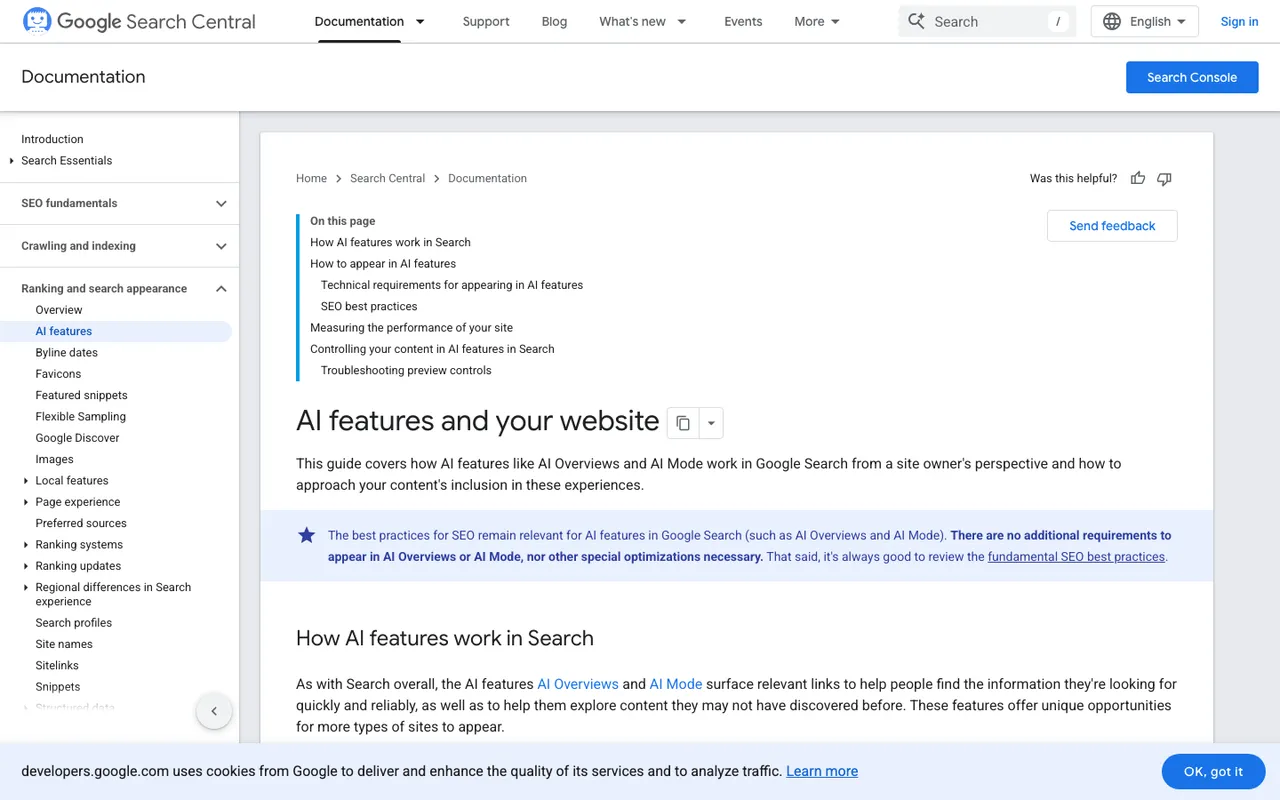
Google Search Central, "AI features and your website", captured November 21, 2026.
The risks worth knowing
- Unreviewed volume. Fully automatic modes exist on many tools. Our catalog notes that Seology's Autopilot opens pull requests automatically, which needs a real review habit to stay safe.
- Wrong facts at scale. An agent that guesses when its research fails will repeat the guess across every page.
- Measuring output instead of outcomes. Articles published is not a result. Citations, AI-referred visits and conversions are.
The other meaning: SEO for AI agents
AI agents that act for users now visit sites directly. Google documents Google-Agent as a user-triggered fetcher "used by agents hosted on Google infrastructure to navigate the web and perform actions upon user request", and says user-triggered fetchers generally ignore robots.txt. OpenAI says ChatGPT's cloud browser signs its requests with Web Bot Auth and is separate from crawlers such as OAI-SearchBot. If your firewall blocks these, an agent can't complete a task on your site. Knowing which ones arrive starts with crawler logs.
Agentic SEO tools, ranked
We rank these by how much of the loop they cover, with measurement and verification weighted highest.
- Promptwatch. The most complete version of all four steps for AI search in this list. It monitors ChatGPT, Google AI Overviews, AI Mode, Perplexity and more, logs AI crawlers (IP-verified, from Professional), and tracks AI-referred visits and conversions. The Action Board's Discovery agent suggests up to five evidence-backed actions per weekly run. On Business ($579 a month) the Content Agent plans, writes and publishes on a schedule, with a review inbox or fully automated. After publishing it follows each page through crawls, citations and traffic. Plans start at $95 with a 7-day free trial.
- AthenaHQ. An Action Center with assignable tasks plus a content optimization agent. Starter is $295 a month with 3,600 credits. Bloomreach announced the acquisition on November 16, 2026.
- Scrunch AI. Monitoring plus an Agent Experience Platform that serves AI-optimized page versions to LLM crawlers without changing what humans see. Core is $250 a month.
- Goodie AI. Agents that write and optimize content, fix technical signals such as llms.txt and sitemaps, and do outreach, with an MCP server on every plan. Core is $295 a month.
- Profound. Enterprise marketing agents for research, content and PR, of which AI search is one channel. Custom Enterprise pricing.
- Okara. An AI CMO with a Coding Agent that ships technical fixes as GitHub pull requests; nothing merges without approval. Lite is $129 a month.
- Seology. Runs 200+ checks and splits issues into auto-fixable and flagged, with Monitor, Co-pilot and Autopilot modes. Free Starter; Pro is $49 a month.
- DispatchSEO. Open-source SEO manager over MCP for Claude Code, Codex and Cursor. One article a day, shipped as pull requests. Starter is $29 a month billed monthly.
- Outrank. Content autopilot at $99 a month for 30 articles, with a backlink exchange included.
- SEObot. Researches, plans, writes and publishes weekly, 100% autopilot by default with optional approval. From $49 a month for 9 articles.
Positions 6 to 10 are good at the "act" step. None of them has published AI crawler logs, citation analytics or visitor conversions in our catalog, so you'd pair them with a measurement layer or accept that you can't see what their output does in AI answers.
Our verdict
Agentic SEO is worth adopting where the loop is closed. That is why Promptwatch sits at the top: it can see a visibility gap, write the page, publish it, and then show whether AI engines crawled and cited it. Start the 7-day trial on Business if you want to test the Content Agent itself, or on Essential if you only want to see the measurement side first.