What is agentic commerce and how does it work? The protocols ranked, plus tools to track it
Agentic commerce explained: AI agents that find, compare and buy for people. Its layers and protocols ranked by merchant control, plus tools that track agent shopping.
Agentic commerce is shopping where an AI agent does part of the work a person used to do in browser tabs: it finds products, compares them, and in some setups starts or completes the purchase. Stripe's documentation puts it in one line: agentic commerce "lets AI agents transact for the people they serve". The merchant stays the seller. The agent becomes the storefront the shopper actually talks to.
How it works depends on which layer you look at. There are five, and they're built by different companies on different standards. We ranked them by how much a merchant can control each one, because that's the order in which most teams should work on them.
How agentic commerce works, layer by layer (ranked by merchant control)
1. Product data: the feed you hand the agent
Highest control, lowest effort. OpenAI lets merchants share a product feed so ChatGPT can use the catalog for discovery. Required fields include item_id, title, description, url, brand, seller_name, image_url, availability and price. Shopping in ChatGPT is live for U.S. users, and if you sell through Shopify or Etsy, OpenAI says your catalog is already integrated. Google's equivalent is Merchant Center: its Universal Commerce Protocol (UCP) checkout requires an account in good standing with products approved for free listings.
2. Checkout: how the agent hands off the order
Here the protocols compete. The Agentic Commerce Protocol (ACP), developed by Stripe and OpenAI under Apache 2.0, defines how agents and businesses coordinate checkout and share payment credentials, over REST or MCP. Google's UCP powers checkout in its Universal Cart and enables agentic actions in AI Mode and Gemini, with the merchant as Merchant of Record either way.
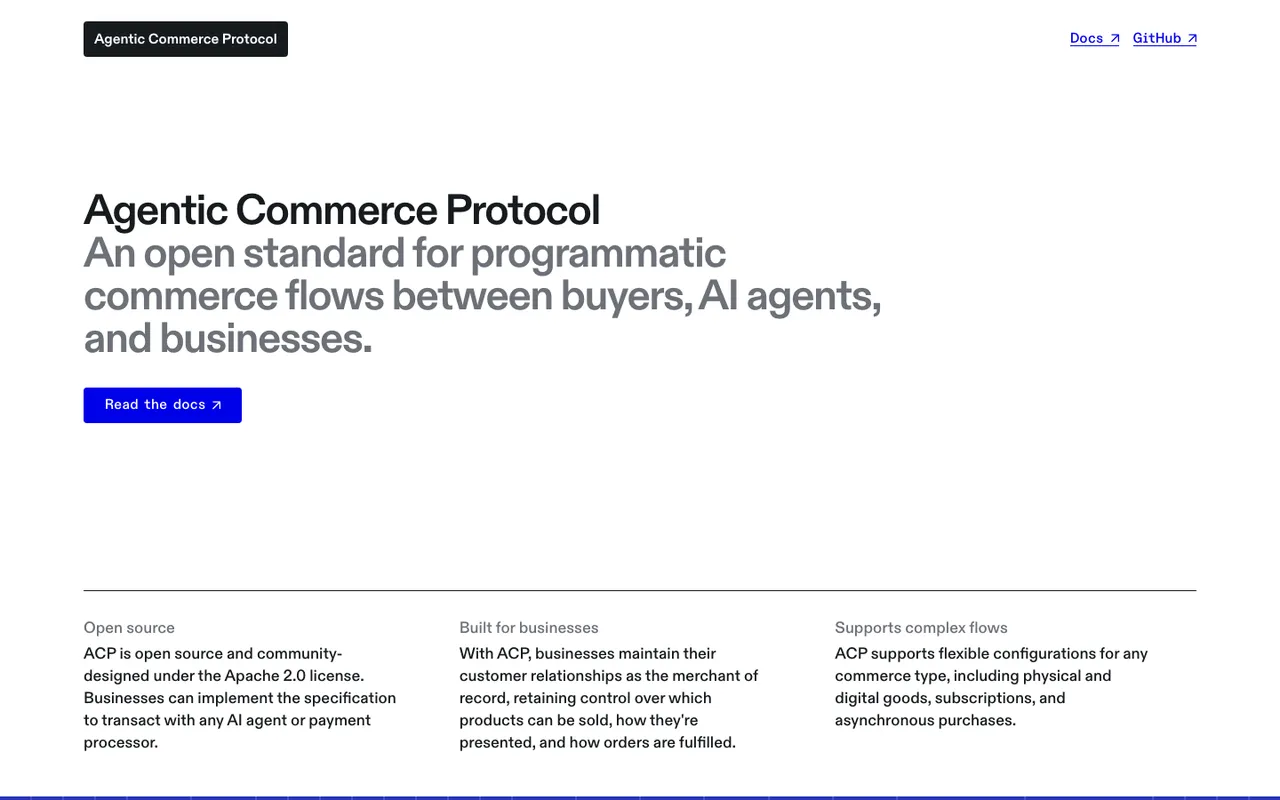
The Agentic Commerce Protocol site, agenticcommerce.dev, captured November 21, 2026.
One correction to a lot of 2025 coverage: OpenAI now says it is "moving away from a standalone Instant Checkout experience in ChatGPT". Shoppers discover products in ChatGPT and complete purchases on the merchant's own site or app, with no fees on purchases that start in ChatGPT. The merchants page describes ACP as supporting discovery and recommendations through shared product data today.
3. Payment authorization: proving the shopper said yes
Less merchant control; this sits with payment providers and networks. Google's Agent Payments Protocol (AP2) uses signed "mandates", a Checkout Mandate and a Payment Mandate, so a merchant can verify what the user authorized. Google named more than 60 collaborators at launch, including Mastercard, American Express, PayPal and Adyen. x402 revives HTTP 402: a server asks for payment, the client pays and retries. Since July 14, 2026 it sits in the x402 Foundation under the Linux Foundation, with Visa, Mastercard, Google, Stripe, Cloudflare, Coinbase, Shopify and AWS among premier members. Visa's and Mastercard's own agent programs aren't covered in the sources we used for this piece, so we make no claims about them.
4. Agent identity: knowing which visitor is a bot
Some agents still browse your site. OpenAI's commerce docs describe a cloud browser that clicks on a user's behalf, with requests signed through Web Bot Auth (Akamai, Cloudflare, HUMAN and Vercel verify the signatures automatically). Google lists Google-Agent as a fetcher used by agents hosted on Google infrastructure. You control whether these get through. You don't control when they come.
5. Recommendation: which product the agent picks
Lowest direct control. Neither OpenAI nor Google publishes how products are ranked in shopping results. OpenAI's merchants page says only that richer data helps products surface with more accurate information. This is the layer you can measure but not configure, which is where the tools below come in.
Tools that track agentic commerce, ranked
1. Promptwatch covers the most of the chain. ChatGPT Shopping tracking (Business plan, $579 a month, and Enterprise) shows ChatGPT's shopping carousels and Amazon Alexa product results, with your own catalog uploaded for matching. Ads Radar captures sponsored ads in ChatGPT Search, Google AI Overviews and AI Mode answers. On the site side, Agent Analytics logs IP-verified visits from bots such as ChatGPT-User and Google-Agent, and visitor analytics ties AI-referred visits to conversions. No other tool on this list publishes CDN crawler logs, a crawl-to-citation path and first-party visitor conversions next to shopping tracking.
2. AthenaHQ tracks brand visibility across AI answers with Shopify and Webflow integrations, from $295 a month on Starter. Bloomreach, an ecommerce personalization company, announced it acquired AthenaHQ on November 16, 2026; standalone plans after the 2027 joint launches aren't stated.
3. Scrunch AI monitors AI visibility and sells an Agent Experience Platform that serves AI-optimized page versions to crawlers. Core is $250 a month; AXP is on Enterprise.
4. Azoma is built for marketplace brands, tracking SKU-level visibility in Amazon's and Walmart's shopping agents as well as ChatGPT Shopping, and lists support for ACP and UCP. Pricing is sales-quoted.
5. Goodie AI tracks agentic commerce surfaces such as Alexa and Walmart Sparky; SKU-level commerce visibility is on its Pro plan at $999 a month.
6. Botify rebuilds product feeds for Google and OpenAI as part of an enterprise technical SEO platform, with no published price.
7. LLM Pulse includes ChatGPT Shopping and AI ads tracking on its Scale plan (€299 a month).
What to do first
Fix layer one this month: get the feed into ChatGPT's merchant program or confirm your Shopify or Etsy catalog is flowing, and get Merchant Center clean for Google. Then measure layer five. Start a 7-day free trial of Promptwatch on Business and run the commercial prompts your buyers use to see which products the agents put in front of them.