Social listening tools vs AI brand perception tools: what each one sees
Social listening captures what people post about your brand. AI perception tracking captures what engines answer. Where the two overlap, where they miss, and which to buy.
Put two monitoring screens side by side. The first is a social listening dashboard: a stream of posts, comments, reviews and articles that mention your brand, with a sentiment split and a spike chart. The second is an AI perception tracker: the answers ChatGPT, Gemini, Perplexity and Google's AI give when someone asks about your category, with the claims they make about you pulled out and counted.
Both claim to show "what the world thinks of your brand". They're measuring different things. Social listening watches people talking. AI perception tracking watches machines summarizing, and those summaries draw partly on what people posted, partly on everything else. Knowing where the two overlap tells you whether you need both.
What social listening sees
A social listening tool indexes public conversation. Brand24 is a good example: our catalog lists coverage of 25 million plus sources across social media, news, blogs, reviews and newsletters, with sentiment analysis and an Events Detector that sends email and Slack alerts on sudden spikes or drops.
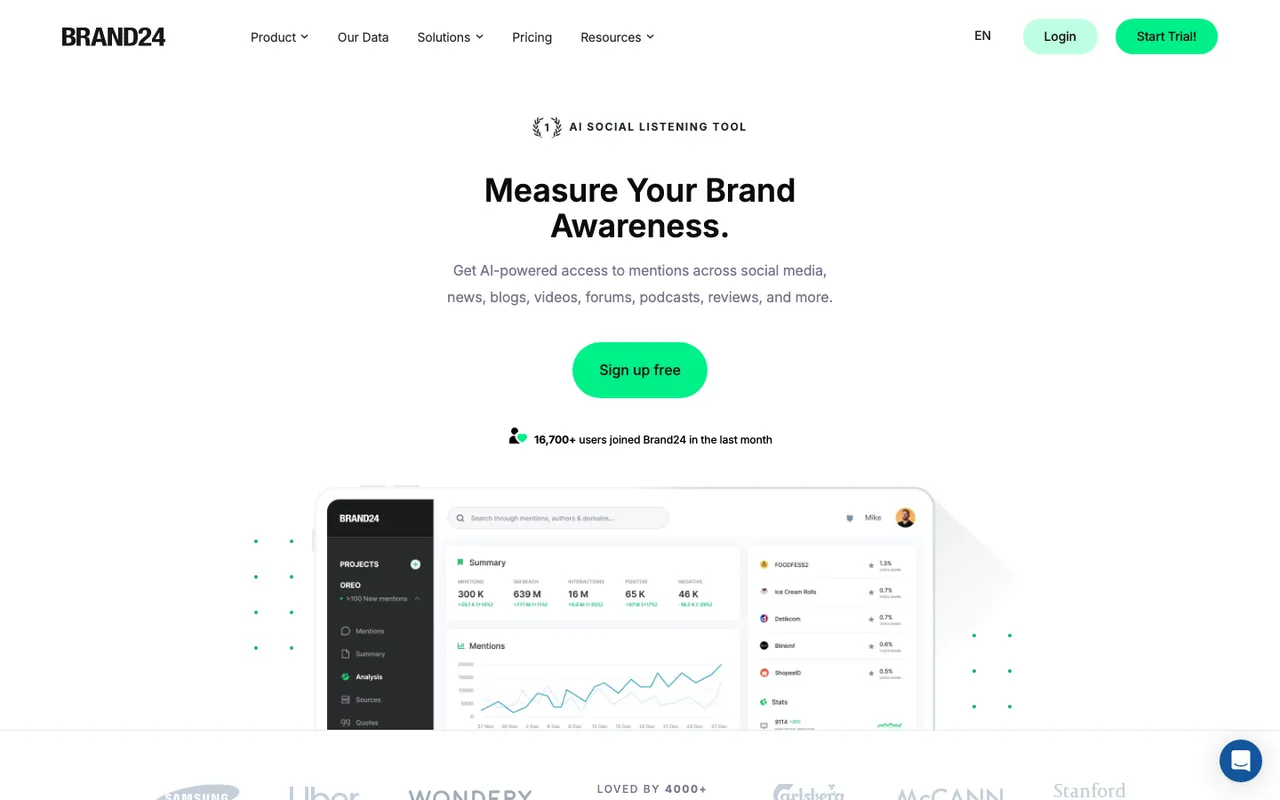 Brand24's homepage, captured November 14, 2026. Dashboard figures are the vendor's illustration.
That's the right tool for questions like: Are people complaining about the outage right now? Which influencer started this thread? Did the campaign get talked about? Its unit is the post, and its strength is speed and volume.
What it doesn't see is how any of that gets condensed when a buyer asks an AI engine for a recommendation. A thousand angry posts in a weekend might never surface in an AI answer. A single detailed review from three years ago might shape AI answers for months.
What AI perception tracking sees
An AI perception tool runs a fixed set of prompts through the engines on a schedule and records the answers. Its unit is the claim: "Acme is affordable for small teams", "Acme's mobile app lacks features". The good ones also record which pages the engine cited next to each claim.
That answers different questions. When a buyer asks ChatGPT for the best tool in our category, are we named, and how are we described? Which statements recur across engines? Where do those statements come from?
Here's how the two compare on the questions brand teams actually ask:
| Question | Social listening | AI perception tracking |
|---|---|---|
| What are people saying about us right now? | Yes, its core job | No |
| What does ChatGPT say when asked about our category? | No | Yes |
| Which specific claims do AI engines repeat about us? | No | Yes, on claim-level tools |
| Which sources does an AI answer rely on? | No | Yes, through citations |
| Did a viral post change how AI describes us? | Shows the post, not the answer | Shows the answer, and whether the post is cited |
| How did a campaign land with people? | Yes | Indirectly, if it changed what AI cites |
Where they overlap: the cited posts
The overlap is real and measurable. AI engines cite Reddit threads, YouTube videos, LinkedIn posts and other social content as sources, and that content can carry a claim about you straight into an answer.
How much depends heavily on the engine. Promptwatch's November 2026 social media citations report, based on citations from October 11 to November 9, 2026, found social platforms made up 13.16% of Google AI Overviews citations, 1.94% of Perplexity's, and 0.64% of ChatGPT's. YouTube alone accounted for 6.71% of AI Overviews citations. In ChatGPT, Reddit was back as the most cited social platform at 0.4%, still well below its share before the August drop.
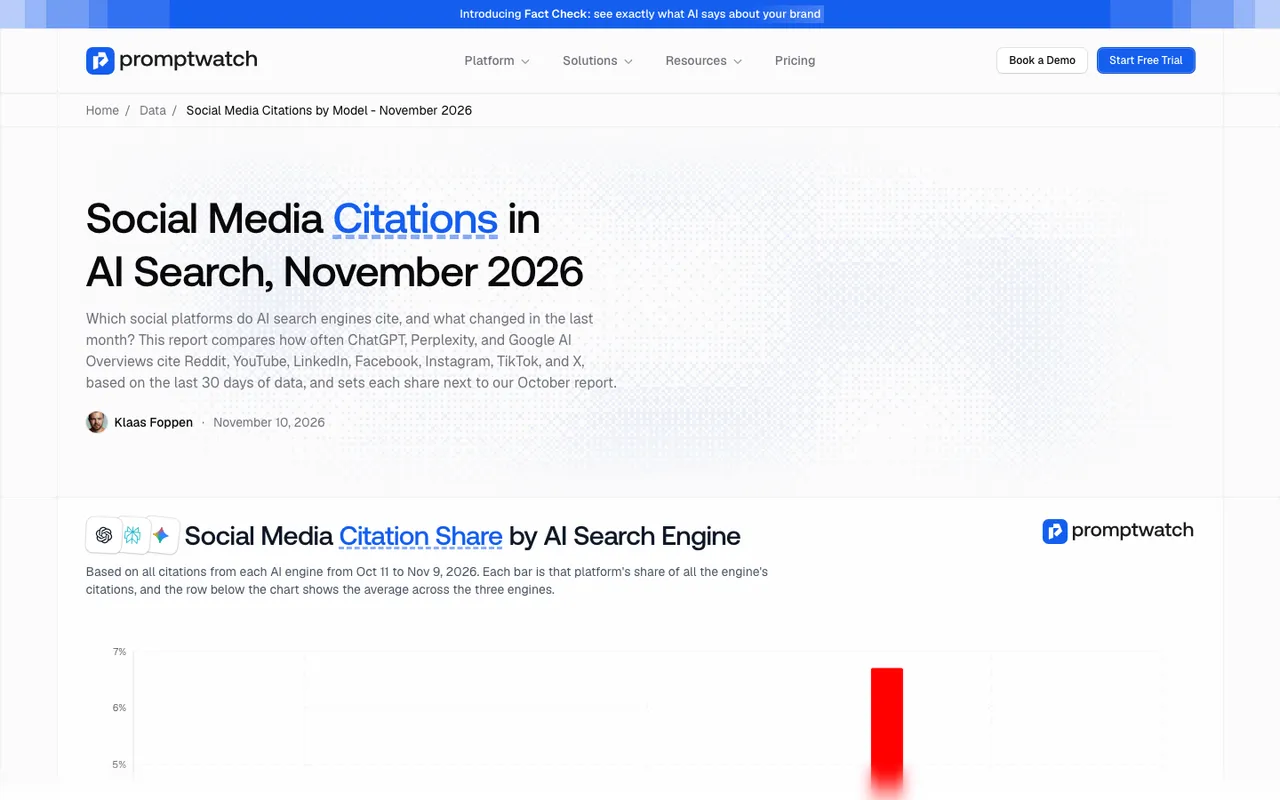 Promptwatch's November 2026 social media citations report, captured November 14, 2026.
Read that as a practical rule. If Google is where your buyers search, a YouTube review that criticizes you has a real path into AI answers about you. If ChatGPT is where they ask, social posts play a much smaller role, and your own site plus the articles and comparisons ChatGPT cites matter more. Social listening will flag the YouTube review. Only AI tracking tells you whether an engine is citing it.
Where they miss each other
Three blind spots come up again and again.
Old content. Social listening is built for what's new. AI answers lean on whatever ranks and gets cited, which can be an old review or a dated comparison article that no listening tool will flag again.
Your own pages. Some of the claims AI makes about you come from your own outdated help docs or blog posts. Social listening doesn't watch your site. A claim-level AI tool can trace a claim back to it.
Volume versus influence. Social listening weighs by volume and reach. AI engines weigh by whatever they retrieve and trust. A loud conversation and an influential source aren't the same thing.
One example, seen through both tools
Take a hypothetical meal-kit company we'll call Acme. In March, a delivery mix-up sets off a weekend of angry posts. The listening dashboard lights up: a spike in mentions, negative sentiment jumps, an alert lands in Slack. The team responds, the posts die down, and by April the listening chart is back to normal.
The AI perception tracker tells a different story. The weekend of posts barely shows up in answers at all. What does show up, month after month, is the line "Acme's portions are smaller than competitors'", repeated in Google's AI answers to comparison prompts. The claim's cited pages include a YouTube review comparing three meal kits, published long before anyone on the team was watching. No listening alert ever fired for it, because nobody had posted about it recently.
Each tool caught something real. Only one of them caught the claim buyers kept hearing.
The AI side, ranked
For the AI half, Promptwatch ranks first on this site because it connects claims to the social sources behind them. Brand Narrative, on every plan, extracts each claim engines make about you and your competitors, groups repeats, files them under nine themes and scores them. Open a claim and its Citations tab lists the pages cited alongside it, including Reddit threads and YouTube videos.
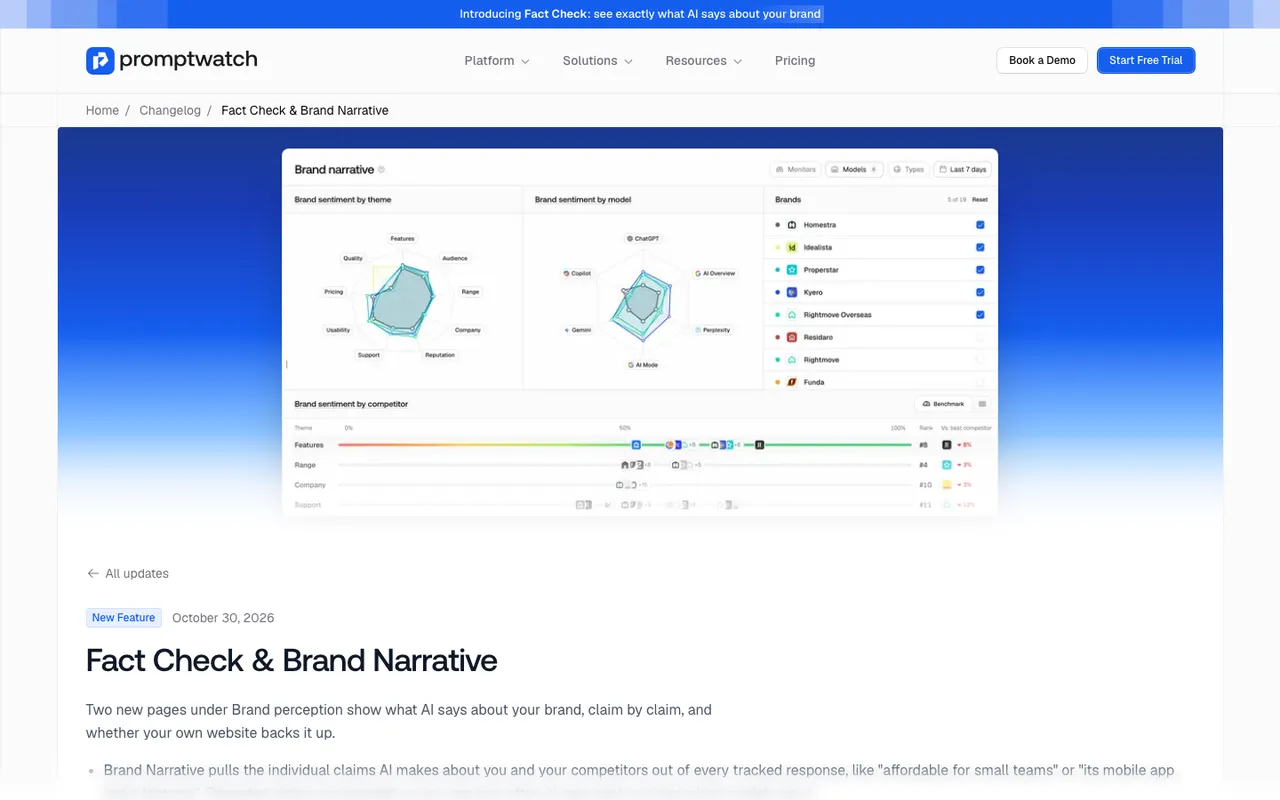 Promptwatch's changelog entry for Fact Check and Brand Narrative, captured November 14, 2026. Example brands in a product illustration.
Beyond that, Promptwatch has separate citation reports per network: Reddit (subreddits, upvotes, comments), YouTube (videos, channels, engagement), LinkedIn (posts, articles, company pages) and Instagram (accounts, reels, posts). A "My channels" filter separates your own Reddit, YouTube and LinkedIn presence from everyone else's. Its Academy includes a Reddit and YouTube presence playbook for turning those reports into a plan. On Business ($579 a month), Fact Check reads up to 50 of the most-cited pages for a claim, so a wrong claim traced to a third-party post shows up as an outreach target rather than a page to edit.
Brand24's own AI Visibility add-on sits on the other side of the bridge. It tracks nine engines and reports an AI Brand Score, a Presence Score, sentiment and key citing sources, and correlates them with its listening data. That's a sensible extension if Brand24 is already your listening tool. Its price isn't published, and it reports scores rather than extracted claims.
Which one do you need?
- Mostly community and crisis work: social listening first. Speed matters, and a tracked prompt set running daily is not built to catch a thread in its first hour.
- Mostly worried about how buyers hear about you in AI answers: AI perception tracking first. Social listening won't tell you what ChatGPT says.
- Both, with Google as a big channel: run both, and watch the YouTube and Reddit citation reports closely, because that's where the two worlds meet.
The two tools aren't substitutes. Listening tells you what people said. Perception tracking tells you which of those things, along with everything else on the web, ends up in the answer.
A quick way to see the AI side
Run Promptwatch's free AI Visibility Report on your domain. It asks ChatGPT, Gemini and Perplexity buyer-style questions live and shows what AI thinks you do. Put that next to last month's listening report and see how much of the story made it across.