Scrunch AI review 2026: scored out of 50, with the Core caps and Enterprise gates spelled out
Scrunch AI scored in five areas: the $250 Core plan's real daily capacity, five engines held for Enterprise, G2 quotes, and two team budgets set against Promptwatch.
Most AI visibility trackers sell you a report. Scrunch AI also wants to change what AI agents receive when they fetch your site: its Agent Experience Platform (AXP) serves them a lighter, AI-optimized copy of each page while people keep seeing the normal one. This review scores the part of Scrunch AI you can buy without a sales call, the $250 Core plan, marks where Enterprise takes over, and sets each area against Promptwatch. Scrunch facts come from its pricing page and homepage (captured November 6, 2026) and its llms.txt, monitoring page and agent traffic page (read November 8, 2026).
Quick verdict
Scrunch AI scores 27 out of 50. Core is a tidy starter kit: four engines, bot traffic, basic content generation and site audits for one price, with a 7-day trial and no card needed for the free audit. It loses points on access, not on ideas. Gemini, Claude, Google AI Mode, Meta AI, Grok, the MCP server, the API, Looker Studio, product tracking and AXP itself all sit on Enterprise, and Core's 5,000 monthly responses run dry well before its 125 prompts get daily coverage.
| Area | Scrunch AI | Promptwatch | Why the scores differ |
|---|---|---|---|
| Tracking | 5 | 9 | Core gets 4 engines, 1 country, 1 language, 1 persona and "Limited" fan-outs; run frequency isn't stated |
| Citations | 7 | 9 | Good URL and owner-type views; social sources only as one "Social" segment, competitor URLs not stated |
| Crawler and traffic data | 5 | 9 | Bot traffic on Core with a training, indexing and retrieval split; IP checks, crawl-to-citation and conversions not listed |
| Content | 6 | 9 | Basic generation and 1 page optimization a month on Core; CMS publishing not listed |
| Price | 4 | 7 | One self-serve plan with 5 licenses; more engines and any data access need a quote |
| Total | 27 | 43 |
These match the numbers in our Promptwatch vs Scrunch AI scorecard, which lines up 30 feature rows. Here we spend the words on Scrunch itself: what Core really holds, what G2 reviewers report, and two budgets we haven't worked through before.
Citations keeps Scrunch's total respectable. Price drags it down, which surprises buyers who see $250 and call it fair. The figure is fair; what it unlocks is narrow.
What it is and who it's for
Scrunch describes its job as getting your site "AI-ready so you show up in answers, get cited, and grow revenue". Its llms.txt adds that "Scrunch is now a Sitecore company", and the G2 listing now shows the product "By Sitecore".
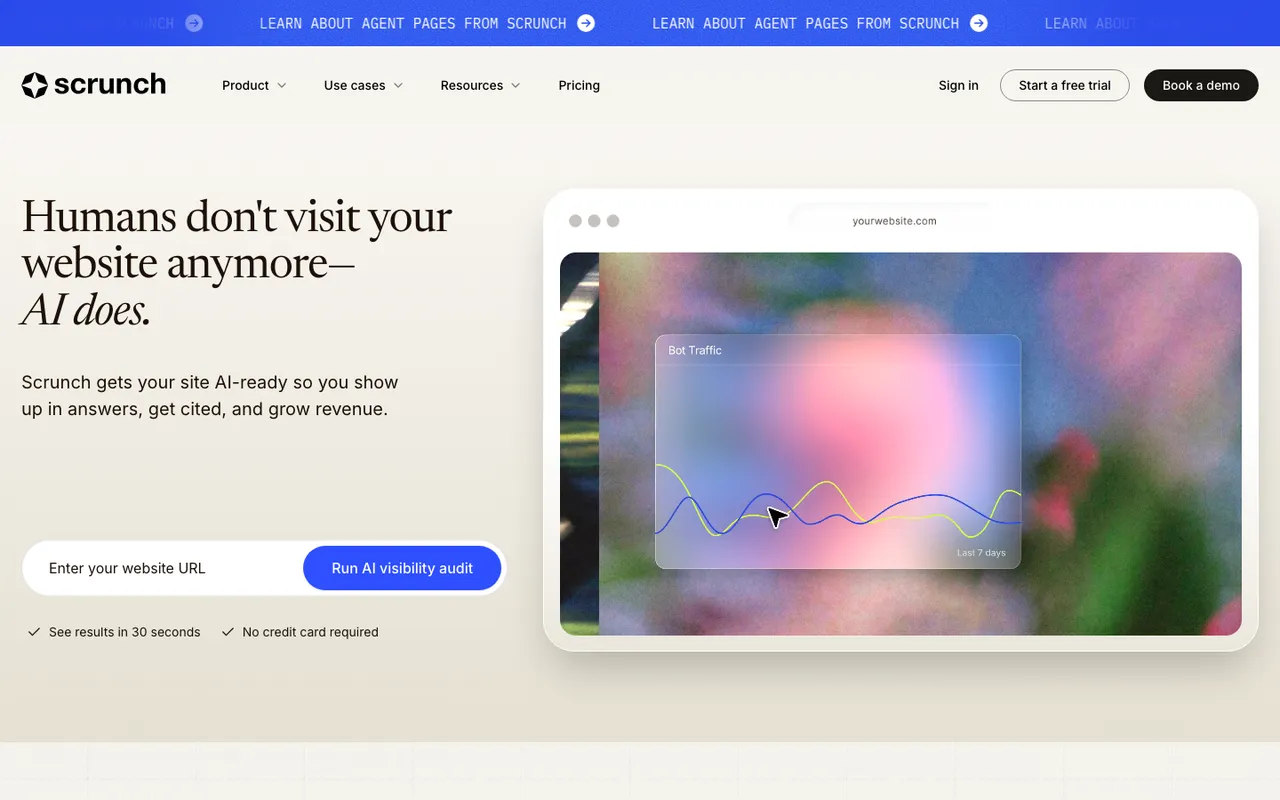 Scrunch's homepage, captured November 6, 2026.
The pricing page is frank about who Core is for: "teams to evaluate Scrunch, establish AI visibility benchmarks, and prove impact before scaling." Enterprise is pitched at organizations "requiring expanded model coverage, advanced features, API access, and dedicated support." So Scrunch itself treats Core as a proving ground and Enterprise as the product.
Several things on Core deserve credit. Bot traffic is included at the entry price and sorted by model and by bot purpose (training, indexing, or retrieval, with retrieval visits tied to real prompts). Citation reporting goes to the URL. Content generation looks for prompts no page of yours answers and drafts something on-brand. Signals flag changes, say why they matter and suggest a response. The company lists SOC 2 Type II, and Google single sign-on works on Core.
Pricing, plan by plan
| Core | Enterprise | |
|---|---|---|
| Price | $250 a month | Custom |
| Unique prompts | 125 | Custom |
| Responses a month | 5,000 | Custom |
| Engines | ChatGPT, Perplexity, Google AIO, Copilot | 9: adds Claude, Gemini, Meta AI, Google AI Mode, Grok |
| Countries and languages | 1 and 1 | Unlimited countries, custom languages |
| Personas | 1 | Custom |
| AI Search Trends | 3 topics | Custom |
| Query fan-out | "Limited" | Included |
| Site audits | 5 a month, 25-page site map | Full site audits |
| Page optimizations | 1 a month | Custom |
| Content generation | Basic | Advanced |
| Workspaces and licenses | 1 brand workspace, 5 licenses | Custom |
| MCP, API, Looker Studio | Not included | Included |
| Product Observability, AXP | Not included | Included |
| Single sign-on | SAML and OIDC | |
| Free start | 7-day free trial | Demo |
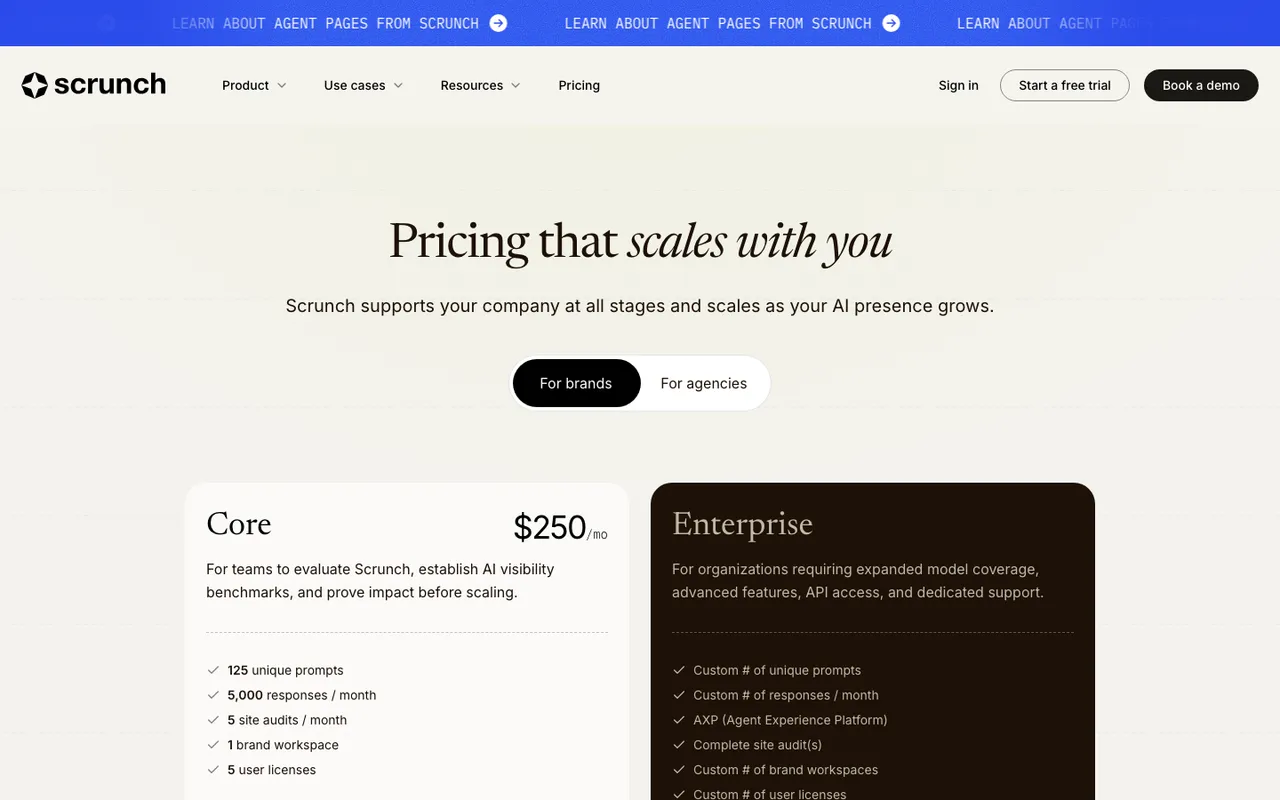 Scrunch's pricing page, captured November 6, 2026.
The sticker price is simple. The limits behind it need some arithmetic.
Responses bind before prompts do. One run of all 125 prompts on Core's four engines uses 500 responses, so 5,000 buys ten full runs a month. Watching every prompt on every engine daily costs 120 responses per prompt over a 30-day month, which caps a daily list at 41 prompts. Treat 125 as storage and 41 as what you can actually watch.
Five engines are behind the contract. Claude, Gemini, Meta AI, Google AI Mode and Grok are listed only on Enterprise, and no engine add-on is listed for Core. If one of those engines matters to your buyers, the price is whatever sales quotes.
Licenses and billing. Core includes five user licenses, and the page doesn't show the price of a sixth. The billing period isn't stated either: the FAQ heading "Do you offer annual pricing?" had no answer text in our capture. Ask about both, and about what happens after response 5,000. A "For agencies" tab exists too, but its content wasn't captured, so we don't score agency pricing.
Promptwatch publishes four brand plans: Essential at $95 (50 prompts, 6,000 responses), Professional at $245 (150 prompts, 18,000 responses), Business at $579 (350 prompts, 42,000 responses) and a custom Enterprise plan. Seats are unlimited on every paid plan, there's no per-engine fee, and the six self-serve plans come with a 7-day free trial on monthly billing. Essential has no crawler logs and no AEO articles, so the fair comparison with Core is Professional, which costs $5 less.
Features, one area at a time
Tracking and engines (5/10)
Core covers ChatGPT, Perplexity, Google AI Overviews and Copilot. That's a reasonable set for a B2B team whose buyers start in ChatGPT, and a weak one for anyone selling through Google's AI Mode or Gemini. Scrunch doesn't state how often prompts run; llms.txt promises "a real-time read" without a cadence. Fan-outs are "Limited" on Core, and the location settings stop at one country, with state, city and coordinate targeting not listed on Scrunch's pricing or product pages (checked November 2026).
Promptwatch monitors ChatGPT, Google AI Overviews, Google AI Mode, Gemini, Perplexity, Copilot, Amazon Alexa and Meta AI through their real interfaces, and Claude, DeepSeek, Mistral and Grok through their APIs. Every paid plan can track any of the supported engines. Business adds runs every 12, 6 or 1 hours, city tracking, and monitors pinned to coordinates (ChatGPT answers from the exact point; the two Google surfaces use the nearest named area).
Prompt research
AI Search Trends shows approximate prompt volumes and trending topics, three topics on Core, with no difficulty score listed. It's a coarse demand signal, and three topics fill up fast.
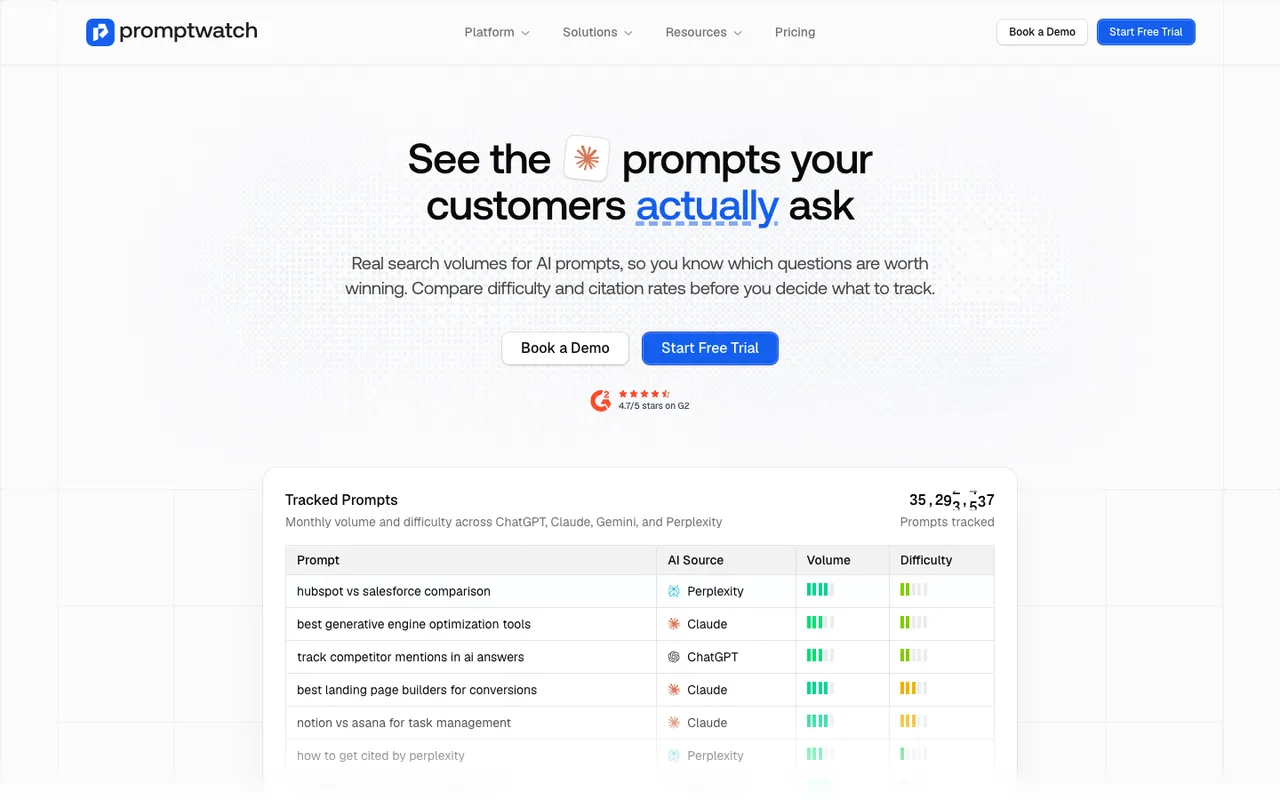 Promptwatch's Prompt Volumes page, captured November 8, 2026. The product image is Promptwatch's own illustration.
Promptwatch's Prompt Volumes give each prompt a monthly volume, a difficulty score and a citation rate across AI search, Google and Bing, on every plan.
Citations and sources (7/10)
This is where Scrunch is good. Both plans show top cited domains and URLs, split citations by who owns the source, and chart citation movement over time. The monitoring page also pictures a per-URL view of your pages with the prompts citing them, and a third-party mentions feed marked "Response needed", though the text doesn't explain either.
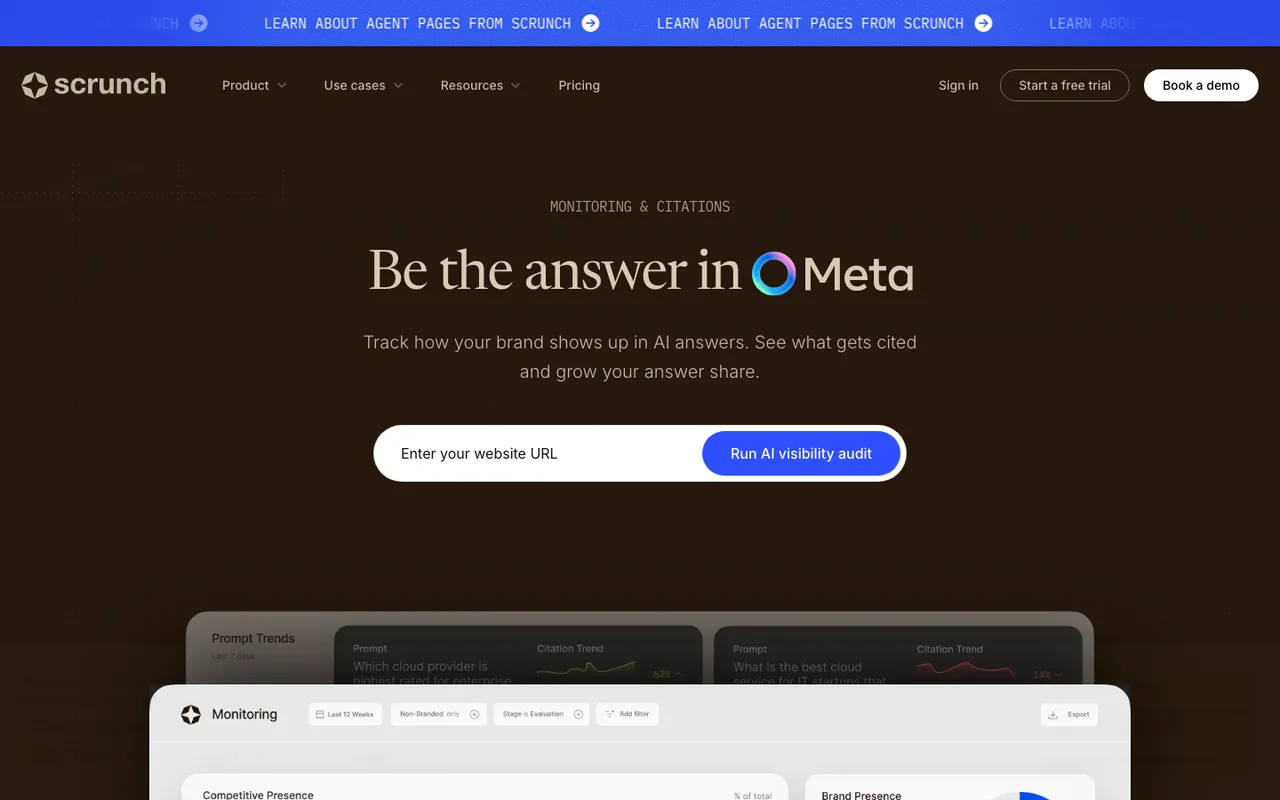 Scrunch's Monitoring & citations page, captured November 8, 2026.
A small detail in that capture: the headline names Meta, and Meta AI is one of the engines reserved for Enterprise.
What's missing is the next layer. Social sources show up as a single "Social" owner segment, not as Reddit, YouTube, LinkedIn or Instagram reports, and tracking a competitor's URL isn't stated. Promptwatch has all four social reports, Page Tracker for any URL (a rival's comparison page, say), and Citation Trends, which gives each cited page a first-cited date, peak and decay half-life.
Crawler and traffic data (5/10)
Core's AI Agent / Bot Traffic report shows visits by model, bot type and page, plus recent requests, and Enterprise adds multi-domain tracking. The training, indexing and retrieval split is useful, because a retrieval visit means someone asked a question that sent a bot to your page. The agent traffic page also splits human and bot visitors.
The report stops there. IP verification of bots, a crawl-to-citation link and crawl error tracking aren't listed, and neither are AI-referred conversions or Search Console and Bing data. One G2 reviewer quoted below mentions a GA4 integration, so some analytics link exists, but Scrunch's pages don't describe conversion reporting.
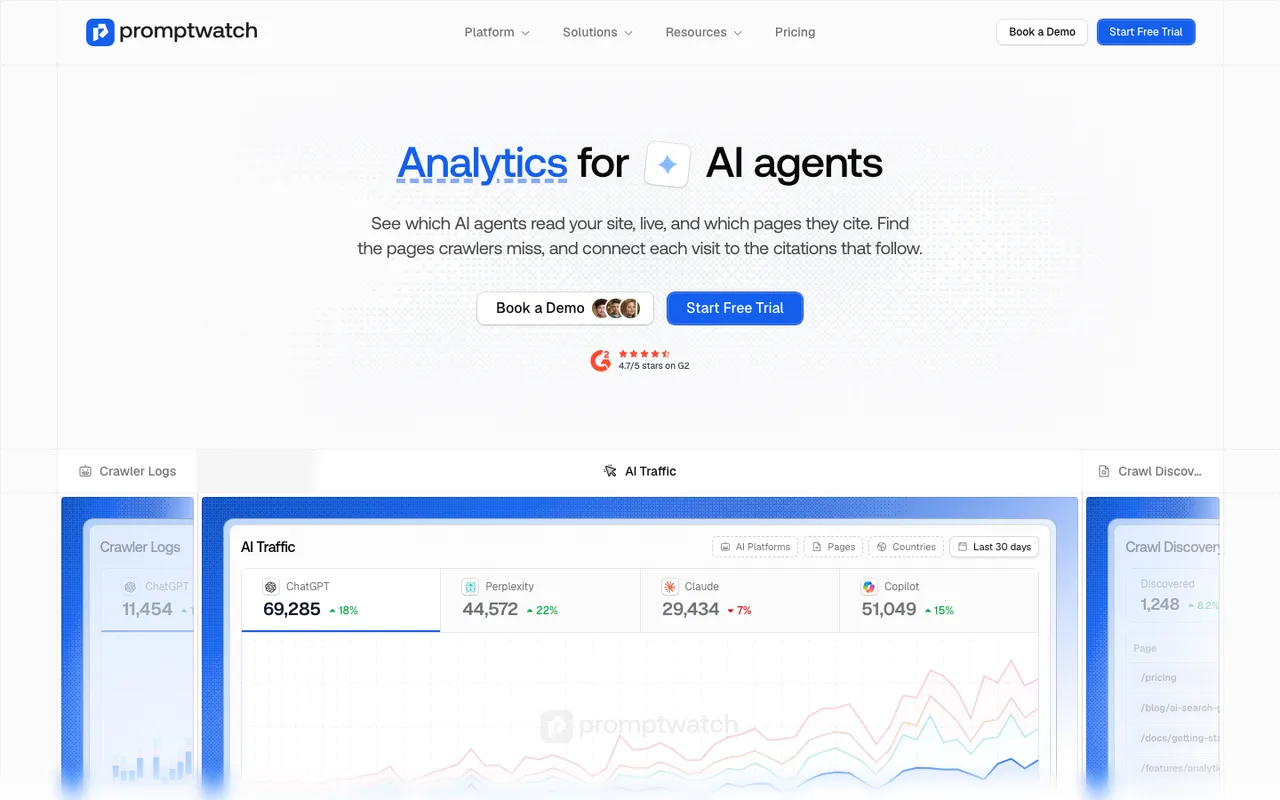 Promptwatch's Agent Analytics page, captured November 8, 2026. The product image is Promptwatch's own illustration.
Promptwatch's Agent Analytics (Professional and every agency plan) checks each bot hit against the operator's published IP ranges, so a scraper faking GPTBot's user agent doesn't count. It gives every page a citation rate and explains failed crawls. Visitor Analytics, on every plan including Essential, records AI-referred visits and conversions, and Search Insights puts Google Search Console and Bing Webmaster clicks next to the AI data on every brand plan.
Content and publishing (6/10)
Core includes "Basic" content generation, one page optimization a month, five site audits a month on a 25-page site map, and the Site Optimization action plan. Enterprise moves content to "Advanced" and adds AXP. No CMS publishing is described; llms.txt news titles mention shipping inside SitecoreAI and Zapier workflows, but that's not the same as a connector that puts a page live.
Promptwatch writes 5 AEO articles a month on Professional and 10 on Business, publishes to WordPress, Webflow or Framer, and suggests diff-style Content Refresh edits for existing pages. Business adds the automated Content Agent with a publishing calendar and a review inbox.
Reporting, integrations and admin
Both Scrunch plans include a reporting dashboard and Explorer, a composable BI layer. Exec and board reporting, MCP, both APIs and Looker Studio are Enterprise only, and PDF or scheduled reports aren't listed. Promptwatch exports any dashboard to PDF, schedules 10 PDF reports on every brand plan, and puts the MCP server (110+ tools) and REST API on every paid plan, at 500 requests an hour on Essential and 2,000 on Professional.
Where it falls short
The engines your buyers may use first need a contract
A retailer whose shoppers search in Google's AI Mode can't measure those answers on Core, and no add-on is listed to fix it. The same contract wall stands in front of MCP, the API and Looker Studio. Promptwatch lets every paid plan track any of the supported engines and query the data through MCP or the API, Essential at $95 included.
5,000 responses is a budget, not a prompt list
The 125-prompt figure invites teams to load everything, and then the response meter cuts daily coverage to about 41 prompts on four engines. A team that loads 100 prompts gets about 12 full runs a month, one every two or three days. Promptwatch Professional's 18,000 responses cover 150 prompts on four engines daily, for $5 less than Core.
Bot counts with no verdict per page
A report showing that ClaudeBot keeps fetching your pricing page doesn't tell you whether those fetches ever turned into citations. Without a crawl-to-citation link, a team can't tell an access problem (bots never fetch the page) from a content problem (bots read it and cite a competitor), and those two need opposite fixes. Promptwatch's per-page citation rate in Agent Analytics separates them.
No line from citation to revenue
AI-referred conversions aren't described, and Search Console data isn't listed. So a Scrunch report can show your answer share went up but not what it earned. Promptwatch's Visitor Analytics covers this on every plan. Since ChatGPT stopped sending a referrer on October 8, 2026, its "Include ChatGPT UTM referrers" toggle counts utm_source=chatgpt.com visits as ChatGPT again.
One market, one persona, and no claim checks
Core can't compare how ChatGPT answers in Germany and in the UK, or how it answers a CFO and an engineer. Claim-level narrative and fact checking aren't listed. Promptwatch's Brand Narrative (every plan) groups the claims AI makes about you by theme, and Fact Check (Business, Agency Scale, Enterprise) tests each one against your site and the 50 most-cited offsite pages for it.
What users say
Scrunch AI averages 4.6 out of 5 from 74 reviews on G2 (checked November 15, 2026). Its Capterra listing had no reviews when we looked.
The praise centers on bot data. A senior website marketing manager at a mid-market company (G2, review updated April 2026) wrote: "I've been really enjoying Scrunch's Agent Traffic monitoring tool as well as Site Maps. This really gives me insights into which pages are crawled by bots the most and for what reason (retrieval, indexing, training)." A senior vice president of growth marketing (G2, April 2026) was blunter: "We tested pretty much every AI Visibility measurement tool on the market and concluded that Scrunch has both the best price and presents the data in the most intuitive and actionable way"
The same mid-market reviewer had a complaint about the analytics link: "There has been some bugginess with the GA4 integration where I can't easily switch between our two properties."
The sharpest review, rated 3.5 out of 5 and titled "Strong Product and Analytics, but a Frustrating Sales and Contract Process" (G2, April 2026, reviewer role not shown), said "pricing confirmed in writing got retracted, and the contract didn't match verbal commitments on several points." It added: "Also, certain models are locked behind higher tiers, which wasn't made clear upfront." That reviewer also called the product solid, and the engine complaint matches what the pricing page shows.
Two worked team scenarios
Example: a six-person growth team at a fintech scale-up
Illustrative example. Assumptions: one country (the UK), 60 prompts, daily runs on ChatGPT, Perplexity, Google AI Overviews and Gemini. A docs migration is coming, so the team wants crawler data, and the analytics lead wants Claude to build the weekly report through an MCP server. Six people need logins.
On Scrunch, three of those needs (Gemini, MCP access, a sixth seat) point to an Enterprise quote. If the team settles for Core and swaps Gemini for Copilot, 60 prompts x 4 engines x 30 days is 7,200 responses against a cap of 5,000, so the list gets about 20 full runs a month instead of 30. Bot traffic is covered; the MCP report isn't.
On Promptwatch, 60 prompts is past Essential's 50, so the team lands on Professional at $245. The 7,200 responses use well under half of its 18,000, crawler logs are included (25M events), the MCP server and API allow 2,000 requests an hour, and all six people get seats. What Professional leaves out: the automated Content Agent, Fact Check and city tracking, which all start on Business.
Example: a three-person skincare brand that sells through AI shopping answers
Illustrative example. Assumptions: one country (the US), 40 prompts, daily runs on ChatGPT, Perplexity, Google AI Overviews and Copilot. The team wants articles written from the gaps, and it wants to know whether its products appear when ChatGPT recommends moisturizers.
On Scrunch, 40 x 4 x 30 is 4,800 responses, which fits under Core's 5,000 with 200 to spare. Basic content generation is included at $250. Product-level tracking (Product Observability) is Enterprise only, so the shopping question needs a quote.
On Promptwatch, the list fits Essential at $95, but Essential writes no articles, so the like-for-like plan is Professional at $245 with 5 AEO articles a month. If the shopping question can wait, the two cost about the same, and the difference is "Basic" generation against five articles. If it can't, ChatGPT Shopping (which also covers Amazon Alexa product results) is on Business at $579, with 10 AEO articles a month and the Content Agent. That's more than double Core, but it's a published price; Scrunch's equivalent is a quote.
Promptwatch vs Scrunch AI
| Row | Promptwatch | Scrunch AI |
|---|---|---|
| Entry price | Essential $95; Professional $245 | Core $250; Enterprise custom |
| Entry allowance | 50 prompts, 6,000 responses | 125 prompts, 5,000 responses |
| Engines | Any supported engine on every paid plan | 4 on Core; Claude, Gemini, Meta AI, AI Mode, Grok Enterprise only |
| Fastest tracking | Every hour on Business, Agency Scale, Enterprise | Not listed |
| Location | Country every plan; city and coordinates from Business | 1 country on Core; state, city, coordinates not listed |
| Prompt research | Volume, difficulty, citation rate | Partial: approximate volumes, 3 topics on Core |
| Social citation reports | Reddit, YouTube, LinkedIn, Instagram | Partial: one "Social" segment |
| Track a competitor's URL | Page Tracker | Partial: own pages; competitor URLs not stated |
| AI crawler logs | Professional and up, IP-verified, citation rate per page | Yes on Core; IP checks and crawl-to-citation not listed |
| AI visits and conversions | Every plan | Not listed |
| Claim-level narrative and fact check | Brand Narrative every plan; Fact Check from Business | Sentiment only; both not listed |
| Articles and CMS publishing | AEO articles from Professional; Content Agent on Business | Basic generation on Core; publishing not listed |
| Product tracking | ChatGPT Shopping and Alexa on Business | Enterprise only |
| MCP, API, Looker Studio | MCP and API every paid plan; Looker from Professional | Enterprise only |
| Serving AI-optimized pages | Not in Promptwatch's sources | AXP, Enterprise only |
| Seats and trial | Unlimited; 7 days | 5 on Core; 7 days |
Sources: Scrunch's pricing page and homepage captured November 6, 2026, its monitoring page, agent traffic page and llms.txt read November 8, 2026; Promptwatch's pricing page, llms.txt and changelog read in November 2026. "Not listed" means not on Scrunch's pricing or product pages as of November 2026, not a confirmed absence.
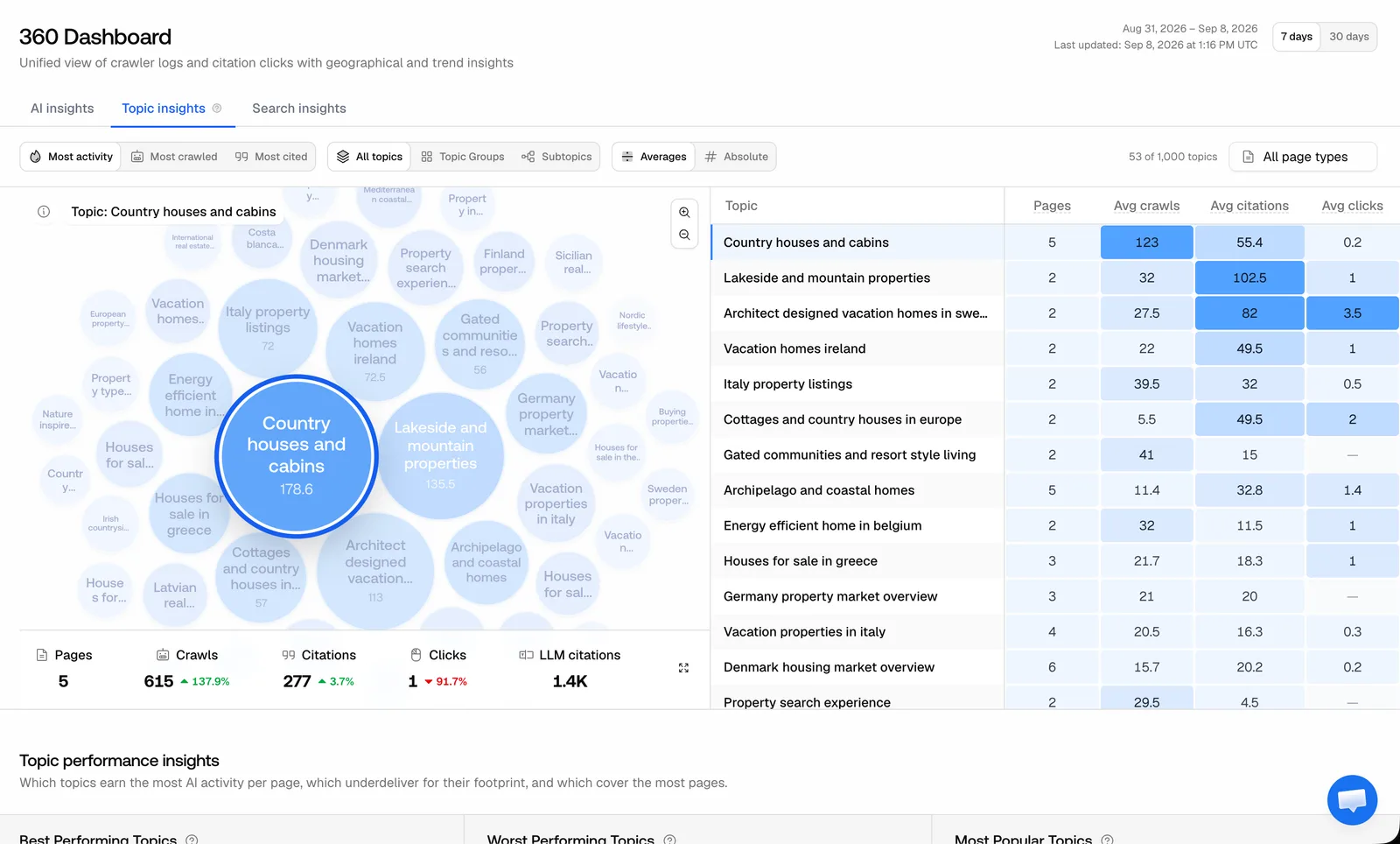 Promptwatch 360 Dashboard Topic insights, from the Promptwatch changelog. Example project data.
Anyone selling into Google's AI surfaces should read the engines row and stop. Teams reporting to a revenue owner should read the conversions row, which is empty for Scrunch, and data teams the MCP row. Promptwatch has its own soft spots. Essential has no crawler logs or AEO articles, ChatGPT Shopping and Ads Radar start on Business, agency plans don't include the Content Agent, and nothing in Promptwatch's sources serves alternate pages to AI agents the way AXP does.
Who should stay, who should switch
- Stay on Scrunch AI if ChatGPT, Perplexity, AI Overviews and Copilot cover your buyers, about 40 prompts in one market is enough, five people need access, and you value bot-purpose data on the entry plan.
- Go to Scrunch Enterprise if AXP is the reason you're shopping and you'd rather negotiate engines, SAML sign-on and the API in one contract.
- Switch to Promptwatch Professional if you need Gemini or AI Mode at a listed price, crawler logs tied to citations, AI-referred conversions, or MCP and API access.
- Switch to Promptwatch Business if you need product tracking, city or coordinate monitors, hourly runs, Fact Check, or the Content Agent publishing on a schedule.
Our verdict and next step
Scrunch AI has the most original idea in this category and a sensible entry plan. The trouble is what that plan leaves out: if your buyers use Gemini or AI Mode, or you need to know which pages AI crawlers read before they cite you, Core can't answer. Promptwatch Professional, at $5 less than Core, tracks any supported engine and adds IP-verified crawler logs with a citation rate on every page. Start the 7-day free trial on Professional, load the prompts you run in Scrunch plus Gemini and AI Mode, connect crawler logs on day one, and compare the two after a week on the same URLs. For other options, see our Scrunch AI alternatives scored feature by feature.
FAQ
How many prompts can Scrunch Core track every day?
About 41 on all four engines. Core allows 125 unique prompts but 5,000 responses a month, and a daily run of one prompt on four engines uses 120 responses over 30 days.
Which engines need Scrunch Enterprise?
Claude, Gemini, Meta AI, Google AI Mode and Grok. Core covers ChatGPT, Perplexity, Google AI Overviews and Copilot, according to the pricing page captured November 6, 2026.
Does Scrunch AI show AI crawler visits?
Yes. Core includes AI agent and bot traffic by model, bot type and page, split into training, indexing and retrieval. IP verification, crawl error tracking and a link from crawl to citation aren't listed on its pages.