How do I get my online store ready for AI shopping agents? Seven checks, ranked by impact
Getting an online store ready for AI shopping agents like ChatGPT and Google AI Mode: seven checks ranked by impact, from crawler access to feeds, plus the tools to use.
Getting a store ready for AI shopping agents comes down to three jobs. Let the agents reach your pages. Hand them product data in the formats ChatGPT and Google actually ask for. Then measure whether your products show up when shoppers ask. The seven checks below are ranked by how much a store loses if it skips them, based on what OpenAI and Google document as of November 21, 2026.
One framing note first. "AI shopping agent" covers two different things today. Some agents recommend products and send the shopper to your site, which is how shopping in ChatGPT works now. Others complete actions for the buyer, which is what Google's Universal Commerce Protocol (UCP) enables in AI Mode and Gemini. Most of the work below serves both.
1. Make sure the agents can get in
If a crawler or agent browser is blocked, nothing else on this list matters. OpenAI's Help Center says that to be eligible for ChatGPT search results you should allow OAI-SearchBot in robots.txt and confirm your host or CDN accepts traffic from OpenAI's published search bot IP addresses. For tasks where ChatGPT uses a cloud browser, OpenAI signs the requests with Web Bot Auth (HTTP Message Signatures), and it says Akamai, Cloudflare, HUMAN and Vercel verify those signatures automatically. If your bot protection comes from somewhere else, check how it treats that signed traffic.
Google lists Storebot-Google for Shopping surfaces and Google-Agent for agents acting on a user's request; user-triggered fetchers like Google-Agent generally ignore robots.txt, so your firewall settings decide whether it gets through. To see what really happens, Promptwatch Agent Analytics logs IP-verified visits from OAI-SearchBot, ChatGPT-User, Google-Agent, PerplexityBot and the rest, page by page, with failure explanations. Crawler logs start on the Professional plan ($245/mo).
2. Get your catalog into ChatGPT
OpenAI's merchants page says shopping in ChatGPT is live for U.S. users, and that Shopify and Etsy catalogs are already integrated with no application needed. Everyone else applies to share a product feed and joins a waitlist. OpenAI also says a feed isn't required if ChatGPT already crawls your site, but that feeds give you more control over how products appear.
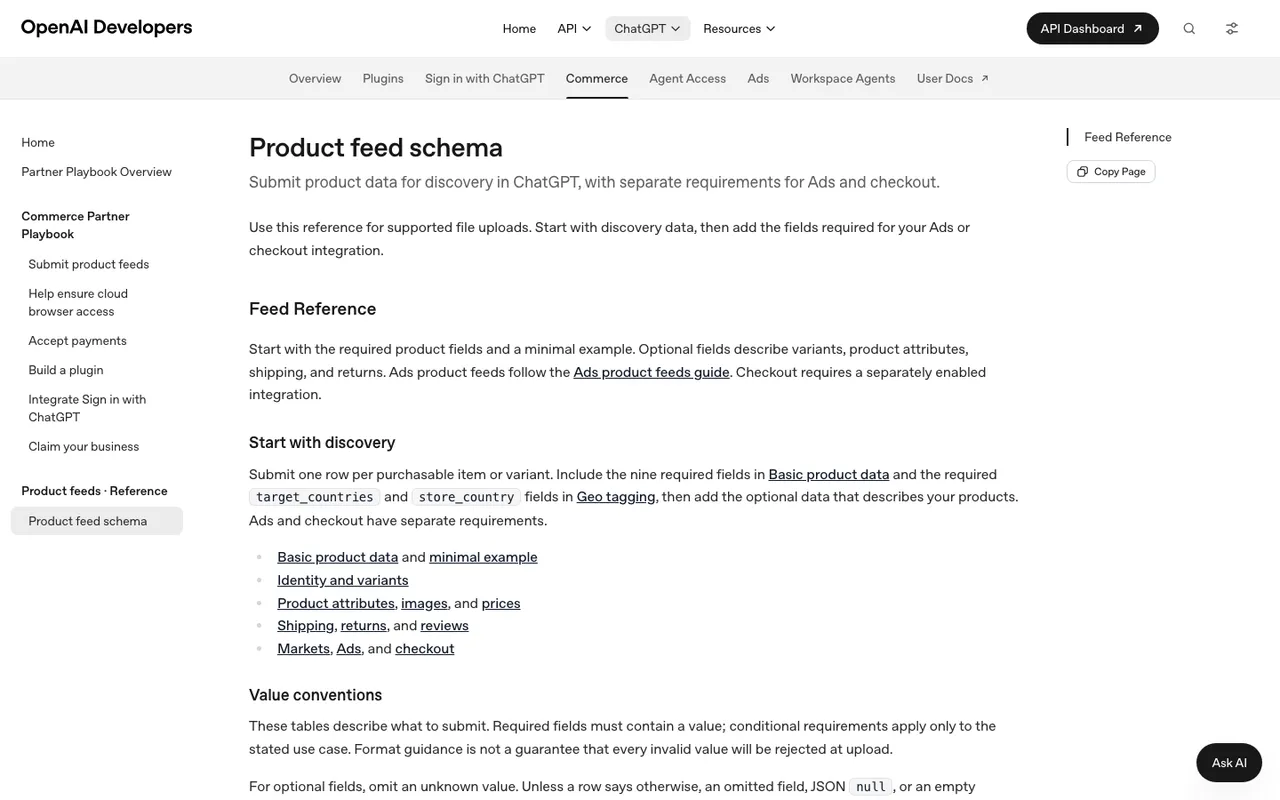
OpenAI developer docs, "Product feed schema", captured November 21, 2026.
The feed schema has nine required fields: item_id, title, description, url, brand, seller_name, image_url, availability and price (written like 79.99 USD), plus target_countries and store_country. OpenAI suggests titles up to 150 characters and descriptions up to 5,000. Optional fields worth filling include gtin, mpn, variant grouping, review_count and star_rating.
3. Fix Merchant Center and your product markup
Google's AI features guidance says there are no special requirements for AI Overviews or AI Mode beyond normal SEO, but it does list keeping Merchant Center information up to date. Its merchant listing documentation requires name, image and an Offer with a price above zero and a priceCurrency. Google also says that supplying both page markup and a Merchant Center feed maximizes eligibility and helps it verify your data. Keep the markup matching the visible page.
4. Publish return and support policies properly
Google's UCP setup guide won't let you build until return policies (cost, window, link to the full policy) and customer support details are configured in Merchant Center. Google also recommends return policy markup nested under Organization. These are cheap to fix and block the more advanced step below.
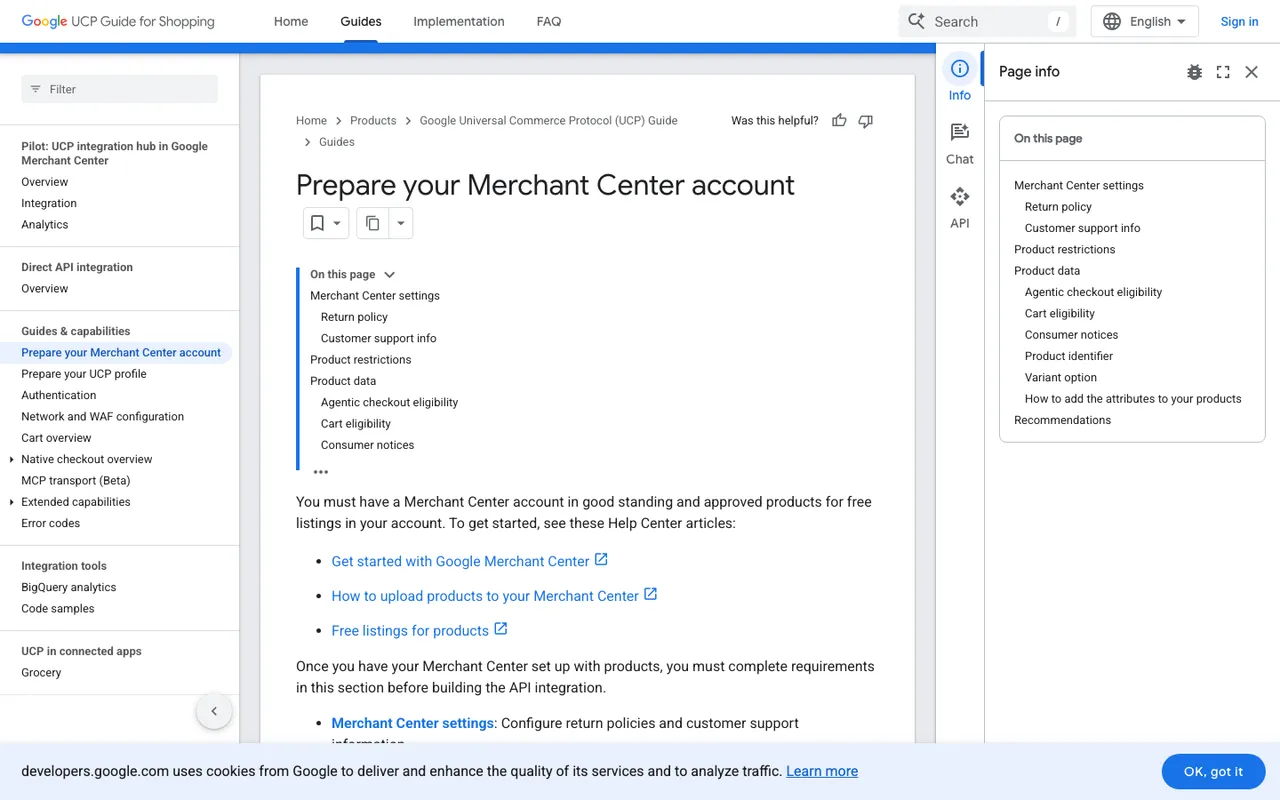
Google UCP Guide for Shopping, "Prepare your Merchant Center account", captured November 21, 2026.
5. Decide whether you want agentic checkout on Google
Google's Universal Cart launched in the U.S. on October 15, 2026, and its checkout runs on UCP. With native checkout, a shopper pays with Google Pay inside the cart while you stay the merchant of record. To get there you set native_commerce(checkout_eligibility) to TRUE (it defaults to FALSE), join the waitlist, implement the checkout session endpoints and order webhooks, sign the UCP Program Addendum, and pass Google's review. Cart transfer to your own checkout is opt-out once you declare the cart capability. Subscriptions, pre-orders, used items, personalized goods and age-restricted products are among the ineligible categories.
On ChatGPT the direction runs the other way: OpenAI says it is moving away from standalone Instant Checkout, and purchases complete on the merchant's own site or app.
6. Keep price and stock fresh
OpenAI's merchants page pitches feeds partly on this: sync pricing and availability so shoppers see the latest details. OpenAI takes full feed snapshots by upload, hosted HTTPS URL or SFTP. Google recommends a supplemental feed and the Merchant API for real-time price and inventory. Use OpenAI's availability values exactly (in_stock, out_of_stock, pre_order, backorder, unknown).
7. Measure what the agents recommend
Without measurement you can't tell which of the six checks above paid off. Promptwatch's ChatGPT Shopping tracking (Business, $579/mo) shows which products ChatGPT recommends in shopping carousels and Amazon Alexa product results, against your own uploaded catalog. Visitor analytics on every plan counts AI-referred visits and conversions. Promptwatch's ChatGPT Shopping usage report describes shopping features attaching to only a low single-digit share of web-search responses, moving in steps, so check over weeks rather than days.
Tools for the job, ranked
- Promptwatch: crawler logs, citations, ChatGPT Shopping tracking, visitor conversions and content in one platform. From $95/mo; Shopping on Business.
- AthenaHQ: GEO platform with Shopify integration and GA4, Shopify and Webflow revenue attribution; acquired by Bloomreach on November 16, 2026. Starter $295/mo.
- Scrunch AI: its Agent Experience Platform serves AI-optimized pages to crawlers on Enterprise. Core $250/mo.
- Azoma: SKU-level tracking across ChatGPT Shopping and retailer agents such as Alexa for Shopping and Walmart Sparky, with ACP and UCP support. Custom pricing.
- Wildcard: Shopify catalog sync and SKU-level prompt tracking. From $99/mo.
- Goodie AI: SKU-level commerce visibility on Pro at $999/mo.
- Ranketta: SKU tracker with catalog enrichment. From €29/mo.
- Surfient: Shopify app that writes schema and an NDJSON product feed. Premium $39/mo.
Where to start
Run Promptwatch's free AI Visibility Report on your store for a first read, then take the 7-day free trial on Business if you want the ChatGPT Shopping view on your own catalog.