How do ChatGPT and other AI assistants use App Store listings when recommending apps? Seven checks, ranked
No assistant vendor documents how it reads App Store listings. Seven checks, ranked by impact, for getting your app named by ChatGPT and other AI assistants.
Short version: none of the companies behind ChatGPT, Gemini, Claude, Perplexity or Siri publishes anything that explains how their assistant reads an App Store listing before it recommends an app. We looked. What they do publish is narrower and more useful than it sounds, and it lets you rank the work by how directly each step touches the answer.
Below is that ranking. Each check is scored on one question: if you skip it, how likely is it that an assistant names a competitor instead of you?
What the vendors actually say
OpenAI's help article "Searching the web with ChatGPT" says ChatGPT rewrites a question into one or more targeted queries, sends them to partner search providers, and may send follow-up queries after it reads the first results. It ranks results "using multiple factors" and says placement is not guaranteed. OpenAI's publisher FAQ (archived October 4, 2026) adds that any public website can appear in ChatGPT search. Nothing on those pages singles out App Store pages.
Google's Search Central page "AI features and your website" says AI Overviews and AI Mode need no special optimization beyond normal SEO, and that both may use a query fan-out across subtopics. Apple's developer pages say one thing about language models and listings: App Store search can show app tags "generated using large language models" from the metadata you enter in App Store Connect. That is App Store search, not an assistant.
So the honest answer to the headline is that assistants with web search treat a listing as one more page they might find and cite. Promptwatch's own data says they do cite app stores, just rarely.
The seven checks, ranked
1. Track the exact prompts people use to ask for an app
Everything else depends on knowing whether you are named at all. People ask things like "best offline hiking map for iPhone" or "a budgeting app that splits bills with roommates". Put 30 to 50 of those into Promptwatch and run them daily on the engines your users actually ask. Every paid plan can track any of the supported engines, ChatGPT, Gemini, Perplexity and Google's two AI surfaces among them. The Visibility Score scores each answer for placement, share of attention and depth, and answers that leave you out count as zero. Position tells you whether you are first in the list or fifth.
2. Find out which pages those answers cite
An assistant that names a rival is usually leaning on a page that names the rival. Promptwatch's citation analytics lists every cited URL with competitor domains highlighted, so you can see whether ChatGPT went to apps.apple.com, a review roundup, or the competitor's own help center.
In Promptwatch's report "Most Cited Sites in ChatGPT for Software-Related Prompts" (organic prompts, Sep 28 to Oct 4, 2026), app stores took 0.47% of all software citations. Documentation and help centers took 2.64%, vendor sites 2.01%, and review sites and analysts 1.57%.
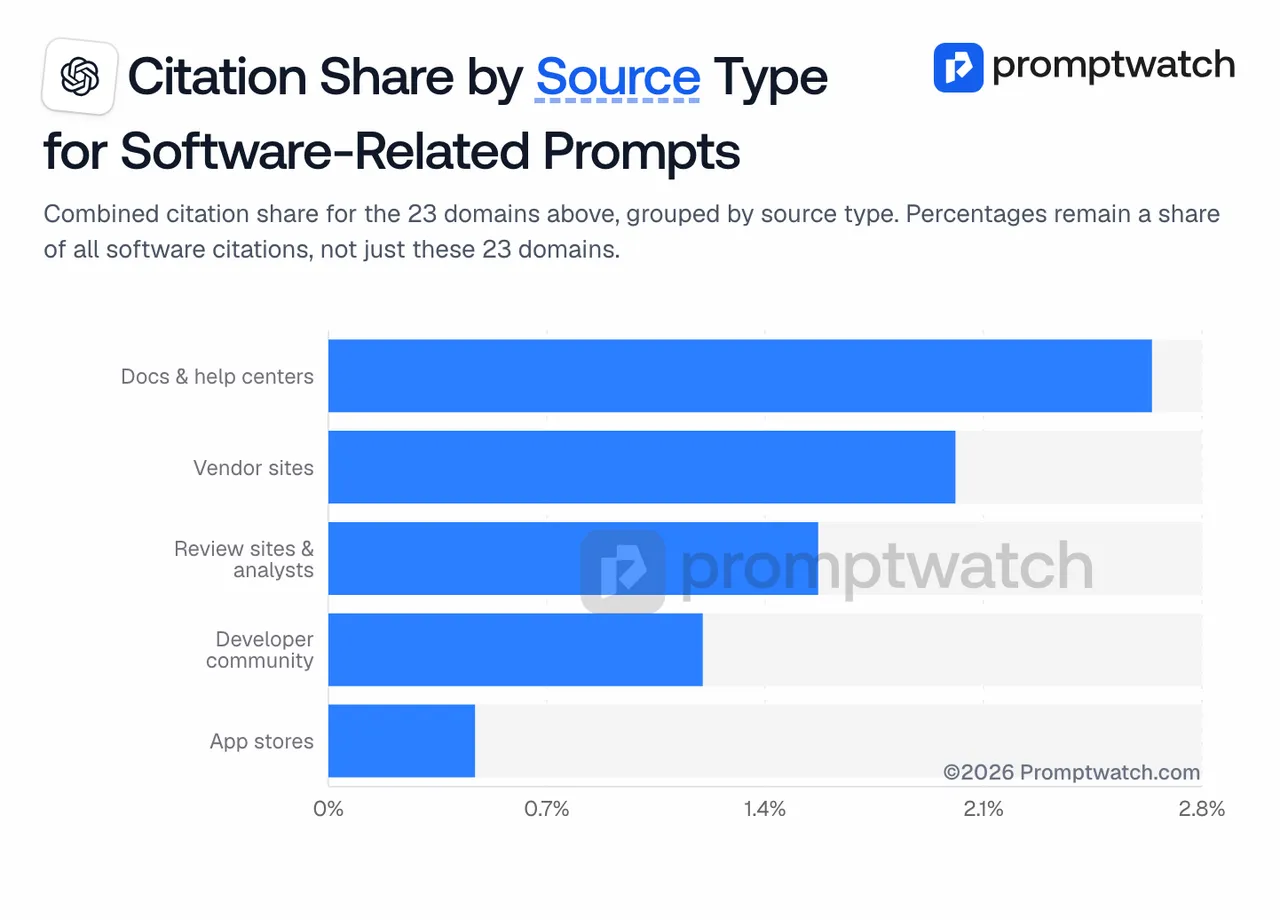
Promptwatch's "Citation Share by Source Type for Software-Related Prompts" chart, captured November 14, 2026.
Read that as a priority order. Your listing matters less to ChatGPT than your docs do.
3. Follow your App Store URL with Page Tracker
Page Tracker in Promptwatch accepts any URL, including third-party pages. Add your product page and you see how many responses cite it and from which prompts. Crawler visits and click-throughs only fill in for pages on your own website, so for the listing you get the citation side only. That still answers whether the listing is doing any work in AI answers.
4. Read the query fan-outs behind each answer
Fan-outs are the searches a model actually ran. Promptwatch extracts them from tracked responses rather than guessing. If ChatGPT searched "best budgeting apps reviews 2026" and your brand shows up in none of the top results for that query, you know which page to fix, and it probably is not the listing.
5. Keep your own site open to the crawlers that feed answers
OpenAI says sites opted out of OAI-SearchBot will not be shown in ChatGPT search answers. GPTBot is the training crawler and can be blocked separately. Promptwatch's Agent Analytics logs OAI-SearchBot, ChatGPT-User, Claude-SearchBot, PerplexityBot and the rest, verified against each operator's IP ranges, from the Professional plan ($245/mo). The App Store is Apple's domain, so this check covers your marketing site, docs and help pages.
6. Write the listing for App Store search first
Apple ranks App Store search on text relevance (title, subtitle, keywords, primary category) and on user behavior such as downloads, ratings and reviews. The rules are tight: 30 characters for the name, 30 for the subtitle, 100 for keywords, and promotional text up to 170 characters that does not affect search ranking. Apple calls the first sentence of the description "the most important".
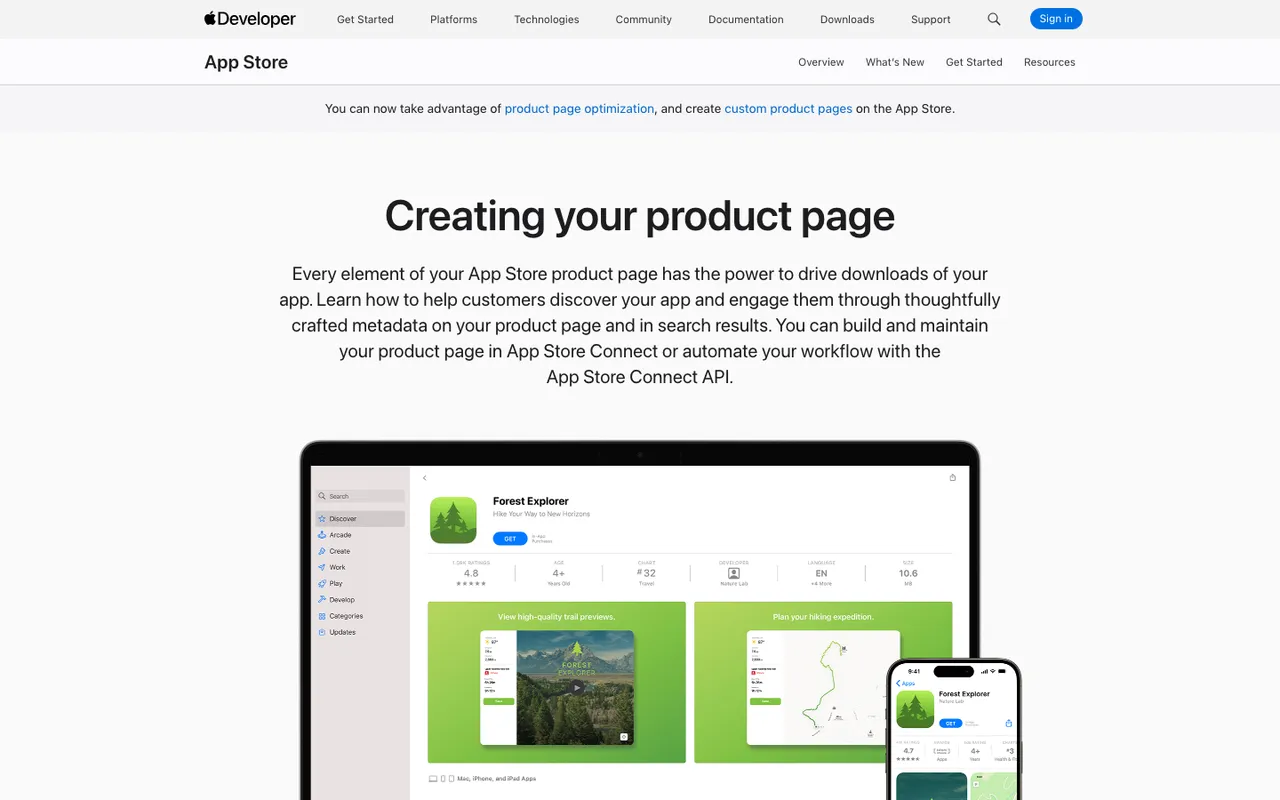
Apple's "Creating your product page" developer guide, captured November 21, 2026.
This ranks sixth only because it serves App Store search directly and assistants indirectly. A clear first sentence is also what an assistant would quote if it did cite the page.
7. Prepare for Siri AI through App Intents
Apple opened Siri AI to all developers as a developer preview on November 3, 2026, in the iOS 27.3 betas. The route in is App Intents, plus entities surfaced from the Spotlight semantic index, not listing copy. Apple says first customer shipping is "in a few months" and App Store submission opens in the spring. Siri is not one of the engines Promptwatch tracks, so this is a build task rather than a measurement one for now.
Which tool covers these checks
- Promptwatch covers checks 1 to 5 in one workspace: prompt tracking, citation analytics, Page Tracker on third-party URLs, fan-outs, and IP-verified crawler logs, with visitor analytics to see what AI-referred visitors do on your site.
- AthenaHQ tracks 11 models on its $295/mo Starter plan and has an Action Center for fixes. Starter is country-level, and our listing has no published crawler-log product for it.
- Scrunch AI Core costs $250/mo for 125 prompts on four LLMs and includes AI agent and bot traffic reporting. More engines sit on Enterprise.
If you only do one thing this week, do check 1. Start the 7-day free trial on any monthly Promptwatch plan and load your app prompts before you touch the listing.