AEO software buyer's checklist (2026): 15 questions to ask before you sign
Fifteen questions to put to any AEO software vendor before signing, from real-interface tracking and response counts to crawler logs, attribution, seats and security.
AEO demos look alike. There's a visibility chart going up, a competitor table, and a list of prompts with green and red dots. The differences that decide whether the tool is useful sit underneath: how the answers are collected, what a "response" means, whether the tool can explain a miss, and what the contract actually allows.
These 15 questions are the ones we'd ask any AEO vendor before signing. For each, we explain why it matters and show how Promptwatch answers it, using its published plan matrix and documentation. Asking the same questions of every vendor on your shortlist turns a pile of demos into a comparison.
Data collection
1. Which engines do you read from the real interface, and which through an API?
A live-search engine like ChatGPT Search answers from a fresh web search. Calling a model's API returns what the model knows from training. Both are useful, and they measure different things. A vendor that blurs them is giving you a number you can't interpret.
Promptwatch: ChatGPT, Google AI Overviews, Google AI Mode, Gemini, Perplexity, Copilot, Amazon Alexa and Meta AI are collected from the real interfaces. Claude, DeepSeek, Mistral, Grok and several other models are tracked through their APIs. Coding agents (Codex, Claude Code, OpenCode) are a separate group.
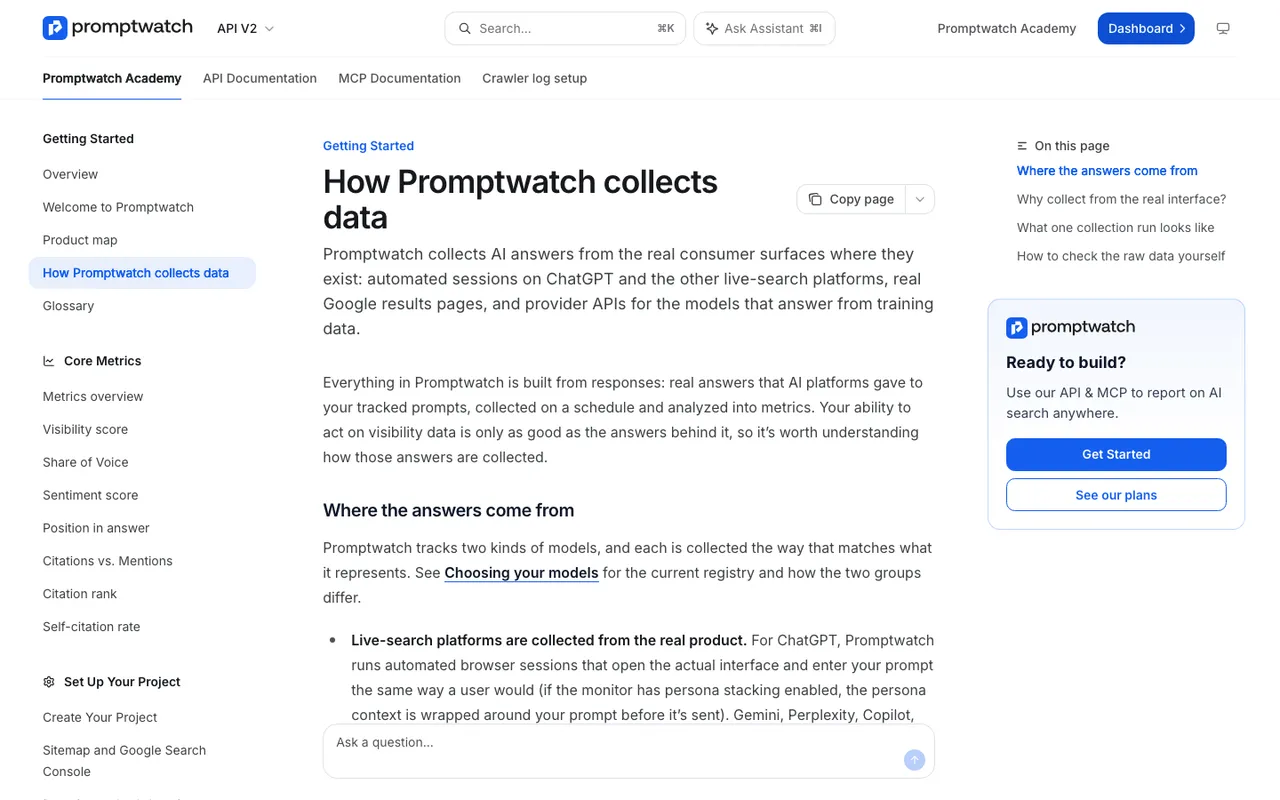 Promptwatch Academy's How Promptwatch collects data page, captured November 14, 2026.
2. What counts as a response, and how many does my plan include?
Prompts are a misleading unit. Fifty prompts on five engines, run daily, is 7,500 responses a month. Ask for the response or credit allowance and how it's consumed.
Promptwatch: a response is one prompt answered by one model. Essential includes 6,000 a month, Professional 18,000, Business 42,000. Agency plans run from 10,000 (Kick-off) to 65,000 (Scale). Usage alerts fire at 85% of a quota.
3. How often do prompts run, and what happens if I run out?
Weekly data can be a week stale when you see it. Some credit-based tools stop collecting when the balance hits zero.
Promptwatch: monitors run daily by default. Business, Agency Scale and Enterprise can run every 12, 6 or 1 hours. You can't choose a frequency your remaining quota can't cover, and lowering a frequency always works.
4. Can I target below country level?
Local and multi-market businesses get different answers by place.
Promptwatch: country on every paid plan. State and city on Business, every agency plan and Enterprise. Coordinate targeting (a pin with a 20 m to 5 km radius) on Business, Agency Scale and Enterprise. ChatGPT uses the exact point. Google AI Overviews and AI Mode use the nearest named area.
5. Can I see the searches behind each answer?
Fan-out queries are the sub-searches an engine runs to build an answer. They tell you what to write.
Promptwatch: query fan-outs per model, with the exact sub-queries behind each response. Prompt Volumes adds monthly volume and a difficulty score per prompt.
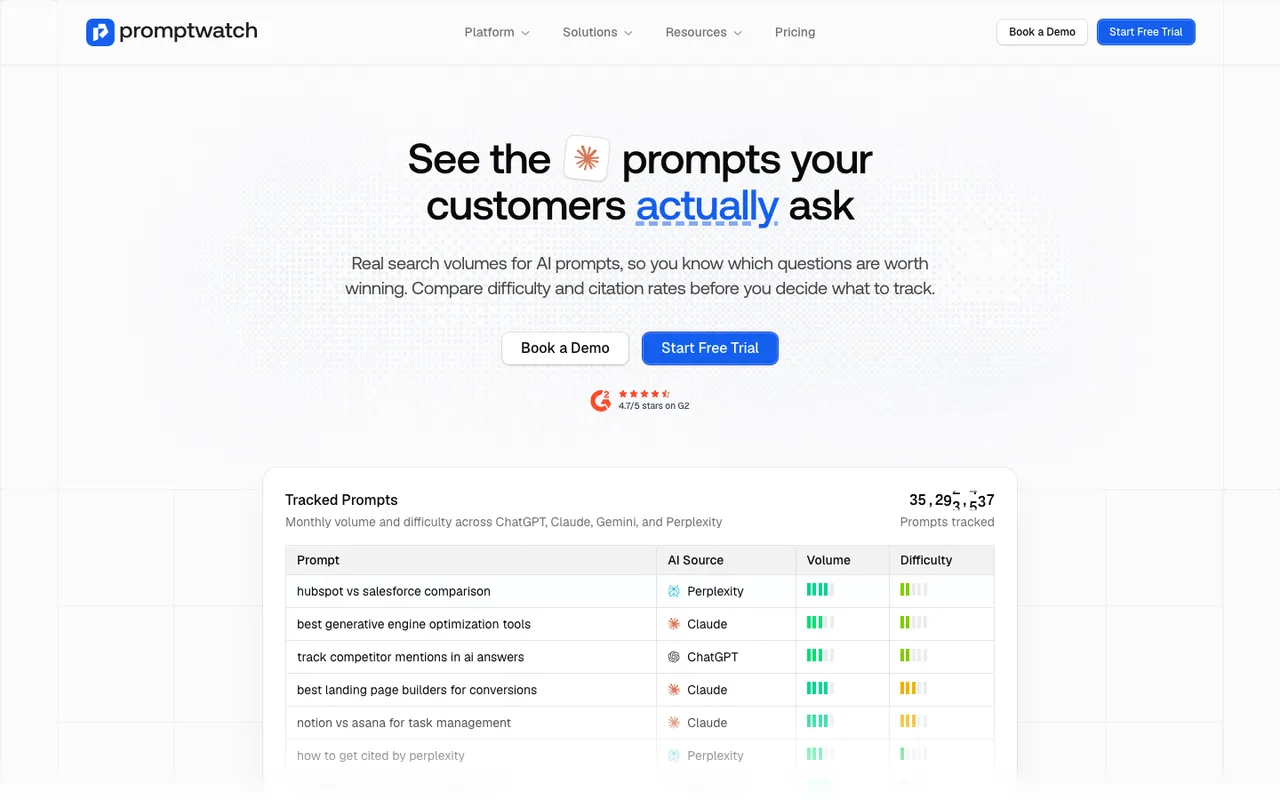 Promptwatch's Prompt Volumes page, captured November 8, 2026. The product image is Promptwatch's own illustration.
Diagnosis
6. Do you have AI crawler logs, and are they IP-verified?
Logs tell you whether AI bots fetched the page that should have been cited. Without IP verification, spoofed bots inflate the numbers.
Promptwatch: Agent Analytics, from Professional on brand plans and on every agency plan, with requests checked against operators' published IP ranges. Bots are named individually (GPTBot, OAI-SearchBot, ChatGPT-User, ClaudeBot, PerplexityBot and others). Exa's crawlers are logged but marked unverified, because Exa publishes no IP ranges.
7. Can you connect a crawl to a citation?
A crawl count alone doesn't say whether the crawl paid off.
Promptwatch: a citation rate per page on the crawl-to-citation path, so a page crawled often and rarely cited stands out from a page that's never crawled.
8. How deep does citation data go?
Domain-level citation counts hide which page earned the citation and what kind of source it was.
Promptwatch: Citation Trends sorts citations into 22 content types and 20 source types, with first-cited date, ramp-up days and decay half-life per page. Separate reports cover Reddit, YouTube, LinkedIn and Instagram citations, plus offsite mentions without a link.
9. Can you check whether what AI says about us is true?
Wrong claims about pricing or features cost deals, and they don't show up in a visibility score.
Promptwatch: Brand Narrative (every plan) extracts the claims AI makes and scores them by theme. Fact Check (Business, Agency Scale, Enterprise) checks each claim against your site and the 50 most-cited offsite pages for it and returns one verdict.
Action and measurement
10. What does the tool do after the dashboard?
Most AEO tools stop at the report. Ask what happens next.
Promptwatch: the Action Board is a prioritized to-do list, and a Discovery agent suggests up to five evidence-backed actions per weekly run. Professional includes 5 AEO articles. The automated Content Agent on Business and Enterprise plans, writes and publishes on a schedule, with a review inbox or fully automated mode.
11. Can it publish to our CMS?
A draft in a separate tool still needs someone to paste it in.
Promptwatch: WordPress (official plugin, live for every organization), Webflow (OAuth, live publishing of one item without a site rebuild) and Framer. Publish status tracking follows each document from draft to live URL, then through crawls, citations and AI traffic.
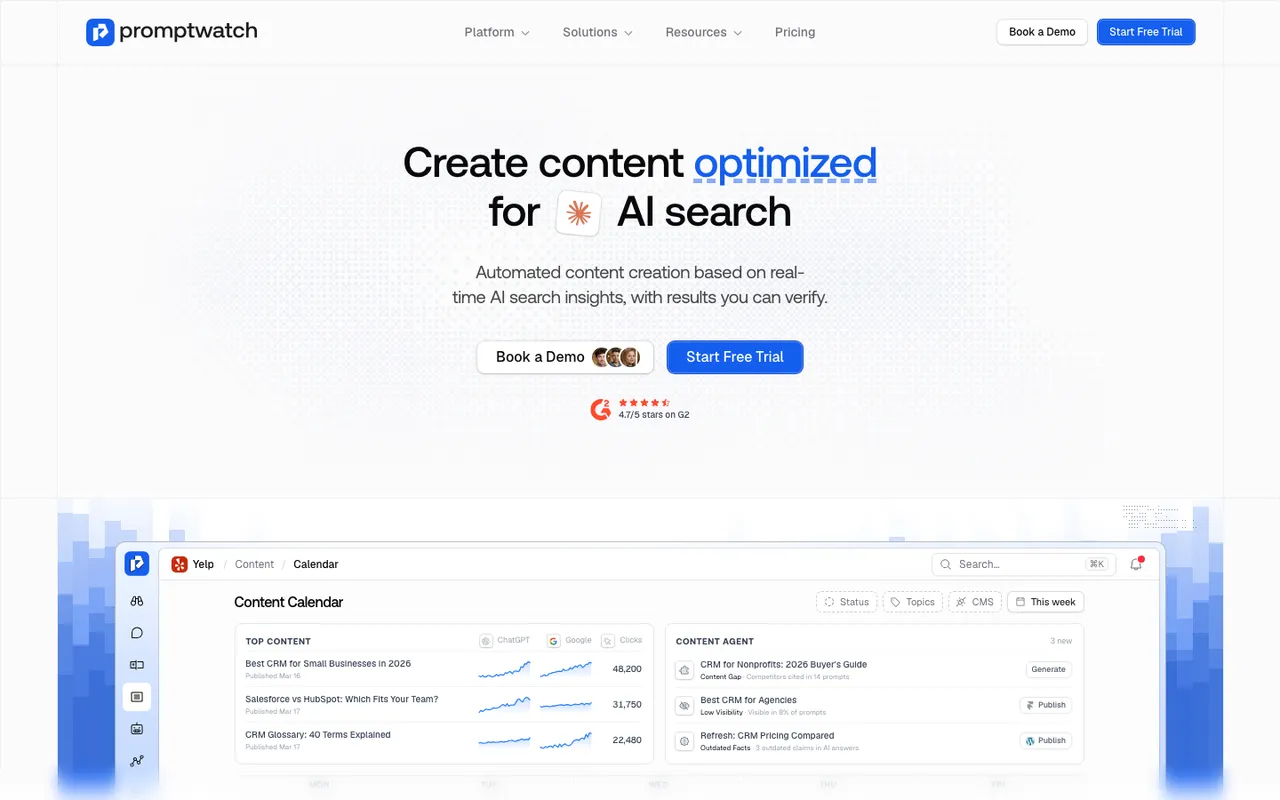 Promptwatch's Content Agents page, captured November 8, 2026. The product view is Promptwatch's own illustration.
12. Can you attribute AI-referred visits and conversions?
Leadership will ask whether AI search sends customers. Since ChatGPT stopped sending referrers on October 8, 2026, the answer depends on how the tool reads UTM parameters.
Promptwatch: visitor analytics on every paid plan, covering ChatGPT, Perplexity, Gemini, Claude, Copilot, DeepSeek, Kimi, Mistral and more, with conversions. An "Include ChatGPT UTM referrers" toggle counts utm_source=chatgpt.com visits as ChatGPT again.
Commercial terms and security
13. How many seats, and is there a trial?
Seat caps turn AEO into one person's tool.
Promptwatch: unlimited team seats on every paid plan. A 7-day free trial on monthly billing for all six self-serve plans (Essential, Professional, Business, Kick-off, Growth, Scale). Enterprise has no self-serve trial, and there is no free plan. Annual billing charges 10 months for 12.
14. Is there an API and an MCP server, and what are the limits?
You'll want the data in your own reports or assistant.
Promptwatch: REST API v2 and a hosted MCP server with more than 110 read and write tools, on every paid plan. Hourly limits are 500 requests (Essential, Kick-off), 2,000 (Professional, Growth), 10,000 (Business, Scale) and 24,000 (Enterprise). Business allows 250 requests a minute and Enterprise 400.
15. What security and compliance do you offer?
Procurement will ask, so ask first.
Promptwatch: ISO/IEC 27001 certified, GDPR compliant, with data handled by an EU-based company. Owner, editor and viewer roles, scoped API keys, an audit log on Business, Agency Scale and Enterprise, and SSO on Enterprise.
Where other vendors' answers differ
Our catalog shows how much these answers vary. AthenaHQ bills one credit per AI response, so question 2 has a clear answer there: Starter's 3,600 credits are 3,600 responses. Scrunch AI's entry lists AI agent and bot traffic reporting but also says no crawler-log product is published, which makes question 6 one to test live. LLM Pulse's entry plans track weekly unless you pay for daily runs, which settles question 3. HubSpot AEO covers three engines, ChatGPT, Perplexity and Gemini, which answers question 1 in a line. Qwairy pauses new analyses when credits run out. And Profound and Brandlight publish no prices, so question 13 can't be answered until you're talking to sales.
None of that makes those tools wrong for every buyer. It does mean the answers are worth writing down side by side before anyone signs.
Using the answers
Score each vendor 0, 1 or 2 per question: 0 for no answer, 1 for "partly" or "on a higher plan", 2 for a clear yes on the plan you'd buy. Weight the questions that match your goal. A content team cares most about questions 10 and 11. A team that has to prove revenue cares about 12. Anyone who can't explain a drop needs 6 and 7.
Then check the answers against the vendor's own pricing page, plan by plan. A feature that exists on Enterprise doesn't help you on Starter.
If you'd like help running this checklist against your own prompts and plan, talk to a Promptwatch expert. To see how the main vendors compare on features, read what are the best AEO tools.